
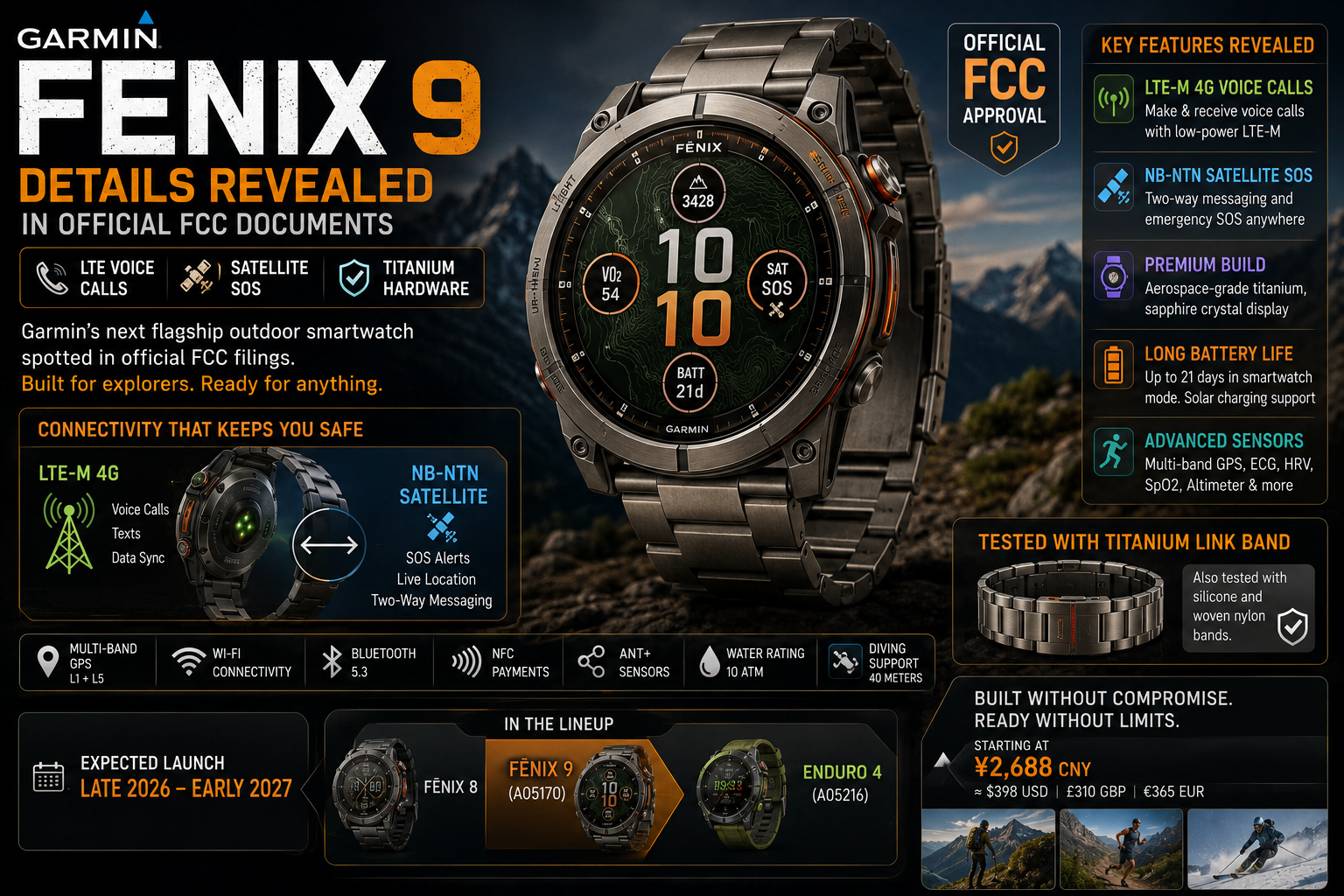
Garmin Fenix 9 Details Revealed in Official FCC Documents: LTE Voice Calls, Satellite SOS, and Titanium Hardware Confirmed
ARTICLE SUMMARY
- The Discovery: Official filings submitted to the Federal Communications Commission (FCC) reveal a new high-end Garmin smartwatch under internal model number A05170.
- Key Connectivity: Features standalone LTE-M 4G mobile connectivity with voice support, direct NB-NTN non-terrestrial satellite communication, Bluetooth, Wi-Fi, NFC, and legacy ANT+ sensor compatibility.
- Premium Materials: Tested for radio compliance using a titanium metal link strap alongside traditional silicone and woven nylon bands.
- Lineup Context: Fills the primary flagship slot following the retirement of the standalone Epix line and sits alongside the upcoming Enduro 4 (Model A05216).
- Expected Launch Window: Late autumn 2026 to early 2027.
Key Takeaways
- Model A05170 Identifies the Garmin Fenix 9: With the Epix line sunsetted and the Enduro 4 separately registered as Model A05216, Model A05170 fits the profile of Garmin’s upcoming flagship outdoor watch.
- Integrated LTE-M 4G Voice Calling: Moving beyond text-only alerts, the FCC documents confirm testing for voice transmission over low-power LTE-M cellular networks.
- Direct Satellite SOS & Messaging: Standardized NB-NTN satellite technology provides two-way emergency communication without needing a separate handheld satellite tracker.
- Tested with Titanium Link Hardware: Official SAR testing explicitly lists a titanium band, confirming top-tier positioning in Garmin’s wearable lineup.
- Full Multi-Protocol Connectivity: Includes Wi-Fi, Bluetooth, NFC for contactless payments, and ANT+ for external heart rate and power sensors.
Table of Contents
- Introduction
- What Happened: The FCC Model A05170 Filing
- Why It Matters: Satellite and Cellular Integration
- Specifications Breakdown
- Features Explained: LTE Voice, Satellite SOS, and Sensors
- Performance Insights: GPS and Network Latency
- Camera and Media Control Features
- Battery Life and Solar Power Management
- Software Features and Ecosystem Integration
- Price and Value Analysis
- Availability and Launch Timeline
- Comparison Table: Fenix 9 vs. Fenix 8 vs. Enduro 4
- Pros and Cons
- Expert Analysis and Market Impact
- Future Industry Expectations
- Final Verdict
- Frequently Asked Questions (FAQ)
- People Also Ask
- Conclusion
Introduction
Garmin’s Fenix lineup has consistently set the standard for high-performance outdoor smartwatches. Known for rugged durability, offline topographic navigation, and multi-week battery life, the series is widely used by trail runners, hikers, and endurance athletes around the world.
Speculation regarding the successor to the Fenix 8 has gained momentum following official regulatory filings submitted to the United States Federal Communications Commission (FCC). An official authorization for a new Garmin smartwatch model—designated internally as A05170—details hardware capabilities that indicate a significant evolution for the Garmin Fenix 9.
First highlighted in reporting by Forbes — Garmin Fenix 9 Details Leak and analyzed by tech outlets including the5krunner — Fenix 9 Satellite Filing Analysis, these regulatory documents outline standalone cellular voice capabilities, direct-to-satellite messaging, and premium titanium build options.
What Happened: The FCC Model A05170 Filing
Before wireless devices can be sold in the United States, manufacturers must submit detailed hardware specifications to the FCC to verify compliance with radio frequency (RF) exposure and transmission limits.
On August 5, 2026, the FCC granted authorization for a wrist-worn Garmin transceiver under model identifier A05170. Although regulatory documents do not state commercial marketing names, product portfolio analysis leaves little doubt regarding its identity:
- Epix Line Consolidation: Garmin simplified its high-end smartwatch portfolio by offering AMOLED and MIP display variants under the Fenix 8 brand, retiring Epix as a separate series.
- Enduro 4 Registered Separately: An earlier FCC listing (Model A05216) corresponds to the upcoming Enduro 4, a watch designed specifically for ultra-endurance racing without cellular or satellite radios.
- Fenix 9 Positioning: Model A05170 features both cellular and satellite transceivers, matching the expected feature set of a new Fenix flagship release.
Why It Matters: Satellite and Cellular Integration
Outdoor enthusiasts often choose between carrying a dedicated satellite communicator, such as a Garmin inReach device, or depending entirely on smartphone coverage. With Model A05170, Garmin appears to be integrating both safety layers directly into the watch casing.
1. Low-Power LTE-M Voice Communication
Unlike earlier LTE smartwatches restricted to text alerts or basic location tracking, the FCC documents cite testing for LTE-M 4G voice transmission. This IoT-optimized cellular standard enables short voice calls and audio messages with significantly lower power draw than traditional LTE networks.
2. NB-NTN Direct-to-Cell Satellite Communication
When beyond the reach of cell towers, the watch connects via Narrowband Non-Terrestrial Networks (NB-NTN). Operating through 3GPP satellite standards, this connection supports two-way emergency SOS alerts, location sharing, and basic text messaging in remote environments worldwide.
Garmin Fenix 9 Safety Mesh:
- Urban & Suburban Coverage: Standard LTE-M 4G for voice calls and fast data sync.
- Backcountry & Wilderness: NB-NTN Satellite for direct emergency SOS and location pings.
- Dense Canopy & Canyons: Multi-Band Multi-GNSS for high-precision GPS positioning.
Specifications Breakdown
While complete commercial specifications remain under official embargo, verified details from the FCC authorization compare directly against existing market flagships:
| Specification / Feature | Garmin Fenix 9 (FCC Model A05170) | Garmin Fenix 8 (Current Gen) | Apple Watch Ultra 2 |
| FCC Identifier | IPH-A05170 | IPH-04500 | BCG-A2986 |
| Cellular Capability | LTE-M 4G (Voice & Data) | Optional LTE (Select Models) | Standard LTE / UMTS |
| Satellite Communication | Direct NB-NTN Satellite SOS | Requires External inReach | Emergency SOS via Satellite |
| Wireless Transceivers | Wi-Fi, Bluetooth, NFC, ANT+ | Wi-Fi, Bluetooth, NFC, ANT+ | Wi-Fi, Bluetooth, NFC, UWB |
| Wristband Materials Tested | Titanium QuickFit, Silicone, Nylon | Titanium, Silicone, Nylon | Titanium, Alpine & Trail Loops |
| GPS Architecture | Multi-Band L1/L5 Multi-GNSS | Multi-Band L1/L5 Multi-GNSS | Precision Dual-Frequency GPS |
| Voice Hardware | Speaker & Microphone Array | Speaker & Microphone Array | Speaker & Microphone Array |
| Water Resistance (Expected) | 10 ATM (100m) / Dive Rated | 10 ATM (100m) / Dive Rated | 100 meters (EN13319) |
Features Explained: LTE Voice, Satellite SOS, and Sensors
LTE-M 4G Cellular Architecture
LTE-M (LTE Cat-M1) is designed specifically for wearable devices and remote IoT applications. It uses narrower frequency channels to preserve battery life while maintaining reliable bandwidth for compressed voice clips and real-time biometric transmission.
NB-NTN Satellite Connectivity
By incorporating 3GPP Release 17 NB-NTN satellite standards, the watch connects to low-Earth orbit (LEO) satellite constellations. This allows outdoor athletes to maintain an emergency communication link without carrying secondary hardware.
Legacy ANT+ Sensor Support
While many consumer wearables rely exclusively on Bluetooth, Garmin continues to support ANT+ broadcasting. This maintains compatibility with specialized cycling power meters, heart rate chest straps, and indoor smart trainers.
Titanium Build Quality
FCC SAR testing explicitly included evaluations with a titanium metal link strap. High-grade titanium provides exceptional durability and corrosion resistance while keeping overall weight minimal.
Performance Insights: GPS and Network Latency
- Positioning Accuracy: SatIQ technology automatically switches between single-band GPS and Multi-Band L1/L5 GNSS based on environmental conditions, optimizing battery efficiency without sacrificing route precision.
- Transmission Latency: LTE-M connections deliver low latency (<200ms) for voice messages, whereas satellite messaging requires a clear line of sight, averaging transmission windows of 30 to 60 seconds depending on satellite pass schedules.
- System Processing: Upgraded processing hardware supports smooth vector map panning, rapid route recalculation, and fast data rendering during multi-sport transitions.
Camera and Media Control Features
The Garmin Fenix 9 does not include a built-in camera sensor, preserving the structural integrity required for 10 ATM water resistance and dive certification. However, it offers comprehensive media management:
- Remote Camera Shutter: Acts as a wireless remote control for GoPro action cameras, Garmin VIRB units, and iOS or Android smartphone cameras.
- Integrated LED Flashlight: A multi-LED light integrated into the top casing features adjustable white brightness, a red safety light, and a cadence-matching strobe mode for night running.
- Offline Audio Storage: Download playlists directly from Spotify, Deezer, or Amazon Music for offline playback using Bluetooth headphones.
Battery Life and Solar Power Management
Managing power consumption across cellular and satellite transceivers is a key design priority. Garmin addresses this using tailored display options and adaptive power modes:
Estimated Battery Performance:
- Smartwatch Mode (MIP Solar): Up to 30 to 37 days with sufficient solar exposure.
- Smartwatch Mode (AMOLED): Up to 16 to 21 days depending on display settings.
- All-Systems GNSS Tracking: Up to 48 to 65 hours continuously.
- LTE-M Standby Mode: Up to 72 hours of continuous cellular readiness.
- Active Satellite SOS Tracking: Up to 24 hours of periodic position pings.
Garmin is expected to maintain two primary display choices:
- Solar MIP (Memory-in-Pixel): High outdoor legibility and minimal power draw for long expeditions.
- High-Brightness AMOLED: High contrast, rich color rendering, and detailed map visuals.
Software Features and Ecosystem Integration
The Fenix 9 will run Garmin’s proprietary real-time operating system, connecting directly with the updated Garmin Connect platform.
- Garmin Connect 5.26 Support: Code references within recent Garmin Connect software updates include backend framework support for managing paired cellular and satellite data plans.
- Offline TopoActive Vector Maps: Preloaded maps feature topographic contours, ski resort runs, and golf course layouts rendered directly on the device without requiring an active network connection.
- Advanced Biometrics: Offers Heart Rate Variability (HRV) Status, Training Readiness scores, Endurance Indicators, ECG recording capabilities, and real-time Stamina monitoring.
Price and Value Analysis
Integrating cellular and satellite radios positions the Fenix 9 in a premium price tier:
- Base Fenix 9 (Silicone / Nylon Strap): Estimated starting price of $999 USD / £899 GBP / ₹89,900 INR.
- Fenix 9 Titanium Edition: Estimated pricing between $1,199 USD and $1,299 USD, reflecting the inclusion of premium metal hardware.
- Service Subscriptions: Standard smartwatch features remain subscription-free, while active LTE voice and non-emergency satellite texting will require a monthly or annual Garmin Consumer Service Plan.
Availability and Launch Timeline
Based on historical product cycles and FCC authorization milestones:
- FCC Authorization Approved: August 5, 2026.
- Expected Announcement Window: Early to mid-autumn 2026.
- Market Rollout: Standard models are expected to launch first, with regional LTE and Satellite editions following in late 2026 or early 2027.
Comparison Table: Fenix 9 vs. Fenix 8 vs. Enduro 4
| Feature | Garmin Fenix 9 (A05170) | Garmin Fenix 8 | Garmin Enduro 4 (A05216) |
| Primary Focus | Outdoor Flagship | Multisport Everyday | Ultra-Endurance Race |
| Cellular Voice (LTE-M) | Yes (Built-in) | No | No |
| Satellite Messaging (NB-NTN) | Yes (Built-in) | No | No |
| Display Technology | AMOLED & Solar MIP | AMOLED & Solar MIP | Solar MIP |
| Integrated Flashlight | Yes | Yes | Yes |
| Speaker & Microphone | Yes | Yes | Yes |
| Water Rating | 10 ATM / Dive Rated | 10 ATM / Dive Rated | 10 ATM |
| Estimated Price | $999 – $1,299 | $899 – $1,099 | $899 – $999 |
Pros and Cons
Pros
- Standalone Safety: Make voice calls over LTE-M and send satellite emergency pings without carrying a smartphone.
- Durable Build: High-grade titanium construction tested for high impact and saltwater exposure.
- Advanced Mapping: Onboard TopoActive vector maps with turn-by-turn navigation and SatIQ route selection.
- Broad Compatibility: Maintains support for legacy ANT+ accessories alongside Bluetooth, Wi-Fi, and NFC.
Cons
- Higher Price Point: Added cellular and satellite hardware increases initial purchase costs.
- Subscription Requirements: Voice calling and non-emergency satellite texting require active service plans.
- Slightly Larger Housing: Antenna configurations require careful internal spatial allocation.
Expert Analysis and Market Impact
Integrating LTE-M voice and NB-NTN satellite connectivity into Model A05170 directly addresses key features offered by competitors like the Apple Watch Ultra 2 and Samsung Galaxy Watch Ultra, while retaining Garmin’s core strengths in battery life and rugged outdoor design.
By utilizing low-power LTE-M rather than full LTE Cat-4, Garmin preserves battery life during cellular usage. Additionally, built-in NB-NTN satellite messaging reduces the need for athletes to carry a separate inReach device during backcountry excursions.
Future Industry Expectations
Following this regulatory approval, key industry developments to watch include:
- Carrier Network Partnerships: Expansion of roaming coverage across major carriers in North America, Europe, Asia-Pacific, and India.
- AI-Driven Analytics: Enhanced algorithms in Garmin Connect for real-time pacing adjustments based on weather, elevation, and heat acclimation.
- Display Technology Advances: Eventual integration of MicroLED screens to provide higher brightness with optimized power consumption.
Final Verdict
The FCC approval of Model A05170 marks a notable update for Garmin’s flagship series. By combining standalone LTE-M voice capabilities, satellite messaging, multi-protocol sensor support, and titanium craftsmanship, the Garmin Fenix 9 establishes a comprehensive safety and navigation tool for outdoor environments.
For athletes and adventurers seeking standalone communication alongside advanced biometric tracking, the upcoming Fenix 9 represents a significant hardware progression.
Frequently Asked Questions (FAQ)
1. What is the Garmin model A05170 listed in the FCC filings?
Model A05170 is a wrist-worn wireless device approved by the FCC. Based on its LTE-M, satellite capabilities, and titanium band testing, it corresponds to the upcoming Garmin Fenix 9 series.
2. Does the Garmin Fenix 9 support voice calling without a smartphone?
Yes. Official FCC filings indicate support for LTE-M 4G voice transmission, allowing users to make calls directly from the watch over supported cellular networks.
3. How does satellite messaging function on the Garmin Fenix 9?
The watch uses 3GPP NB-NTN non-terrestrial network protocols to connect directly with orbiting satellites, enabling emergency SOS alerts and text messaging outside cellular coverage zones.
4. Will using cellular and satellite features require a subscription?
Standard smartwatch functions remain subscription-free. However, active LTE voice services and non-emergency satellite messaging will require a service plan managed through Garmin Connect.
5. Is the Garmin Epix line being replaced by the Fenix 9?
Yes. Garmin consolidated its premium lineup by offering both AMOLED and MIP displays under the Fenix umbrella, ending Epix as a separate series.
6. What materials are used in the Garmin Fenix 9 construction?
FCC compliance documents list testing with titanium metal link bands, as well as silicone and woven nylon straps.
7. How does the Fenix 9 compare to the Garmin Enduro 4?
The Fenix 9 includes LTE-M and satellite radio transceivers, whereas the Enduro 4 (Model A05216) focuses on ultra-lightweight design and maximum battery life without cellular or satellite hardware.
8. Does the Garmin Fenix 9 support ANT+ sensors?
Yes. The filing confirms full support for ANT+ broadcasting alongside Bluetooth, Wi-Fi, and NFC, ensuring compatibility with heart rate straps and cycling power meters.
9. What is the expected price of the Garmin Fenix 9?
Pricing is estimated to start around $999 USD for standard models, with Titanium and Satellite Pro editions ranging between $1,199 USD and $1,299 USD.
10. When will the Garmin Fenix 9 be available?
Following its August 2026 FCC approval, official announcements and global availability are expected during autumn 2026 or early 2027.
People Also Ask (PAA)
- Q: Is the Garmin Fenix 9 worth waiting for compared to the Fenix 8?A: If standalone voice calling and direct satellite messaging are important for your outdoor activities, the Fenix 9 provides significant hardware additions worth waiting for.
- Q: Can the Garmin Fenix 9 send text messages via satellite?A: Yes, using its integrated NB-NTN satellite transceiver for two-way emergency communications and basic text exchanges in remote areas.
- Q: Does the Fenix 9 include a built-in LED flashlight?A: Yes, continuing the multi-LED flashlight housing design with variable brightness settings and red safety modes.
- Q: What display options will be available on the Fenix 9?A: Garmin is expected to offer both a high-brightness AMOLED screen variant and an power-efficient Solar MIP (Memory-in-Pixel) variant.
- Q: How accurate is GPS tracking on the Garmin Fenix 9?A: It features Multi-Band L1/L5 GNSS paired with SatIQ technology to maintain position accuracy while managing battery consumption.
Conclusion
The official FCC filing for Model A05170 outlines a clear overview of Garmin’s upcoming flagship smartwatch. By integrating low-power LTE-M voice capabilities, direct satellite communication, multi-protocol sensor support, and titanium construction, the Garmin Fenix 9 provides an updated option for outdoor navigation and safety.
Stay updated with KunduTech for continued coverage and detailed reviews as official product details are released.
AUTHORITATIVE EXTERNAL SOURCES
- Forbes Coverage: Garmin Fenix 9 Details May Have Been Revealed In Official Documents — Forbes
- Technical Filing Analysis: Garmin Fenix 9 Pro Filing Confirms Satellite Split — the5krunner
- Official Brand Site: Garmin Official Newsroom
- Regulatory Database: FCC Equipment Authorization Search