
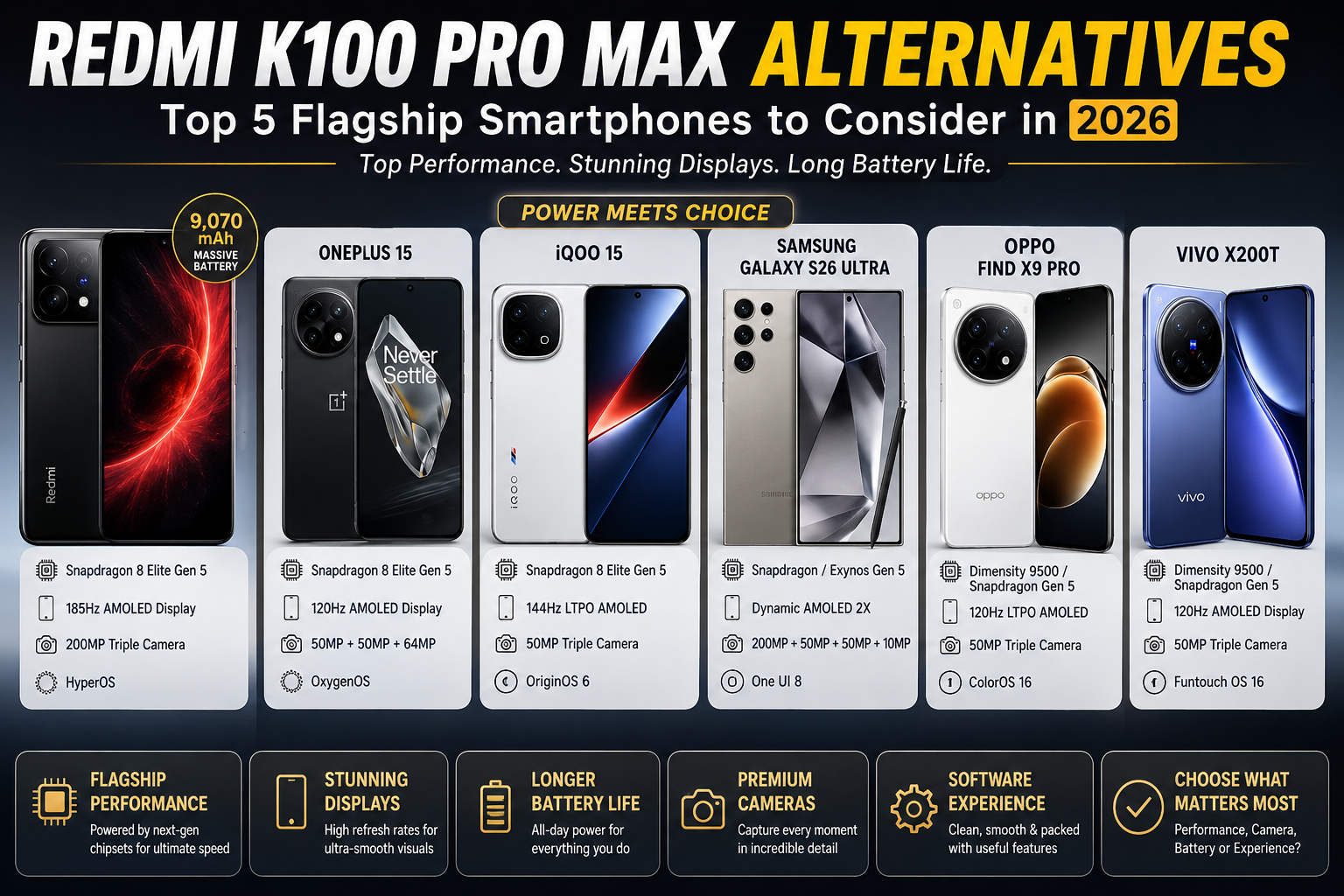
Redmi K100 Pro Max Alternatives: Top 5 Flagship Smartphones to Consider in 2026
The smartphone landscape saw a significant shake-up in August 2026 with the release of the Redmi K100 Pro Max. With its staggering 9,070 mAh battery, a blazing 185Hz display, and the latest Snapdragon 8 Elite Gen 5 chipset, it has captured the attention of power users and tech enthusiasts globally.
However, flagship ownership is rarely a one-size-fits-all decision. Whether the Redmi K100 Pro Max is currently restricted to the Chinese market, or you simply prefer a different software experience, design philosophy, or camera tuning, you might be looking for alternatives.
If you are hunting for flagship-grade performance, high-end display tech, or battery endurance that rivals the K100 Pro Max, here are the top five alternatives you should consider in the current market.
Why Look for Alternatives?
Before diving into the options, it is important to address why users look for alternatives to a device that, on paper, seems perfect. The Redmi K100 Pro Max is a specialized piece of hardware. Its “battery-first” design, while impressive, leads to a larger physical footprint. Furthermore, Xiaomi’s “K” series often faces software and availability hurdles outside of its home market.
When choosing a smartphone, you aren’t just buying hardware; you are buying into an ecosystem. Here are the top contenders that offer comparable—and sometimes superior—experiences.
1. OnePlus 15
If you are prioritizing a balance between raw performance and a clean, user-friendly software experience, the OnePlus 15 remains a formidable contender.
- Why it competes: Like the K100 Pro Max, it utilizes the Snapdragon 8 Elite Gen 5 chipset, ensuring your gaming and multitasking are buttery smooth.
- Key Advantage: OxygenOS (or the global ColorOS integration) offers a refined software experience that many users find more accessible than Xiaomi’s HyperOS.
- Verdict: Choose this if you want flagship speed with software stability.
2. iQOO 15
The iQOO series has long been the “performance-first” rival to Redmi. The iQOO 15 is specifically tuned for gamers who do not want to sacrifice camera quality or display excellence.
- Why it competes: It mirrors the high-refresh-rate capabilities of the K100 Pro Max but often includes dedicated chips for frame interpolation in games, which can actually make low-frame-rate games look smoother.
- Key Advantage: Superior thermal management. If you spend hours in high-intensity gaming sessions, the iQOO 15’s cooling architecture is arguably more robust for sustained loads.
3. Samsung Galaxy S26 Ultra
For those who view the smartphone as a productivity tool rather than just a gaming device, the Samsung Galaxy S26 Ultra is the industry benchmark.
- Why it competes: You might be sacrificing the 9,000+ mAh battery capacity for something closer to 5,000-5,500 mAh, but you gain access to the S-Pen, a superior camera zoom system, and the best display calibration in the industry.
- Key Advantage: Long-term software support and the most versatile camera array on the market.
4. OPPO Find X9 Pro
The OPPO Find X9 Pro is for the user who demands a luxury feel and professional-grade photography.
- Why it competes: While the Redmi K100 Pro Max is a utilitarian powerhouse, the Find X9 Pro is a style icon. Its camera hardware—specifically the sensor size and processing—tends to outperform the K-series in portrait and low-light photography.
- Key Advantage: Build quality and camera optics. The materials and in-hand feel are undeniably premium.
5. Vivo X200T
The Vivo X200T rounds out our list as the “all-rounder” flagship. It is particularly adept at handling mixed-use scenarios, making it an excellent daily driver.
- Why it competes: Vivo’s imaging algorithms are often cited as the best in the industry for skin tones and natural color reproduction. It offers a very similar performance tier to the K100 Pro Max.
- Key Advantage: Consistent, reliable camera performance without the need to fiddle with manual settings.
Quick Comparison Table
| Feature | Redmi K100 Pro Max | OnePlus 15 | Samsung S26 Ultra |
| Processor | Snapdragon 8 Elite Gen 5 | Snapdragon 8 Elite Gen 5 | Exynos / Snapdragon Gen 5 |
| Battery | 9,070 mAh | 5,500 mAh | 5,000 mAh |
| Camera | 200MP Triple | 50MP + 50MP + 64MP | 200MP + 50MP + 50MP + 10MP |
| Software | HyperOS | OxygenOS | One UI |
Note: Specifications for competing models may vary by region.
Making the Right Choice
Choosing between these devices comes down to your personal priorities:
- Gaming/Power: If you prioritize the absolute highest refresh rates and raw processing, stay tuned to the K100 Pro Max or choose the iQOO 15.
- Everyday Utility: If you need a phone that handles daily tasks, work apps, and social media with ease and consistent updates, the OnePlus 15 or Samsung Galaxy S26 Ultra are superior.
- Photography: If you want professional photos with less effort, the Vivo X200T or OPPO Find X9 Pro should be at the top of your list.
The Redmi K100 Pro Max is undeniably an impressive piece of engineering, specifically regarding its massive battery and display specs. However, the market in 2026 is rich with alternatives that offer better software support, more established global service networks, and more balanced hardware profiles. Evaluate what you actually need from your next device before committing to a purchase.
FAQ
Question 1
Is the Redmi K100 Pro Max available in India?
Answer
As of August 2026, the Redmi K100 Pro Max has been launched in China. There has been no official announcement regarding an India launch. Often, Redmi K-series devices are rebranded as Poco devices for the global and Indian markets, so keep an eye out for potential Poco “F” series announcements.
Question 2
Which phone has the best battery life among these alternatives?
Answer
The Redmi K100 Pro Max features a massive 9,070 mAh battery, which currently dwarfs most flagship competitors. If battery life is your absolute number one priority, no alternative on this list will match it, though the OnePlus 15 and iQOO 15 offer excellent power efficiency for standard daily use.
Question 3
Does the Redmi K100 Pro Max use a specialized processor?
Answer
It uses the Qualcomm Snapdragon 8 Elite Gen 5 chipset. This is a top-tier flagship processor, and several other 2026 flagships, including the OnePlus 15, also utilize this same high-performance chip.
Question 4
Are these alternatives more expensive than the Redmi K100 Pro Max?
Answer
Generally, yes. Devices like the Samsung Galaxy S26 Ultra and the OPPO Find X9 Pro are positioned in the “ultra-premium” segment and often carry higher price tags than the Redmi K series, which is usually marketed as a “flagship killer” or high-value flagship.