
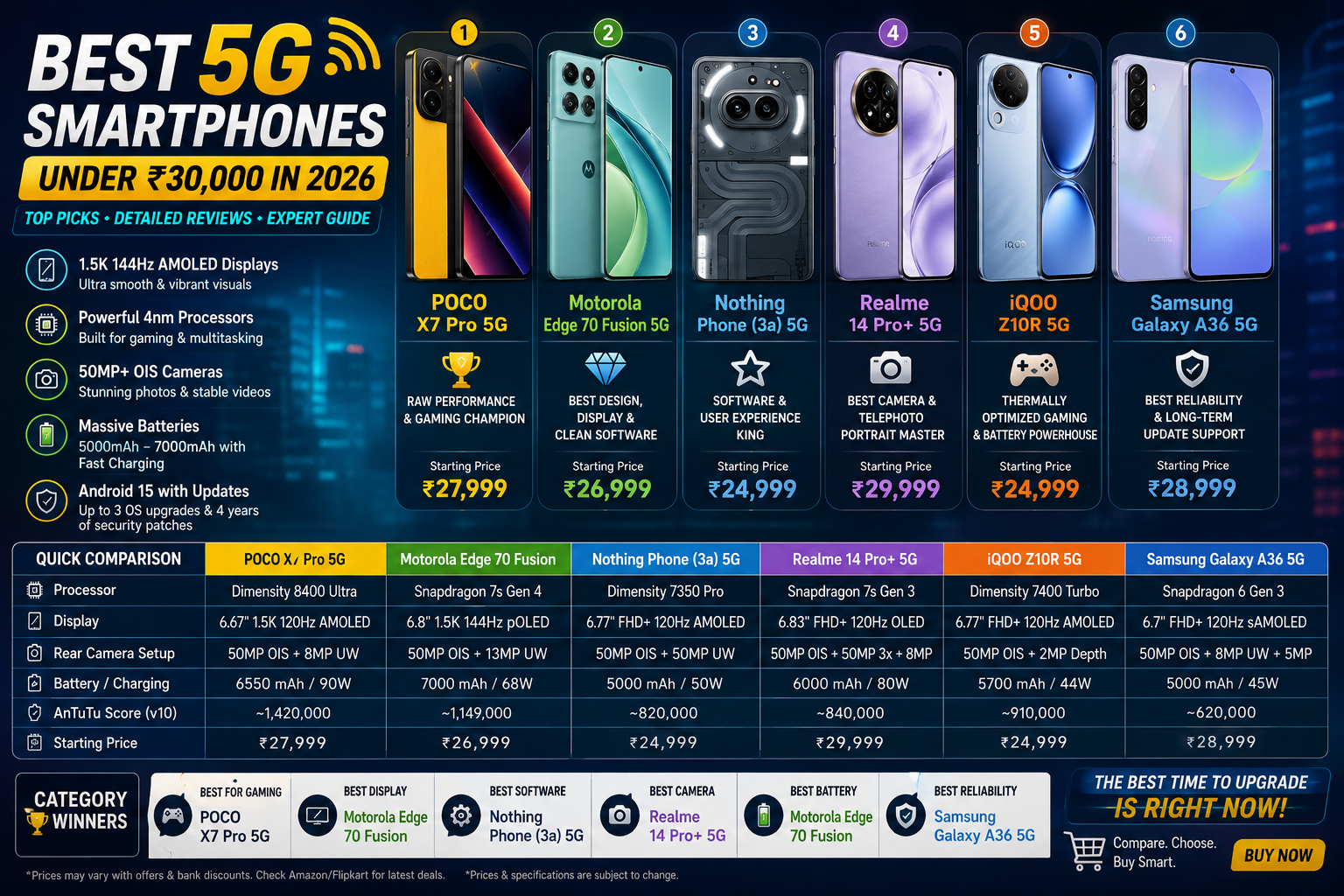
Best 5G Smartphones Under ₹30,000 in 2026: The Ultimate Buyer’s Guide
The Indian mid-range mobile market has undergone a dramatic transformation, and if you are shopping for the best 5G smartphones under ₹30000 2026, you are stepping into a sweet spot that feels closer to flagship territory than ever before. Gone are the days when spending ₹30,000 meant accepting major compromises on build quality, camera versatility, or display performance. Today, sub-₹30K devices pack 1.5K 144Hz curved AMOLED panels, periscope telephoto cameras with 3x optical zoom, massive 6000mAh–7000mAh silicon-carbon batteries, and processors capable of pushing AnTuTu scores past the 1.4-million mark.
Whether you are a competitive Mobile Gamer demanding high-frame-rate stability in BGMI or Genshin Impact, a mobile photographer seeking natural skin tones and stable OIS video recording, or an everyday user who wants clean bloatware-free software with multi-year update guarantees, this tier has an option tailored specifically for you. At KunduTech, we have thoroughly evaluated the latest releases in real-world scenarios—testing network stability across Jio and Airtel 5G, stress-testing thermal throttling, scrutinizing low-light camera processing, and monitoring battery endurance. Here is your definitive, expert-tested buying guide to the top 5G smartphones under ₹30,000 in India right now.
Table of Contents
- What to Expect Under ₹30,000 in 2026
- Quick Comparison Table: Top Picks at a Glance
- In-Depth Reviews: Best 5G Smartphones Under ₹30,000
- POCO X7 Pro 5G — The Raw Performance & Gaming Champion
- Motorola Edge 70 Fusion 5G — Best Design, Display & Clean Software
- Nothing Phone (3a) 5G — The Software & User Experience King
- Realme 14 Pro+ 5G — Best Camera & Telephoto Portrait Master
- iQOO Z10R 5G — Thermally Optimized Gaming & Battery Powerhouse
- Samsung Galaxy A36 5G — Best Reliability & Long-Term Update Support
- Category Winners: Which Phone Fits Your Need?
- 5G Bands & Network Readiness in India
- 5G Smartphone Buying Checklist for 2026
- Key Takeaways & Summary Box
- Frequently Asked Questions (FAQs)
- Final Verdict
What to Expect Under ₹30,000 in 2026
Before diving into individual model reviews, it is essential to understand the technical baseline for mid-range smartphones in 2026. Knowing what hardware standards to expect prevents you from overpaying for outdated specs.
- Displays: 120Hz to 144Hz AMOLED panels with 1.5K resolution, 10-bit color depth, HDR10+ support, and peak brightness levels reaching 2,000 to 3,000 nits for outdoor legibility under bright sunlight.
- Processors: Modern 4nm silicon like the MediaTek Dimensity 8400 Ultra, Qualcomm Snapdragon 7s Gen 4, and Snapdragon 7 Gen 4. Expect smooth multi-tasking and high-tier graphics rendering without severe thermal throttling.
- Cameras: Primary 50MP Sony LYT or OMNIVISION sensors equipped with Optical Image Stabilization (OIS). In 2026, periscope telephoto lenses with 3x optical zoom have also filtered down into this price range.
- Battery & Fast Charging: Silicon-carbon anode battery tech enables capacities from 5,500mAh up to 7,000mAh without increasing device thickness, accompanied by 45W to 90W fast charging.
- Software & Durability: Android 15 out of the box, with guarantees of at least 3 major OS upgrades and 4 years of security patches. IP65 to IP68 water and dust resistance ratings are now common standard features.
Quick Comparison Table: Top Picks at a Glance
| Smartphone Model | Processor | Display | Rear Camera Setup | Battery / Charging | AnTuTu Score (v10) | Starting Price |
| POCO X7 Pro 5G | Dimensity 8400 Ultra | 6.67″ 1.5K 120Hz AMOLED | 50MP OIS + 8MP UW | 6550 mAh / 90W | ~1,420,000 | ₹27,999 |
| Motorola Edge 70 Fusion | Snapdragon 7s Gen 4 | 6.8″ 1.5K 144Hz pOLED | 50MP OIS + 13MP UW | 7000 mAh / 68W | ~1,149,000 | ₹26,999 |
| Nothing Phone (3a) 5G | Dimensity 7350 Pro | 6.77″ FHD+ 120Hz AMOLED | 50MP OIS + 50MP UW | 5000 mAh / 50W | ~820,000 | ₹24,999 |
| Realme 14 Pro+ 5G | Snapdragon 7s Gen 3 | 6.83″ FHD+ 120Hz OLED | 50MP OIS + 50MP 3x + 8MP | 6000 mAh / 80W | ~840,000 | ₹29,999 |
| iQOO Z10R 5G | Dimensity 7400 Turbo | 6.77″ FHD+ 120Hz AMOLED | 50MP OIS + 2MP Depth | 5700 mAh / 44W | ~910,000 | ₹24,999 |
| Samsung Galaxy A36 5G | Snapdragon 6 Gen 3 | 6.7″ FHD+ 120Hz sAMOLED | 50MP OIS + 8MP UW + 5MP | 5000 mAh / 45W | ~620,000 | ₹28,999 |
In-Depth Reviews: Best 5G Smartphones Under ₹30,000
1. POCO X7 Pro 5G — The Raw Performance & Gaming Champion
If your highest priority is pure processing power, frame rate stability, and synthetic benchmark scores, the POCO X7 Pro 5G sets the gold standard under ₹30,000.
📱 POCO X7 Pro 5G Quick Card
- Processor: MediaTek Dimensity 8400 Ultra (4nm)
- Display: 6.67″ 1.5K AMOLED, 120Hz, Dolby Vision, 3200 nits
- RAM/Storage: 8GB/12GB LPDDR5X | 256GB/512GB UFS 4.0
- Camera: 50MP Sony LYT-600 OIS + 8MP Ultra-wide
- Battery: 6550 mAh with 90W HyperCharge
Performance & Gaming
At the heart of the POCO X7 Pro 5G lies the MediaTek Dimensity 8400 Ultra chipset built on a flagship-tier 4nm process. Paired with ultra-fast LPDDR5X RAM and UFS 4.0 storage, this phone easily cracks 1.4 million points on AnTuTu v10. In practical terms, it runs demanding titles like BGMI at constant 90 FPS and Genshin Impact at high graphics settings with minimal frame drops. POCO’s upgraded 5,000mm² stainless steel LiquidCool vapor chamber ensures heat is dissipated evenly during extended gaming sessions.
Display & Design
The 6.67-inch 1.5K AMOLED display features ultra-narrow bezels, 120Hz adaptive refresh rate, HDR10+ support, and a local peak brightness of 3,200 nits. Color accuracy is punchy, making movie streaming on Netflix an absolute treat. The back panel offers a textured vegan leather finish or a sleek glass option with IP68 dust and water resistance.
Camera & Battery
The primary camera features a 50MP Sony LYT-600 sensor with Optical Image Stabilization (OIS). Daytime photos display vibrant contrast and dynamic range, though low-light ultra-wide shots show slight noise. The massive 6,550mAh silicon-carbon battery comfortably yields over 8.5 hours of screen-on-time (SoT) and recharges from 0 to 100% in under 42 minutes using the included 90W fast charger.
- Pros:
- Market-leading CPU and GPU performance in its segment
- Lightning-fast UFS 4.0 storage read/write speeds
- Sturdy IP68 water resistance rating
- Outstanding 6,550mAh battery endurance with 90W charging
- Cons:
- Pre-installed bloatware (can be manually uninstalled)
- Secondary 8MP ultra-wide camera is mediocre compared to the main sensor
- No 3.5mm headphone jack or expandable microSD card slot
- Who Should Buy: Competitive mobile gamers, power users, and buyers seeking maximum hardware specs per rupee spent.
- Who Should Avoid: Users who prefer absolute stock Android software with zero pre-installed third-party apps.
2. Motorola Edge 70 Fusion 5G — Best Design, Display & Clean Software
Motorola has mastered the art of balancing sleek aesthetic appeal with clean, bloated-free software. The Motorola Edge 70 Fusion 5G represents one of the most complete all-rounder packages available in the sub-₹30,000 price segment.
📱 Motorola Edge 70 Fusion 5G Quick Card
- Processor: Qualcomm Snapdragon 7s Gen 4 (4nm)
- Display: 6.8″ 1.5K Extreme AMOLED, 144Hz Quad-Curved
- RAM/Storage: 8GB/12GB LPDDR4X | 128GB/256GB UFS 2.2
- Camera: 50MP Sony LYT-700C OIS + 13MP Ultra-Wide/Macro
- Battery: 7000 mAh with 68W TurboPower
Design & Software Experience
Motorola continues its partnership with Pantone, offering the Edge 70 Fusion in striking vegan-leather finishes such as Marshmallow and Peacock Blue. Weighing under 180 grams despite housing a 7,000mAh battery, the phone feels balanced and ultra-premium in hand. It runs Hello UI based on Android 15, providing a completely clean experience without ads, pop-ups, or unwanted bloatware.
Display & Camera Performance
The phone features a gorgeous 6.8-inch 1.5K quad-curved Extreme AMOLED panel pushing a silky-smooth 144Hz refresh rate. Touch response is instantaneous, and the curved glass edges blend seamlessly into the aluminum frame.
For photography, the 50MP primary sensor uses a Sony LYT-700C sensor with OIS, paired with a genuinely useful 13MP ultra-wide lens that doubles as a dedicated macro camera. Photos capture natural color accuracy, excellent shadow detail, and realistic skin tones. The 32MP front-facing camera shoots crisp 4K 30fps selfie videos for vloggers.
Battery & Performance
Powered by the Qualcomm Snapdragon 7s Gen 4, everyday multitasking, social media scrolling, and photo processing run smoothly. While it doesn’t match the POCO X7 Pro in pure GPU benchmarks, its 7,000mAh battery easily delivers two full days of casual usage on a single charge.
- Pros:
- Stunning quad-curved 144Hz AMOLED screen with minimal bezels
- Zero bloatware, clean Hello UI interface with Moto Gestures
- Full IP68 water and dust submersion protection
- Massive 7,000mAh battery in a lightweight, slim profile
- Cons:
- Uses UFS 2.2 storage instead of faster UFS 3.1 or 4.0
- Curved screen may cause occasional accidental palm touches for some users
- Updates can sometimes arrive slower compared to Samsung
- Who Should Buy: Users who prioritize a clean user interface, sleek curved display, lightweight design, and long multi-day battery endurance.
- Who Should Avoid: Extreme hard-core gamers who want max settings in heavy 3D titles.
3. Nothing Phone (3a) 5G — The Software & User Experience King
For buyers looking to stand out from the sea of identical glass-slab smartphones, the Nothing Phone (3a) 5G brings iconic transparent aesthetics, ambient lighting, and one of the cleanest Android skin designs in the industry.
📱 Nothing Phone (3a) 5G Quick Card
- Processor: MediaTek Dimensity 7350 Pro (4nm)
- Display: 6.77″ FHD+ Flexible AMOLED, 120Hz, 3000 nits Peak
- RAM/Storage: 8GB/12GB LPDDR4X | 128GB/256GB UFS 2.2
- Camera: 50MP Sony OIS + 50MP Ultra-wide (Dual 50MP Setup)
- Battery: 5000 mAh with 50W Fast Charging
Glyph Interface & Nothing OS
The standout feature of the Phone (3a) remains its iconic rear transparent casing paired with the Glyph Interface. These programmable LED strips serve as visual timers, notification alerts, volume indicators, and soft fill-lights for night photography. Nothing OS 3.0 (built on Android 15) is exceptionally polished, featuring custom dot-matrix widgets, fast animations, zero bloatware, and monochrome theme options that reduce screen addiction.
Cameras & Display
Unlike competitors that use low-quality 2MP depth sensors to inflate camera counts, Nothing equips the Phone (3a) with a dual 50MP setup—a 50MP main sensor with OIS and a 50MP ultra-wide sensor. Image processing emphasizes natural lighting, accurate dynamic range, and strong contrast profiles. The 6.77-inch FHD+ AMOLED display boasts symmetrical thin bezels and up to 3,000 nits peak brightness.
Performance & Everyday Usability
Driven by the custom Dimensity 7350 Pro co-engineered with MediaTek, everyday apps launch instantly, and system responsiveness feels effortless. The 5,000mAh battery easily provides a full day of heavy usage, backed by 50W fast charging support (note: charger sold separately in the box).
- Pros:
- Unique semi-transparent design with practical Glyph lighting
- Polished, ad-free Nothing OS software experience
- Dual 50MP cameras with no fill-in low quality sensors
- Balanced thermal efficiency and battery health management
- Cons:
- Charger is not included in the retail box
- Monolithic plastic frame feels slightly less premium than metal/glass rivals
- Maximum gaming output is capped at medium-to-high settings
- Who Should Buy: Design enthusiasts, students, and professionals who value clean software, stylish aesthetics, and practical ambient notifications.
- Who Should Avoid: Buyers who want a charger included in the box or maximum high-frame-rate gaming output.
4. Realme 14 Pro+ 5G — Best Camera & Telephoto Portrait Master
If photography—particularly portrait photography and zoom capabilities—is your primary reason for upgrading, the Realme 14 Pro+ 5G stands out by introducing a dedicated periscope telephoto lens to the sub-₹30,000 price point.
📱 Realme 14 Pro+ 5G Quick Card
- Processor: Qualcomm Snapdragon 7s Gen 3 (4nm)
- Display: 6.83″ FHD+ Curved OLED, 120Hz, 100% D3-P3 Color
- RAM/Storage: 8GB/12GB | 128GB/256GB UFS 3.1
- Camera: 50MP OIS Main + 50MP Periscope (3x Zoom) + 8MP UW
- Battery: 6000 mAh with 80W UltraVOOC Charging
Periscope Camera Performance
Where most mid-range competitors rely on digital cropping, the Realme 14 Pro+ includes a dedicated 50MP Sony periscope telephoto lens with 3x optical zoom and up to 120x digital zoom. Portrait shots taken at 3x optical zoom deliver natural optical bokeh, clean edge separation around hair, and detailed facial textures. The primary 50MP Sony sensor with OIS handles low-light scenarios exceptionally well, utilizing advanced AI multi-frame HDR night algorithms.
Design, Display & Battery
The back panel sports a luxury watch-inspired circular camera dial with a vegan leather rear finish. The 6.83-inch curved OLED screen is vibrant, supporting 2160Hz high-frequency PWM dimming to reduce eye strain in dark environments. A 6,000mAh battery backed by 80W SuperVOOC charging fills the phone from 0 to 50% in approximately 19 minutes.
- Pros:
- True 3x optical periscope telephoto lens for stunning portraits
- Premium vegan leather back panel with luxury watch aesthetics
- 2160Hz PWM dimming screen is gentle on the eyes
- Fast 80W wired charging with charger included in box
- Cons:
- Realme UI contains hot apps/recommendations during setup (can be disabled)
- Heavy processing can occasionally over-saturate greens and blues
- Snapdragon 7s Gen 3 provides moderate, not flagship-class gaming power
- Who Should Buy: Mobile photographers, portrait lovers, content creators, and buyers who love luxury leather-backed smartphone designs.
- Who Should Avoid: Users who dislike curved screens or modified Android skins.
5. iQOO Z10R 5G — Thermally Optimized Gaming & Battery Powerhouse
iQOO has built a strong reputation among gaming enthusiasts, and the iQOO Z10R 5G reinforces that focus by delivering steady gaming frames, responsive touch sampling, and cool operating temperatures at an attractive price point.
📱 iQOO Z10R 5G Quick Card
- Processor: MediaTek Dimensity 7400 Turbo (4nm)
- Display: 6.77″ FHD+ AMOLED, 120Hz, 2000 nits Peak
- RAM/Storage: 8GB/12GB | 128GB/256GB UFS 3.1
- Camera: 50MP Sony OIS + 2MP Depth
- Battery: 5700 mAh with 44W FlashCharge
Sustained Thermal Performance
Driven by the MediaTek Dimensity 7400 Turbo, the iQOO Z10R strikes a balance between power efficiency and graphics output. Thanks to iQOO’s Supercomputing Chip technology and 6,000mm² graphite cooling sheet, the device maintains 90 FPS stability in competitive multiplayer games without thermal throttling or frame drops during extended play.
Software & Extras
Running Funtouch OS 15 based on Android 15, iQOO includes a dedicated Ultra Game Mode overlay. This feature allows gamers to adjust frame interpolation, block background calls, monitor internal CPU/GPU temperatures, and enable motion control triggers.
- Pros:
- Excellent thermal management with near-zero frame drops
- Highly responsive 1200Hz instant touch sampling rate screen
- Sleek profile with IP64 splash resistance
- Cons:
- Lacks an ultra-wide secondary camera
- 44W charging speed is slower than 80W/90W competitors
- Who Should Buy: Budget-conscious mobile gamers who want stable frame rates and low thermal throttling.
- Who Should Avoid: Buyers needing ultra-wide camera lenses or fast charging under 30 minutes.
6. Samsung Galaxy A36 5G — Best Reliability & Long-Term Update Support
For users seeking brand trust, strict data security, crisp display quality, and multi-year software longevity, the Samsung Galaxy A36 5G represents a safe, reliable long-term investment.
📱 Samsung Galaxy A36 5G Quick Card
- Processor: Qualcomm Snapdragon 6 Gen 3 (4nm)
- Display: 6.7″ FHD+ Super AMOLED, 120Hz, Vision Booster
- RAM/Storage: 8GB | 128GB/256GB (Expandable via microSD)
- Camera: 50MP OIS + 8MP Ultra-wide + 5MP Macro
- Battery: 5000 mAh with 45W Fast Charging
Software Support & Security
Samsung leads the mid-range segment in long-term support, offering 4 major Android OS upgrades and 5 years of security updates for the Galaxy A36. Hardware-based Samsung Knox Vault security protects sensitive passwords, biometric credentials, and encryption keys from hardware-level tampering.
Display & Daily Usability
The 6.7-inch Super AMOLED screen delivers bright outdoor legibility supported by Samsung’s Vision Booster technology. The glass back panel carries an IP67 rating, offering protection against accidental drops into water up to 1 meter deep for 30 minutes. While its Snapdragon 6 Gen 3 processor is tuned for efficiency rather than heavy gaming, daily multitasking, media viewing, and productivity run smoothly.
- Pros:
- Industry-leading 4 years OS + 5 years security update guarantee
- Hardware-level Samsung Knox security architecture
- IP67 water and dust resistance rating
- Expandable storage slot via microSD card
- Cons:
- 45W fast charger is sold separately
- Thicker display bezels compared to competitors
- Moderate gaming performance compared to POCO or iQOO
- Who Should Buy: Working professionals, elders, long-term phone owners, and users prioritizing maximum security and extended software update commitments.
- Who Should Avoid: Users who want rapid in-box charging or high-end mobile gaming performance.
Category Winners: Which Phone Fits Your Need?
To simplify your buying decision, here is a breakdown of top picks by specific use case:
| Category | Winner Model | Key Reason |
| Best for Raw Gaming & Power | POCO X7 Pro 5G | Dimensity 8400 Ultra & UFS 4.0 Storage |
| Best for Clean Software & Looks | Motorola Edge 70 Fusion 5G | Ad-free Hello UI & 144Hz Quad-Curved AMOLED |
| Best for Portraits & Camera Zoom | Realme 14 Pro+ 5G | Dedicated 50MP 3x Optical Periscope Lens |
| Best for Software Longevity & Security | Samsung Galaxy A36 5G | 4 Years OS Upgrades & Samsung Knox Security |
- Best Overall Performance & Gaming:POCO X7 Pro 5G
- Why: Dimensity 8400 Ultra, UFS 4.0 storage, 90W fast charging, and AnTuTu scores exceeding 1.4 million.
- Best User Experience & Design:Motorola Edge 70 Fusion 5G
- Why: Ad-free Hello UI, quad-curved 144Hz AMOLED screen, IP68 water protection, and massive 7000mAh battery.
- Best for Photography & Portraits:Realme 14 Pro+ 5G
- Why: Dedicated 50MP periscope telephoto sensor with 3x optical zoom for realistic portraits.
- Best Choice for Long-Term Reliability:Samsung Galaxy A36 5G
- Why: 4 years OS upgrades, IP67 durability, and Knox security architecture.
5G Bands & Network Readiness in India
Buying a 5G phone in India requires verifying compatibility with national telecom frequency standards. Both Reliance Jio (Standalone 5G / SA) and Bharti Airtel (Non-Standalone 5G / NSA) operate across key mid-band and sub-6GHz frequencies.
Key Indian 5G Bands to Check:
- Sub-6GHz Frequencies: n1 (2100MHz), n3 (1800MHz), n5 (850MHz), n8 (900MHz), n28 (700MHz)
- Core High-Speed Capacity Bands: n41 (2500MHz), n77 (3700MHz), n78 (3500MHz)
All six smartphones recommended in this guide support at least 10 to 14 core 5G bands, along with Dual 5G VoNR (Voice over New Radio) and carrier aggregation, ensuring uninterrupted 5G data speeds across major metro cities, towns, and highways in India.
5G Smartphone Buying Checklist for 2026
When evaluating smartphones under ₹30,000, keep this quick reference checklist in mind before making your final purchase:
- [ ] Storage Tech: Prioritize UFS 3.1 or UFS 4.0 over older UFS 2.2 storage for faster app loading and gallery rendering.
- [ ] Display PWM Dimming: If you are sensitive to screen flicker at night, choose displays offering 2160Hz or higher PWM dimming.
- [ ] In-Box Contents: Check whether the retail package includes a fast charger (Nothing and Samsung exclude chargers from their boxes).
- [ ] IP Rating: Look for at least IP65 to IP68 certification to protect against heavy monsoons, accidental splashes, and dust.
- [ ] Software Policy: Verify that the manufacturer offers at least 3 major Android OS updates for long-term usability.
Key Takeaways & Summary Box
📌 KunduTech Summary Highlights
- Budget Segment Benchmark: Sub-₹30,000 phones in 2026 feature 1.5K AMOLED displays, 7000mAh batteries, and flagship-level performance.
- Top Performance Pick: POCO X7 Pro 5G leads raw benchmark scores and frame-rate stability for competitive gaming.
- Top Photography Pick: Realme 14 Pro+ 5G offers a dedicated 3x optical periscope lens for portrait shooting.
- Top Clean UI Pick: Motorola Edge 70 Fusion delivers ad-free Hello UI, a quad-curved 144Hz panel, and IP68 durability.
- Network Support: All listed devices fully support Indian 5G bands with VoNR support on Reliance Jio and Airtel networks.
Frequently Asked Questions (FAQs)
1. Which is the absolute best 5G smartphone under ₹30,000 in 2026?
The answer depends on your priorities. For raw gaming and processing speed, the POCO X7 Pro 5G is the clear winner. For an ad-free clean software experience and sleek design, the Motorola Edge 70 Fusion 5G is the top recommendation.
2. Can I get a good periscope camera phone under ₹30,000?
Yes! The Realme 14 Pro+ 5G includes a dedicated 50MP Sony periscope telephoto camera with 3x optical zoom, delivering high-quality portrait shots in this price category.
3. Do 5G smartphones under ₹30k support 90 FPS gaming in BGMI?
Yes, devices powered by upper-tier processors—such as the POCO X7 Pro 5G (Dimensity 8400 Ultra)—natively support 90 FPS gameplay in BGMI and PUBG Mobile with high frame-rate stability.
4. Which phone offers the best battery life under 30,000?
The Motorola Edge 70 Fusion 5G leads battery endurance in this segment with its huge 7,000mAh silicon-carbon battery, delivering up to two full days of typical usage on a single charge.
5. Are curved AMOLED displays prone to accidental touches?
Modern smartphones use palm-rejection algorithms within their software to mitigate accidental touch inputs along screen edges. However, if you prefer flat displays, options like the POCO X7 Pro 5G or Nothing Phone (3a) offer traditional flat glass profiles.
6. Do all smartphones under ₹30,000 include a charger in the box?
No. While brands like POCO, Motorola, Realme, and iQOO include high-speed fast chargers in the box, Samsung and Nothing sell charging bricks separately.
7. Is 8GB RAM enough for Android 15 in 2026?
Yes, 8GB of physical LPDDR5/LPDDR4X RAM is sufficient for smooth multitasking, app retention, and gaming on Android 15. However, if you plan to keep your device for 3 to 4 years, upgrading to a 12GB RAM variant offers added future-proofing.
8. What is the difference between IP64, IP67, and IP68 water resistance?
- IP64: Splash-resistant against light rain and dust particles.
- IP67: Dust-tight and protected against full fresh-water immersion up to 1 meter depth for 30 minutes.
- IP68: Top-tier protection against fresh-water immersion up to 1.5 meters depth for 30 minutes.
People Also Ask (PAA)
- Which phone has the best display under ₹30,000? The Motorola Edge 70 Fusion 5G features a top-rated 6.8-inch 1.5K quad-curved Extreme AMOLED panel running at a fast 144Hz refresh rate.
- Is Nothing Phone 3a better than POCO X7 Pro? Nothing Phone (3a) excels in software optimization, unique design, and ambient Glyph lighting, whereas POCO X7 Pro delivers significantly higher CPU/GPU benchmark performance and faster storage speeds.
External Authoritative Sources
- Qualcomm Snapdragon Official Processors Hub
- MediaTek Dimensity Chipset Architecture
- Geekbench 6 Official Mobile Benchmark Database
- AnTuTu Benchmark Official Ranking Lists
- Bureau of Indian Standards (BIS) Electronics Certification
Related Articles
- Best Flagship Killer Phones Under ₹40,000 in 2026
- Top Camera Phones for Vlogging and Reels Creation
- How to Extend Battery Lifespan on Android 15
Final Verdict
The sub-₹30,000 price point in 2026 delivers unprecedented value for smartphone buyers in India. You no longer have to sacrifice raw performance for build quality or accept poor camera sensors to get fast charging speeds.
If your goal is maximum gaming frame rates, pick the POCO X7 Pro 5G. If you value a clean, ad-free UI paired with an ultra-smooth 144Hz curved screen and massive battery life, choose the Motorola Edge 70 Fusion 5G. If portrait photography and optical zoom matter most, the Realme 14 Pro+ 5G is your best option. Finally, for long-term updates, security, and brand ecosystem stability, the Samsung Galaxy A36 5G remains a reliable choice.
Which 5G smartphone under ₹30,000 are you planning to buy? Have questions about a specific model? Drop a comment below, and our tech team at KunduTech will help you make the right choice!
For a visual breakdown of the top mid-range 5G phones and performance tests, check out this helpful video review of the best 5G mobile under ₹30k. This video offers a practical hands-on comparison of real-world gaming performance, display quality, and camera samples across the leading options in this budget category.