
A slight shift of focus, and the future could still turn out like Deus Ex after all…
— Deus Ex lead writer Sheldon Pacotti, speaking in 2014
The reviews that greeted Ion Storm’s Deus Ex upon its release in June of 2000 ranged along a continuum from cautiously to wildly positive. Computer Gaming World, the Gray Lady of the hobby, came with one of the most nuanced takes. Reviewer Thierry Nguyen spoke of “loving” the game in the abstract, but lamented “deep flaws that sometimes frustrated me, as they detracted from its ambitious design”; these included performance issues, poor artificial intelligence on the part of the enemies, and a sense of contrivance that clung to some of the environments and plot points. The excitable lads at Australia’s PC Powerplay, on the other hand, placed no such qualifiers on their declaration of love for Deus Ex. In a special feature published when the game was not yet three months old, they declared it to be quite simply The Best Game Ever: “Every action within Deus Ex’s expansive environments has far-reaching consequences, making it seem like the player is ensconced within a living, breathing world.”
For better or for worse, the critical consensus over the quarter-century since Deus Ex was a brand-new game has hewed more to PC Powerplay than Computer Gaming World. As the years have passed, it has been praised more and more fulsomely, not only for its gameplay but for being a full-blown work of interactive speculative fiction, full of uncanny insights into the ways the world has changed since it was released just as the Dot-com Bubble was bursting. YouTube in this Year of Our Lord 2026 is overflowing with videos that declare it to be “The Most Important Videogame Ever Made,” the game that “predicted the future,” the proud home of “some of the most insightful philosophy that you will ever witness in the gaming medium.” It’s become fodder for a certain species of painfully earnest commentator who desperately wants games to be culturally relevant true-blue art, whilst also continuing to allow him to run around and blow shit up in the manner to which he’s become accustomed. All too often, this causes such folks to make claims for Deus Ex that have only a tangential relationship with its reality, lacking the necessary grounding in the cultural circumstances that produced it. Which is no surprise really; some of these folks weren’t even born yet when Deus Ex was new on store shelves.
My favorite anecdote in this vein involves the name of the protagonist: J.C. Denton. It was theorized for years that the “J.C.” stood for “Jesus Christ,” pointing to the literal deus ex machina (“God in the machine”) of one of the game’s three possible endings, in which Denton merges with an artificial intelligence — in the Singularity sense, not that of the algorithms controlling the enemies who run through the game’s corridors shooting at you — to take over the world. At a Game Developers Conference postmortem in 2017, Deus Ex’s mastermind Warren Spector, who had always stayed mum on the subject prior to this event, brought forth a revelation that caused jaws to drop almost audibly throughout the room: the initials really did stand for “Jesus Christ.” But then came the deflating coda. Rather than having any deeper thematic or philosophical implications, the name of the protagonist came from a friend of Spector’s with the first name of Denton, who was so nice and helpful that it could become downright “irritating,” as Spector put it. “Jesus Christ, Denton!” he would say at these junctures. When production on Deus Ex began, Spector thought that the phrase had a nice ring to it. So much for philosophy.
Like Planescape: Torment and to some extent even Alpha Centauri, Deus Ex has become as much an aspirational ideal as a concrete artifact. And that’s fine; we all need things to which to aspire, after all. Still, in this article I’m going to do my best to drill down on the less hyperbolic reality of Deus Ex. If this meaning pushing back at times against its popular reputation as a sui generis masterpiece, know that that doesn’t mean it isn’t a fine and groundbreaking game, a game which dares to attempt to do a lot of difficult things and manages to succeed at a remarkable number of them.
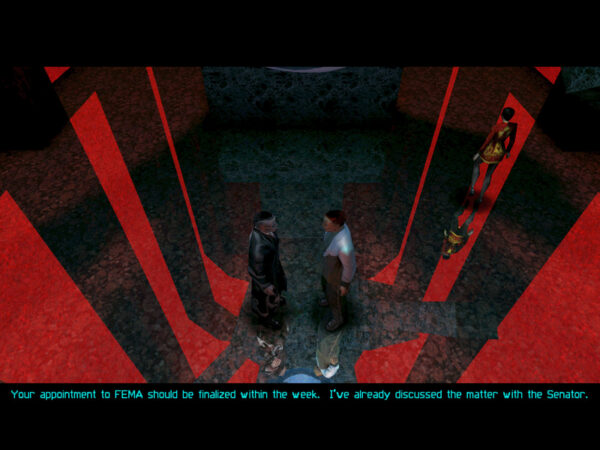
The secret organization that J.C. Denton works for is the Federal Emergency Management Agency. How’s that for a deep state?
As I’ve already implied, discussions of Deus Ex tend to break down along two axes: the innovations of its gameplay and the statements it makes — or seems to make — about the very future in which we are now privileged or condemned to be living. The gameplay is both the easier subject to get a handle on and the one where the more grandiose claims require less qualification, so let’s start there.
Whatever else it happens to be, Deus Ex is the greatest game that Looking Glass Studios never made, steeped in that creative collective’s ethic of the “immersive sim.” As longtime readers of this site know, Looking Glass’s very first game, Ultima Underworld, appeared in 1992, right about the same time that id Software released Wolfenstein 3D, their dry run for DOOM. For the balance of the decade, Looking Glass was the yin to id’s yang. Both studios worked with first-person 3D, but, while id emphasized straightforward shooter gameplay, Looking Glass stubbornly stuck to a much more complex, multi-variant gameplay model that strove to drop the player right into a believable 3D world. It was a far more difficult path to walk, with far fewer commercial rewards to be found along the way, yet it resulted in a catalog of games that are still well remembered and widely recognized as formative to what gaming has become in the decades since. It might not be going too far astray to call Looking Glass the Velvet Underground of gaming.
In my opinion, the greatest, most quintessential Looking Glass game of all is System Shock, which was released in 1994, still fairly early in the studio’s run. It casts you as the sole surviving human aboard a space station where an evil central computer, the chillingly iconic SHODAN, has killed everyone else and turned their corpses into bloodthirsty zombies. You have to shoot, sneak, hack, and engineer your way to victory against her, in combinations that can and will vary from player to player. The game is less a fixed story than an emergent playground of problems and possibilities that yields a story, if the player is doing it right. System Shock so impressed Warren Spector, who was serving as Looking Glass’s producer and liaison at the publisher Origin Systems at the time it went into development, that it caused him to quit his job there and join Looking Glass full-time.
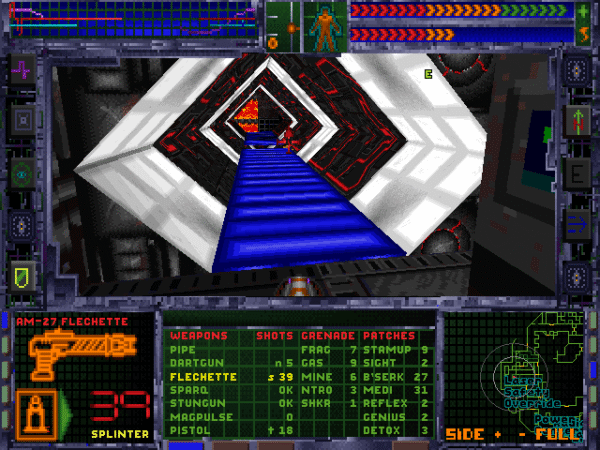
System Shock. One of its design principles was a thoroughgoing commitment to diegesis; you aren’t privy to any information which the character you play isn’t also privy to. What you see onscreen is exactly what the protagonist sees through the heads-up display installed in his environmental suit’s helmet. (Valve’s Half-Life would famously employ the same approach four years later.)
All told, System Shock was the most uncompromising implementation of an immersive sim that Looking Glass ever created — for that matter, one of the most uncompromising that anyone has ever created, right up to the present day. Confronted by feedback from players who found the scope of possibility which System Shock allowed them less bracing than confusing, Looking Glass shrank it just slightly in their later games. Their 1998 game Thief, for example, made it clear to the player that stealth was the only real route to success. Yet Spector found the early builds of that game, which is at least as critically lauded as System Shock today, to be more frustrating than freeing. What happened if you were discovered in one of the dark corners of the game, despite all of your best efforts to stay hidden? It usually just led to a swift game-over screen, so inept was your character in a straight-up sword fight. Spector wondered why he couldn’t be allowed to take a different approach to the game’s problem space than that of pure stealth, if he so chose. After having worked on System Shock, Thief felt too constrictive.
This was the direction his thoughts were traveling when John Romero called him up to offer him $3 million to make “any game you want to make.” Deus Ex was a return to the ethic that had produced System Shock, and thus cannot be fully understood without reference to that earlier game. Like System Shock, it gives you a goal and sets you loose to try to achieve it in any way you can conceive and pull off. The core of Spector’s mission statement to his team was just three words long: “Problems, not puzzles.” Instead of insisting that you work your way to solutions that have already been thought up by the designers — the definition of puzzle-based gameplay — it’s content to offer up a selection of challenges and affordances and then trust in the multi-variant simulation to do the rest. This gives emergent possibilities for problem-solving — as opposed to puzzle-solving — that even the designers may never have imagined. If this approach wasn’t quite as breathtakingly new in 2000 as some of the YouTube commentariat seem to think it was — again, see System Shock — it was most definitely the road less traveled in 3D gaming at the time.
That said, Deus Ex is more willing than System Shock to compromise on the ideology of the immersive sim in order to satisfy other goals. It’s slightly less committed to diegesis, being willing to foreground information that System Shock prefers to keep hidden. The changes which the protagonist of System Shock undergoes all happen organically, as a result of his actions in the world. In Deus Ex, while you will always play an agent with the code name of J.C. Denton, your identity is less intimately bound up with his. You’re free to make your own version of him by explicitly choosing which skills to invest in initially and which ones to improve as the game goes on, from a modest menu of same that includes Computers, Electronics, Environmental Training, Lockpicking, Medicine, Swimming, and an array of Weapons competencies. (Interestingly, a 1999 direct sequel to the original System Shock that was developed by Irrational Games rather than Looking Glass themselves made the same choice to crack open the black box, as it were, and expose the CRPG elements.)
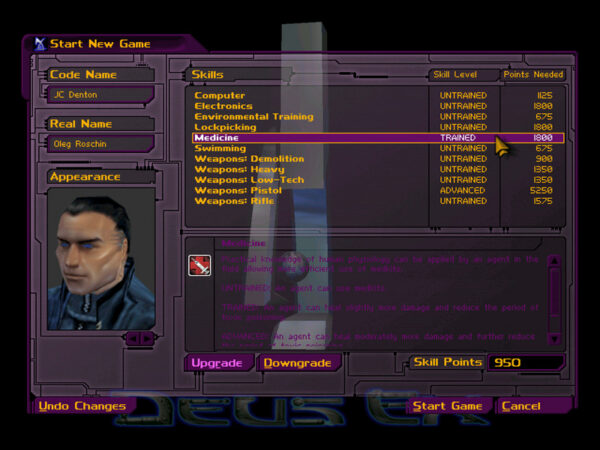
Deus Ex’s character-creation screen.
Instead of taking place in one contiguous space like System Shock — albeit a space with plenty of locked doors and balky elevators to be sorted out — Deus Ex embraces a more typical first-person-shooter campaign structure, giving you a set of twelve missions that are played out one after the other. Each mission is, we might say, a kind of mini-System Shock, a self-contained simulation space that must be “solved” in one way or another in order to proceed to the next one. In terms of its overarching narrative, then, Deus Ex is really a quite traditionalist game.
The campaign structure does allow Deus Ex to present a far broader array of environments than it otherwise could, the polar opposite of the relentlessly uniform, suffocating corridors of System Shock. You hopscotch from New York City to Hong Kong to Paris among many other destinations, ending up — inevitably, given the nature of the story — at good old Area 51. But what is gained in cosmopolitan diversity is lost in the ability of players to make their own story. While each mission can be solved in a huge number of ways, it will always lead to the same mission afterward; the game will always dance to the tune of the same set of fixed plot beats. The “living, breathing world” that so delighted PC Powerplay back in the day is an illusion outside of the granular frame of how you complete each individual mission. Whether you choose to make your J.C. Denton a hyper-violent super-soldier who assassinates moral niceties along with everyone else he meets or a tormented soul engaged in what he suspects more and more to be a bad business, he will always arrive there at Area 51 via the same basic series of steps. Yes, one might argue that System Shock as well has a somewhat linear, deck-by-deck instead of mission-by-mission progression, but the ability — indeed, the necessity — to periodically go back to decks you might have thought you had “cleared” gives it a verisimilitude that Deus Ex can’t quite match.
So, for all its reputation for innovation, well-deserved in many respects, Deus Ex’s wide-frame approach to storytelling is almost as old as digital games themselves. At the climax of the linear campaign, you are given a choice between three pre-crafted endings. Other than by dying and failing to reach the climax at all, you have no more control than this over the final outcome of the story. This could be construed as a weakness, given the stakes of the plot, which is vastly more complicated than System Shock’s personal zero-sum game between yourself and SHODAN. Still, I do understand why it was done this way, and don’t really blame anyone for it: because truly interactive storytelling, especially on a scale like this one, is hard, as decades of experience have taught us all too well. As I’ve written many times, game design is an art of the possible; having made their bed by choosing to tackle such an ambitious story, the designers of Deus Ex had to lie in it as best they could.
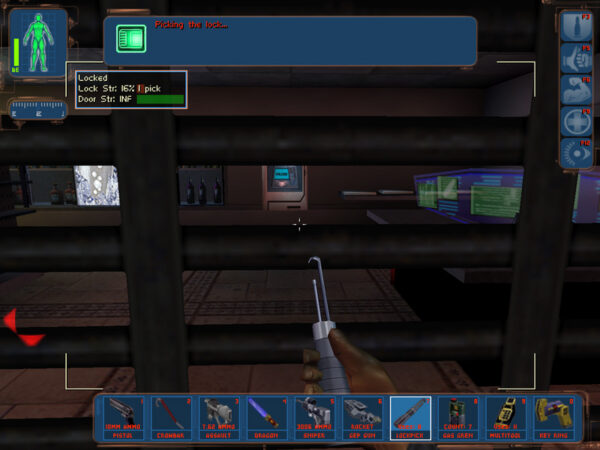
Try to pick the lock or blow it open? The choice is yours… or maybe you can do something else, perhaps something totally unexpected, instead.
At the level of the individual missions, however, the game does do an admirable job of living up to its goal of letting you figure things out for yourself. If you want to go for maximum lethality, you can do that, although the limited quantity of ammunition to hand will make it a daunting task. (Just why does the organization you work for spend a fortune to turn you into an augmented super-soldier and then scrimp on bullets like a corporate Karen in charge of an office-supply cabinet?) If you want to rely on stealth and technological trickery, reserving your kill shots for the people who really deserve them, you can do that too. The best way to know if an immersive sim is successful at what it has set out to do is to imagine that you — the real you, that is — are actually in the situation it depicts, ask yourself how your real-world self would react, and then find out if the game allows you to do that. If the answer is yes, then the game is probably onto something. And by this standard, Deus Ex acquits itself pretty darn well, all things considered.
Indeed, for many years after the game’s release, the designers were regaled with tales of players who had devised solutions to the missions’ problems that they had never even thought of — another sign of a successful immersive sim. One of the most famous examples emerged when the game was still in testing. It involves magnetic explosive charges that can be attached to doors and windows for the purpose of blowing them open, or to make booby-traps for enemies. The testers discovered that they could use these in a whole different way: to make a kind of staircase for climbing a wall by attaching them one after another at increasing heights, hopping from one rung to the next. It was a clever and totally unanticipated way to reach high balconies and rooftops. Informed of this exploit, many a design team would have contrived some way to block it and moved on to the next bug on the list. But Warren Spector’s team took it as a challenge to make their virtual realities that much more airtight, such that even climbing to someplace you “shouldn’t” be couldn’t break them.

An improvised ladder made from magnetic explosive charges.
The worst thing you can say about this aspect of Deus Ex is that the simulation of the real world sometimes leads to situations where behaviors are entirely emergent, but a long way off from believable. Deus Ex goes so far in simulating a logically functioning environment in comparison to most games of its era that it occasionally falls into a kind of uncanny valley of realism, amenable to “cheap” solutions on the player’s part that remind her all too clearly that she’s merely playing a game. The most notorious examples of this phenomenon tend to revolve around the behavior of the various guards, terrorists, and other enemies in the spaces, who act more like confused herd animals than trained operatives. There are lots of ways to lead these clowns astray in order to avoid and/or kill them, ways that would never fly in the real world. But they stand out only because so much else has raised our expectations so high…
One of the many choices which Deus Ex largely leaves up to its player is how much to engage with its convoluted, much-discussed story line. You can treat the game as nothing more than a series of tactical scenarios to overcome, if you’re so inclined. Or you can really dig into the lore by exhausting every possible line of interrogation with the people you meet and carefully reading through the many documents you stumble across. It’s to this side of the game, which is increasingly described as prescient if not downright prophetic by people looking back from these dystopic-feeling current times of ours, that I’d like to turn now.

The most infamous and chilling “proof” of Deus Ex’s alleged facility for predicting the future is a view of the New York City skyline that you can see in the very first mission. This game that was released fifteen months before the terrorist attacks of September 11, 2001, nonetheless shows only empty sky where the twin towers of the World Trade Center ought to be. As the people who made the game have always been quick to explain, this was not intended as a conscious statement of any sort, much less a prophecy. The towers were left out simply because the rendering engine couldn’t handle any more polygons. But still… what a coincidence! It’s almost enough to make you believe that the ghost of the Oracle of Delphi really does haunt Deus Ex.
The game that follows that disconcerting skyline view is littered with quotes that seem almost as unnervingly prescient, especially when pulled out of context. They seem to apply all too well to our present age of ever greater disparities of wealth, all but unchecked corporate power, solipsistic social media, and widespread surveillance in both digital and physical spaces. Add to all of that the claim that our computers are on the verge of waking up to sentience and taking over the world…
For 100 years, there’s been a conspiracy of plutocrats against ordinary people. In 1945, corporations paid 50 percent of federal taxes. Now they pay about 5 percent. In 1900, 90 percent of Americans were self-employed. Now it’s about 2 percent. It’s called consolidation. Strengthen governments and corporations, weaken people. With taxes, this can be done imperceptibly over time.
This is real freedom: freedom to own property, make a profit, make your life. The West, so afraid of strong government, now has no government. Only financial power. All taxes are social engineering. That’s always been their real purpose. What happens is that politicians get money from big companies, so all the social engineering is for making big companies.
The need to be observed and understood was once satisfied by God. Now we can implement the same functionality with data-mining algorithms. The human organism always worships. First it was the gods, then it was fame (the observation and judgment of others), next it will be the self-aware systems you have built to realize truly omnipresent observation and judgment.
But before we get too hot and bothered over this 26-year-old game that seems to have so accurately captured the world we live in today, we should perhaps take a step back to ask ourselves where its ideas actually came from and what its makers were actually trying to do with them.
This supposed engine of prophecy is in reality one of the last enduring artifacts of 1990s conspiracy culture, that virulent Petri dish of vanished civilizations, crash-landed aliens, hidden historical overlords, secret societies, and more government coverups than an army of Boy Scouts could shake their sticks at. While the guiding ethic of Deus Ex’s gameplay was “problems, not puzzles,” that of its story was almost as simple: “What would the world be like if every conspiracy theory — every single one of them — was true?” It’s the trashcan cocktail of conspiracy culture, with some of just about everything thrown in. This was done not because its makers earnestly believed in most of what they wrote into their game, but for the most typical reason that any group of game developers do anything: because they thought it would be fun in a game that was to be, as Warren Spector described it, “James Bond meets The X-Files by way of Neuromancer.” To that list of influences can be added Blade Runner, The Terminator, and Snow Crash, along with a small library’s worth of dodgy books about aliens and pseudo-history. As anyone who has been reading these histories of mine for a while will readily recognize, this is not a strikingly original collection of gaming source material. Deus Ex stands out more for its maximalist approach and utter commitment to its subject matter than for the subject matter itself.
What follows may be a fool’s errand, but I’m going to try to summarize — in extremely abbreviated fashion, mind you — the conspiracy-addled backstory of Deus Ex as I understand it. (Credit where it’s due: the script of Deus Ex is primarily the work of Sheldon Pacotti and Austin Grossman, with much input from Warren Spector and the rest of his 30-person team.)
It all goes back at least as far as the Knights Templar — it’s always the Knights Templar, isn’t it? — who during the Crusades set up a banking system that would help them to rule the world, money being power and all. They morphed via several intermediate steps into the Illuminati, the hidden hand behind the last three or four centuries of human history, who numbered among their ranks the Founding Fathers of the United States. (Their symbol is right there on the American dollar bill!)

In 1947, this strand of conspiracy theory collided violently with another one, when a UFO crash-landed in Roswell, New Mexico. The Illuminati suppressed news of the close encounter, setting up a new and ultra-secret arm of the American government, known as Majestic 12, to study the alien artifacts that were recovered. All was more or less well in the national-security state for the better part of a century thereafter; some of the information gleaned from Roswell was strategically leaked to the scientific establishment, other parts held back as instruments of social engineering and mind control.
Some decades into the 21st century, however, the Illuminati fell victim to infighting within their own ranks. Bob Page, a filthy-rich industrialist who was one of the Illuminati’s ruling Council of Five, decided to assassinate his colleagues and take over the organization all by himself. This plan only partially came off, resulting in two dueling would-be Earth-dominating secret societies.
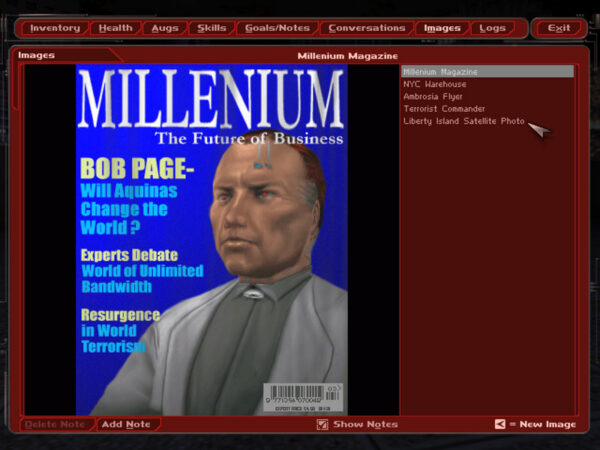
Page, who was quite a piece of work even by Illuminati standards, tried to consolidate his power by unleashing a massive pandemic to kill off billions of people and destabilize the world’s governments. (Have I mentioned that this game really can feel unnervingly prophetic?) Then he deployed an artificial intelligence by the name of Icarus to invade and subsume the entire Internet. (Have I mentioned… oh, yes, I have, haven’t I?) While he was about all of this, Page genetically engineered himself and a small team of agents into supermen. Among these agents was one J.C. Denton, the player’s avatar in the game proper.
There’s much, much more to it, including a second rogue AI that sets about fighting the first one on the highways and byways of the Internet, but that will have to do for our purposes. The game itself kicks off in 2052 on Liberty Island in New York Harbor, where a gang of “terrorists” — freedom fighters by other people’s definition — are threatening to blow up the statue that gives the island its name. J.C. Denton is called in to stop them. He does so, but while he’s about it he’s given cause to wonder whether he’s been told the whole truth about the organization he works for, which he had heretofore believed to be completely benevolent. The plot takes many twists and turns thereafter, with J.C. Denton bouncing from team to team — including not only the two feuding dominant secret cabals, but others who oppose them both.
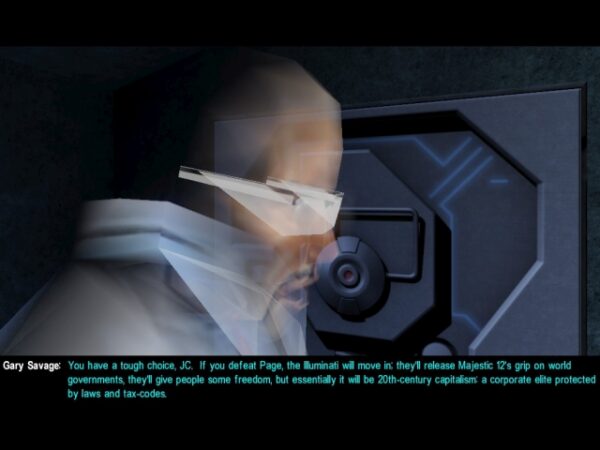
As I wrote earlier, it all comes to an end at Area 51, where J.C. Denton is confronted with a choice of three solutions to the chaos. One is to blow up the Internet and all other global communications systems and throw humanity into a new “Dark Ages” for at least the next few hundred years, in the hope that his descendants will make less of a mess of things when they get around to reinventing the technology that he is about to destroy; one is to join with the original Illuminati who have been fighting Bob Page all along and help to rule the world as one of them; and one is to join with the AI to form a true superintelligence combining the best parts of humans and computers, and rule the world alone that way. Warren Spector has often said that he wanted the choices the player makes in Deus Ex to say less about J.C. Denton than they did about the person behind the monitor; this choice of endings is surely the ultimate expression of that impulse. (For the record, I’d have to go for the Dark Ages as the least bad choice in this situation. There’s even a part of me — possibly the most morbid one, granted — that thinks this might not be such a bad thing. Maybe we could use a few centuries to rediscover our humanity: to learn to breathe real air, eat real food, do real work, and talk to one another face to face again.)
So, it’s not as if the story of Deus Ex gives no food for thought. Yet it’s better understood as an exercise in pastiche than philosophy, much less prophecy. The relationship of past, present, and future is actually a quantum one: the act of predicting or warning us about the future can itself produce the very outcomes it depicts. Novelist Thomas M. Disch cottoned onto this inverse relationship in the pages of his Hugo-winning nonfiction book The Dreams Our Stuff is Made Of already a couple of years before Deus Ex was released, in chapters with titles like “The Future as a Lifestyle,” “Science Fiction as Religion,” and “Republicans on Mars.” Not long afterward, the ubiquitous “flip phones” of the aughts, modeled on the communicators found in the original Star Trek television series of the 1960s, provided an indubitable example to everyone of what can happen when engineers who have been raised on vintage science fiction are placed in charge of product design.
More recently, manifestations of the same phenomenon have begun to feel more and more sinister. We live in a world today in which Mark Zuckerberg — admittedly, not one of the brighter bulbs in the Silicon Valley firmament — renamed one of the largest and most profitable companies on the planet after the virtual-reality network found in Neal Stephenson’s Snow Crash, having apparently failed to understand that the novel in question was intended as satire. We live in a world in which Sam Altman and Dario Amodei are constantly arguing over which one’s statistical pattern-matching and probabilistic text-generating machine will spontaneously wake up to consciousness and enslave us all first, all because the novelist Vernor Vinge has told us this is inevitable. We live in a world in which seeing is no longer believing, because any photograph or even video clip we see may be AI-generated. In short, we are all struggling to discern reality through an ever thicker fog of what Jean Baudrillard dubbed “hyperreality” back in the 1980s. Large-language models have become the perfect symbols of the age, what with their congenital inability to separate fact from fiction. Small wonder that some people have convinced themselves that life itself is probably just a giant videogame.
The conspiratorial view of history fits so neatly into this milieu because it actively encourages us to substitute what might be true — or what we would like to be true — for what we can know to be true. Once upon a time, it was easy to see it as just good fun. Certainly most of the makers of Deus Ex never thought they were making a grand statement about the way the world really was or would become as they piled trope upon trope to create their grand conspiratorial edifice, any more than did the makers of The X-Files, the television show from which they drew so much inspiration. But, as literary theorists have long told us, you are still saying something about our world even when you insist that you’re saying nothing at all.
Betwixt and between the quotations that have come to seem so prescient, Deus Ex also bangs away on tired old anarcho-libertarian drums about the evils of the United Nations and the so-called “deep state.” These quotations have aged rather less well than the ones I included above, coming across more like prescriptions for than descriptions of our current problems, revealing Deus Ex to be a game that is as much of its time as timeless. One can all too easily imagine these sentences coming straight from the mouth of Alex Jones, back in the days when he could still be dismissed as just another reactionary nutcase crackling through the ether on the further reaches of the AM-radio dial.
The whole project of world government — going back to the League of Nations — has been funded and manipulated, mainly by wealthy bankers. Remember that the U.N. itself was built on land donated by John D. Rockefeller. The U.N. was founded, not to end war, but to gradually replace national governments with a globalist meritocracy.
The entire executive branch is hand-picked. Nineteen of the last 23 U.S. presidents have been members of the Trilateral Commission. The Trilateral Commission is financed by the Rockefellers and the Rothschilds.
I find the way that Deus Ex turns honest attempts to improve our world — for instance, on the part of the founders of the United Nations and at least some American presidents — into yet more nefarious conspiracies to be as personally aggravating as it is unhelpful to our modern political discourse. Lurking in the accusations against “wealthy bankers” is the oldest, ugliest conspiratorial trope of all, the idea — stemming from the 1903 forgery “The Protocol of the Elders of Zion” — that a cabal of Jews secretly run the world. “Famous conspiracy theories always turn out to be just antisemitism,” this website’s regular commenter Ross theorized after reading a piece I wrote about the thoroughly unpleasant Pierre Plantard, the man behind some of the most outlandish tales surrounding the French village of Rennes-le-Château. The more conspiracy theories I examine in depth, the more true this proposition seems.
The writers of Deus Ex might respond, reasonably enough on the surface, that all of the most controversial statements come from its various feuding characters; it would be as unfair as it would be schizophrenic to claim that the writers are in agreement with every word these characters say. In case I haven’t made myself clear, know that I don’t accuse anyone who worked on this game of being personally antisemitic. The thing is, though, that even explicitly fictional conspiracy theories — heck, even explicitly satirical ones — have a way of overflowing the vessels that are meant to contain them. Take, for instance, all of this business about the Illuminati, a staple of decades of conspiracy culture that naturally made its way into Deus Ex. The original wellspring of it all, in a modern context at least, is the Illuminatus! trilogy of novels, published in 1975 by Robert Shea and Robert Anton Wilson. They are convoluted, endlessly discursive, and filled with unexpected and eye-opening connections… and also a giant joke in the same style as Umberto Eco’s later novel Foucault’s Pendulum, being an intellectual shell game and a parody of the fever dreams of the hippie generation. And yet there were people who decided it was all real, worked it into their worldview, and refused to be dissuaded from belief even by the very authors who had made it all up.
It seems to me that there are two principal dangers here. One is the way that, as our friend Ross so cogently noted, all or almost all conspiracy theories tend to wind up in dark places by the time they reach maturity, no matter how harmless they start out. The other one is still more insidious: by teaching us to look for all of the world’s ills in secret cabals of consciously evil people, conspiracy theories mislead us as to how history fundamentally works, thereby leading us to seek simple solutions to complicated problems. Way too often, the result is demagoguery. Again, we can see this all around us today; I trust that I don’t need to belabor the point further.
Suffice to say then that the story of Deus Ex does make me a little uncomfortable, for all of the reasons I’ve just listed. Even if we acknowledge that it puts its fingers on many of the ailments besetting us today with improbable accuracy, the reasons it posits for those ailments, and thus the ways of combating them that it might lead us to adopt, are deeply misguided.
But that’s just me, viewing it with the benefit of a quarter-century of hindsight. Setting aside sociopolitical concerns, I still wouldn’t call Deus Ex’s story a great one; the best drama does not arise from merely piling backstory complication upon complication, as television shows like The X-Files and Lost proved when their unwieldy conspiratorial edifices finally collapsed into weary incoherence. Thankfully, though, a videogame seldom needs a great story in the way that so much linear media does; in some cases, it may even be an unnecessary distraction. The story of Deus Ex is effective enough within the frame of this particular videogame, lending it a memorable atmosphere and gravitas while only modestly compromising its bona fides as an immersive sim. I just wish we could all agree not to force it to punch above its weight by assigning it a profundity it hasn’t earned and doesn’t even really aspire to. This fiction is pulp, not prophecy.
Having chewed my way through all of the above, I’m left with just one more question on my docket: what do I think of Deus Ex? You know, just as a computer game?
I must admit that I approach this question with some trepidation. I know that some of you think highly of it indeed; more than one of you have told me that it’s your favorite game of all time. Many years ago now, during one of those occasional discussions we have around here about where these histories of mine ought to end, one or two of you suggested that Deus Ex might be a good place, an argument predicated on the assertion that it brings together all of the strands of narrative and interactivity that I’ve spent so many years running down and wraps them up in a neat little bow. (For the record: I don’t actually plan on stopping. I can already hear the sighs of relief raining down on me from the galleries, along with perchance a few disgruntled grumbles from the Statler and Waldorf types.)
Personally, I wouldn’t go so far in praising Deus Ex. However, let me state very clearly that Deus Ex is a landmark game that is in most ways brilliantly conceived and executed. There is good reason that it struck many folks as a revelation upon its release all those years ago, what with its rich breadth of player possibility and its compelling atmosphere of tension and betrayal. This was the immersive sim’s breakthrough moment, the one that Looking Glass, the inventor of the approach, ironically never got to enjoy. Deus Ex sold over 1 million copies, spawned a series of equally commercially successful if never quite as critically lauded sequels, and influenced the design conversation in games for two and a half decades. Deus Ex knows exactly what it wants to be, and realizes most of its ambitious goals smoothly while avoiding a Kenyan motorway worth of potential potholes.
So, when I tell you that it left me somewhat less thrilled than it did many of you, know that it wasn’t really the game but the player who was at fault. My central stumbling block with a game like this is that it asks a little bit more from me than I’m prepared to give it at this point in my life. My sweet spot of an evening these days is sitting on the sofa next to my wife, bantering about the game I — usually “I,” but sometimes “we” — play on the television screen. This is not the way that Deus Ex wants to be played; it wants me to put on headphones and burrow my way deep down into its hermetic virtual world, where I can start at every shadow and react to every passing footfall. The experience it wants to give me just isn’t the one I’m looking for these days. (In light of that reality, I do wonder how I would respond today to System Shock, a game I still want to rate above this one…)
It’s awful to say, I know, but when I play Deus Ex I can’t escape a certain sense of ennui, not only with all of the tactical energy it demands of me, but with its all too typically “gamerdark” aesthetics and laundry list of influences that I’ve become just a bit too familiar with by this point. On the whole, I prefer some more light to accompany my shade. I’m afraid my favorite Warren Spector joint remains The Worlds of Ultima: Martian Dreams, that delightfully quirky and totally original journey to Edwardian Mars.
But that’s just, like, my opinion, man. You should absolutely try Deus Ex for yourself to form your own. At best, you might discover your new favorite game. And even if you’re a sourpuss like me, you’ll walk away with a better understanding of why it holds that status for so many other people.
Did you enjoy this article? If so, please think about pitching in to help me make many more like it. You can pledge any amount you like.

Sources: The book Deus Ex: Prima’s Official Guide by Chris McCubbin; Computer Gaming World of March 2000 and October 2000; PC Powerplay of September 2000.
Online sources include Warren Spector’s postmortem at the 2017 Game Developers Conference and “How Deus Ex Predicted the Future” by Richard Wordsworth for Kotaku.
Where to Get It: Deus Ex: Game of the Year Edition is available as a digital purchase at GOG.com.