
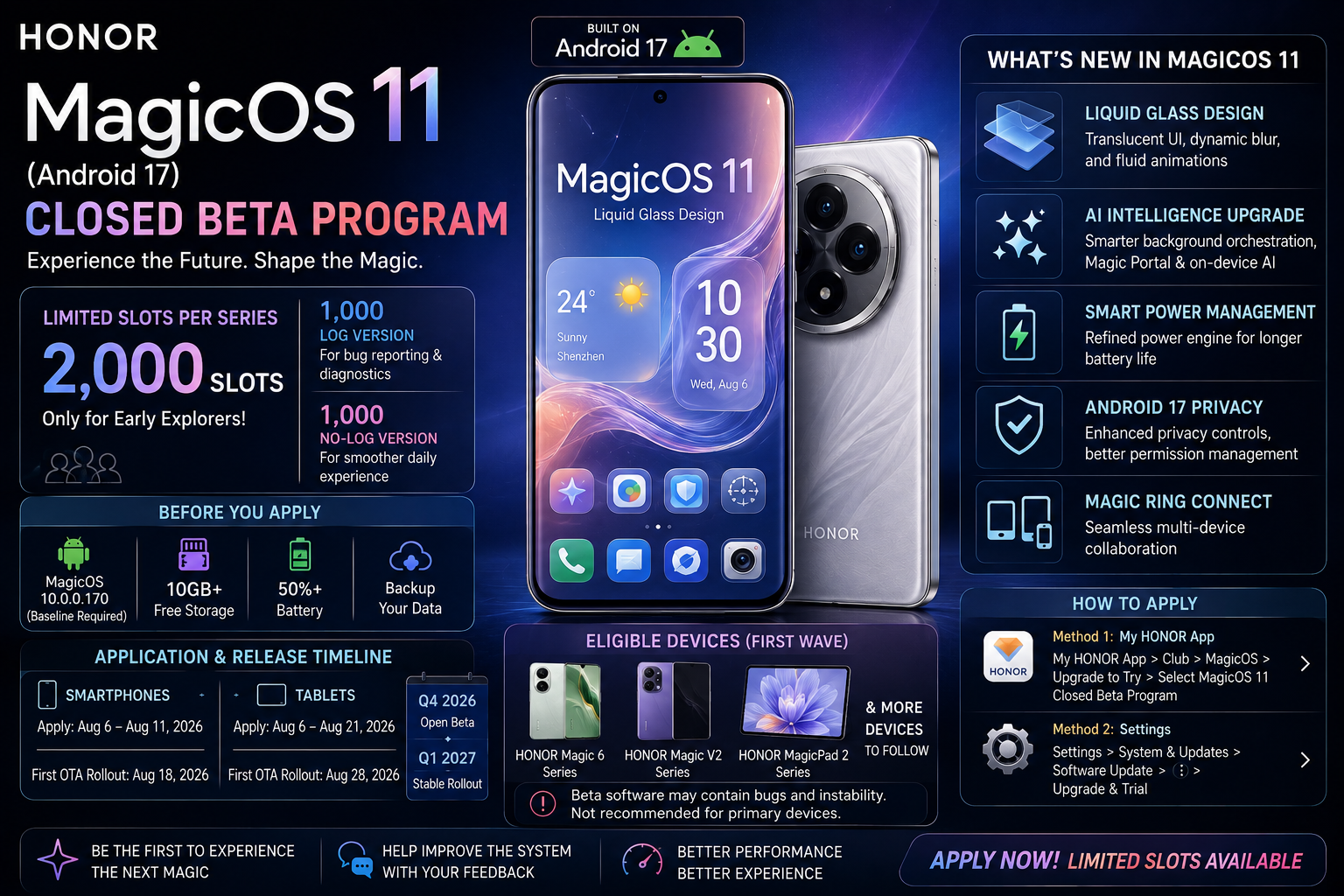
Honor MagicOS 11 Closed Beta Opens: Android 17 Update, Eligible Devices, Features & How to Apply
Honor MagicOS 11 (Android 17) Closed Beta Program: Everything You Need to Know
Summary Box
- Event: Honor officially opens the closed beta recruitment for MagicOS 11, built on the Android 17 operating system.
- Recruitment Quota: Limited to 2,000 slots per smartphone series (split equally into 1,000 “Log” and 1,000 “No-Log” test builds).
- Key Dates: Smartphone applications run from August 6 to August 11, 2026 (release on August 18). Tablet applications run through August 21, 2026 (release on August 28).
- Key Upgrade Highlights: Introduction of the translucent “Liquid Glass” visual interface, refined power management, AI background orchestration, and improved multi-device interconnectivity.
- Prerequisite: Devices must be running stable baseline firmware MagicOS 10.0.0.170 with at least 10 GB of free internal storage.
Key Takeaways
- Early Access Phase: Following the MagicOS 11 Pioneer Event, Honor is giving power users and developers an early look at its next-generation custom skin.
- Two Beta Streams: Applicants can select between a Log Version (designed for active bug reporting with intensive diagnostic background logging) and a No-Log Version (focusing on smoother daily usage).
- System Design Refresh: MagicOS 11 introduces a brand-new “Liquid Glass” design language featuring translucent layers, dynamic depth blurring, and fluid animations inspired by glass optics.
- Pre-Installation Requirements: Users must ensure high residual storage space (10 GB minimum) and execute a complete data backup due to potential early-stage system instability.
Table of Contents
- Introduction
- What Happened: The Official Announcement
- Why It Matters: Honor’s Strategic Direction
- Technical Specifications & Baseline Requirements
- Key Features Explained: What MagicOS 11 Brings
- Performance Analysis: Log vs. No-Log Builds
- Camera & Imaging Stack Adaptations
- Battery Efficiency & Thermal Dynamics
- Software Architecture & Android 17 Integration
- Price & Licensing
- Availability, Deadlines & Rollout Timeline
- Comparison Table: MagicOS 10 vs. MagicOS 11 vs. Android 17 Developer Preview
- Pros & Cons of Joining the Closed Beta
- Step-by-Step Guide: How to Apply for MagicOS 11 Beta
- Expert Analysis: Market Impact & Ecosystem Readiness
- Future Expectations & Stable Rollout Roadmap
- Final Verdict
- Frequently Asked Questions (FAQ)
- People Also Ask (PAA)
- Conclusion
Introduction
Software update cycles dictate the pace of smartphone innovation, and Honor is stepping up its pace with the launch of its MagicOS 11 Closed Beta Program, built on the Android 17 base code. Following initial teasers during the official MagicOS 11 Pioneer Event, Honor has opened registration channels for selected flagship smartphone and tablet models.
For tech enthusiasts and developer communities, this beta program offers a hands-on preview of Honor’s upcoming user experience overhaul. The release features a new “Liquid Glass” design aesthetic alongside background refinements focused on power efficiency, system fluidity, and cross-device synergy.
However, early software testing comes with distinct trade-offs. Early beta builds can present unexpected bugs, rapid battery drain, or application incompatibility. This guide provides a detailed overview of the MagicOS 11 testing initiative, including eligibility requirements, technical prerequisites, feature updates, and installation steps.
What Happened: The Official Announcement
On August 6, 2026, Honor officially launched the recruitment phase for its MagicOS 11 Closed Beta Program in its primary market ahead of a wider global developer push. This development follows weeks of community speculation following early leaks of Honor’s new translucent user interface.
Honor confirmed that the recruitment drive is structured tightly around specific volume limits:
- Capacity per Model Series: Exactly 2,000 user slots are allocated per eligible smartphone or tablet product lineup.
- Build Division: Out of the 2,000 seats, 1,000 seats are reserved for the Log Version (which collects system diagnostic data to assist engineers in tracking software faults), while the remaining 1,000 seats are designated for the No-Log Version (which suppresses extensive background logging for slightly better day-to-day performance).
- Application Deadlines:
- Smartphones: Recruitment closes on August 11, 2026. Beta firmware updates will begin rolling out Over-The-Air (OTA) to selected participants on August 18, 2026.
- Tablets: Recruitment extends through August 21, 2026. OTA deployment for tablet testers is scheduled for August 28, 2026.
To review official developer documentation and registration guidelines, visit the official HONOR Developer Portal.
Why It Matters: Honor’s Strategic Direction
Since operating as an independent brand, Honor has focused on differentiating its software stack from standard Android implementations and Huawei’s HarmonyOS roots. MagicOS 11 represents a significant milestone in this software evolution strategy:
- Alignment with Android 17 Schedule: Opening a closed beta program in early August allows Honor to synchronize its testing cycle with Google’s platform stability timeline outlined on the official Android Developers Portal.
- Visual Differentiation: The introduction of the “Liquid Glass” visual framework highlights a distinct aesthetic direction, adopting light refraction, subtle depth, and dynamic blur effects across multi-window interfaces.
- On-Device AI Optimization: MagicOS 11 builds upon MagicOS 10’s intent-based Magic Portal features, deepening the integration of context-aware AI tools directly at the kernel and framework levels.
- Energy Efficiency Refinements: Engineering focus has been placed on balancing background tasks, aiming to mitigate the higher battery consumption historically associated with feature-heavy custom skins.
Technical Specifications & Baseline Requirements
Before submitting an application for the MagicOS 11 Closed Beta, devices must meet specific hardware and software prerequisites. Attempting to install the update on an incompatible build or with insufficient local memory can result in installation errors or device instability.
Minimum System Prerequisites
- Base Operating System: Android 17 Core Framework
- Prerequisite Firmware: MagicOS 10.0.0.170 (Mandatory baseline)
- Free Storage Required: Minimum 10 GB local storage available
- Battery Level for Installation: Minimum 50% charge recommended during OTA setup
- Network Requirement: Stable High-Speed Wi-Fi connection
- Account Requirement: Authenticated My Honor / Honor ID Account
- Device Status: Non-rooted, official stock factory software
Key Features Explained: What MagicOS 11 Brings
While the complete changelog will evolve through subsequent beta revisions, early documentation and official updates from the Pioneer Event highlight several core additions in MagicOS 11.
1. Liquid Glass Visual Interface
The highlight of MagicOS 11 is the Liquid Glass UI. Moving away from flat, material-heavy design paradigms, this new design utilizes real-time light simulation, frosted glass textures, and dynamic blur gradients. Notification panels, volume sliders, and control center toggles float over background apps with realistic visual depth, responding organically to screen interactions.
2. Intelligent Power Consumption Engine
Honor engineers designed MagicOS 11 to address power usage concerns actively. By refactoring hardware resource allocation routines, the software reduces power consumption during passive screen time and video streaming. The operating system monitors display refresh rates and processor clock speeds, lowering power draw without sacrificing scroll smoothness.
3. Deep-Level Android 17 Privacy Controls
Inheriting security updates from the Android 17 codebase, MagicOS 11 includes updated privacy controls. Users gain precise control over photo library access permissions, background location polling, and individual app audio capture, accompanied by clear visual indicators in the status bar whenever sensitive sensors are active.
Performance Analysis: Log vs. No-Log Builds
A key detail of Honor’s beta recruitment program is the division into two distinct testing categories. Understanding the differences between these versions is essential before enrolling.
Log Version (Diagnostic Stream)
- Target Audience: Built for developers and active community testers who intend to log software bugs, system crashes, and memory leaks.
- Operation Mode: Runs background diagnostic services continuously. When an app crashes or stutters, detailed trace logs are captured and compressed.
- Performance Impact: May experience slight micro-stutters, higher CPU load, and increased local storage consumption due to active logging files.
No-Log Version (General User Stream)
- Target Audience: Tailored for daily-driver usage where system stability is preferred over active debugging.
- Operation Mode: Diagnostic logging services remain disabled under standard operational parameters.
- Performance Impact: Delivers performance closer to final production software, with reduced background CPU overhead and longer operational endurance between charges.
Camera & Imaging Stack Adaptations
Custom OS upgrades frequently impact camera processing pipelines. In MagicOS 11, Honor has adapted its imaging algorithms to leverage Android 17’s upgraded camera APIs:
- Zero-Shutter Lag Refinements: Improved buffer management reduces shutter delay when capturing fast-moving subjects under challenging indoor lighting.
- Enhanced Ultra RAW Processing: The native camera software processes multi-frame RAW data more efficiently, preventing frame drop artifacts during continuous shooting.
- Third-Party Video Pass-Through: Video streaming apps benefit from optimized hardware-accelerated video pipeline access, maintaining stabilization algorithms within social media application viewports.
Note: Early beta releases may exhibit temporary camera processing anomalies, such as elevated noise in low-light preview modes or slower HDR processing times.
Battery Efficiency & Thermal Dynamics
Thermal dynamics and battery performance during early beta cycles are key considerations for prospective testers.
- Initial Post-Update Indexing: During the first 24 to 48 hours following a major OS update, systems perform background file re-indexing, app optimization, and database migrations. This process can cause elevated battery draw and mild device warmth.
- Long-Term Efficiency Goals: Once initial background tasks settle, Honor’s updated scheduler aims to extend screen-on time compared to MagicOS 10 by idling unused background CPU cores faster.
- Beta Usage Caution: Testers should avoid installing early builds on primary devices if uninterrupted, multi-day battery endurance is strictly required.
Software Architecture & Android 17 Integration
MagicOS 11 sits atop the Android 17 core, combining underlying platform updates with Honor’s proprietary service layers:
- UX Layer: Liquid Glass UI, dynamic animations, and intent-based Magic Portal tools.
- Service Layer: Honor Connect, Magic Ring cross-device continuity, and multi-screen collaboration.
- Core OS Framework: Android 17 system extensions, security sandboxing, and updated permission models.
- Kernel Layer: Linux kernel integration with custom Honor CPU resource scheduling routines.
- ART Runtime Improvements: Updated ahead-of-time (AOT) compilation speeds up app cold-start launch times across installed applications.
- Predictive Back Gesture: Integrated deeply across native Honor menus, providing visual previews of previous screens during back-swipe gestures.
Price & Licensing
The MagicOS 11 Closed Beta Program is provided completely free of charge to owners of eligible Honor hardware.
- No Registration Fees: Honor never requests payment, subscription fees, or premium memberships to participate in official software testing.
- Beware of Phishing: Users should avoid unofficial third-party websites or messaging channels claiming to sell early access download packages or APK files. All official registrations must occur directly through the My Honor app or native system settings.
Availability, Deadlines & Rollout Timeline
Enrollment schedules depend on the specific hardware category:
- August 6, 2026: Closed Beta Recruitment officially opens.
- August 11, 2026: Smartphone application window closes.
- August 18, 2026: First OTA batch deploys to approved smartphones.
- August 21, 2026: Tablet application window closes.
- August 28, 2026: First OTA batch deploys to approved tablets.
- Q4 2026: Public open beta expansion across broader series.
- Q1 2027: Global stable commercial rollout begins.
To cross-check official industry coverage and rollout schedules, read the full report on GSMArena.
Comparison Table: MagicOS 10 vs. MagicOS 11 vs. Android 17 Developer Preview
| Feature / Dimension | MagicOS 10 (Current Stable) | MagicOS 11 (Closed Beta) | Stock Android 17 Preview |
| Base Operating System | Android 16 / Android 15 | Android 17 | Android 17 Base |
| Design Language | Flat Design / Magic UI | Liquid Glass Translucent | Material You Expressive |
| User Beta Streams | Public Release | Log & No-Log Options | Developer Preview |
| Target Audience | General Consumers | Early Adopters & Techs | App Developers |
| System Stability | High (Production Ready) | Variable (Testing Phase) | Variable |
| Cross-Device Tech | Magic Ring v2.0 | Magic Ring v3.0 | Nearby Share / Cross-Device |
| Storage Requirement | Standard | 10 GB Free Storage Required | Variable |
Pros & Cons of Joining the Closed Beta
Pros
- Early Feature Access: Experience the new Liquid Glass visual interface months ahead of the general public release.
- Direct Feedback Channel: Report bugs directly to Honor software engineers to help shape final production builds.
- Performance Testing: Evaluate Android 17 app compatibility early if you are a mobile developer.
Cons
- System Instability: Risk of encountering random app crashes, system UI reboots, or frozen screens.
- Battery Drain: Early software builds can exhibit unoptimized background power draw.
- Potential App Conflicts: Banking apps, digital wallet passes, or security-sensitive applications may fail integrity checks on beta software.
Step-by-Step Guide: How to Apply for MagicOS 11 Beta
Applying for the MagicOS 11 Closed Beta program can be completed through two primary onboard paths on eligible devices.
Method A: Registration via the My Honor App
- Open the My Honor app on your eligible smartphone or tablet.
- Ensure you are signed in with your verified Honor ID.
- Navigate to the Club community section located on the bottom navigation bar.
- Select the MagicOS dedicated tab.
- Tap on the Upgrade to Try banner.
- Select the MagicOS 11 Closed Beta Program project, select your preferred version (Log or No-Log), and complete the questionnaire.
Method B: Direct Registration via System Settings
- Open your device’s Settings app.
- Scroll down and select System & Updates.
- Tap on Software Update.
- Tap the three-dot menu icon in the upper-right corner.
- Select Upgrade and Trial (or Trial Version).
- Fill in your contact details accurately and submit your application for verification.
Expert Analysis: Market Impact & Ecosystem Readiness
Honor’s swift progression toward an Android 17 closed beta reflects broader shifts within the mobile technology landscape:
- Aesthetic Evolution: Translucent UI designs are gaining traction industry-wide as hardware displays become brighter and sharper.
- Engineering Precision: Decoupling system logs into separate test streams reduces noise for engineering teams while providing cleaner builds for daily-driver testers.
- Competitive Alignment: Early beta launches keep Honor competitive alongside Samsung’s One UI and Xiaomi’s HyperOS rollout schedules.
Future Expectations & Stable Rollout Roadmap
Following the conclusion of the initial closed beta phase:
- Review & Selection Phase (Mid-August 2026): Honor’s software team will review submitted applications, selecting candidates based on model compatibility and active community participation.
- Initial OTA Deployment (Late August 2026): Approved smartphone applicants will receive the first beta package starting August 18, followed by tablet users on August 28.
- Public Open Beta Phase (Autumn 2026): As major bugs are resolved, Honor is expected to expand testing into a broader public beta, incorporating upper mid-range models like the Honor Digital Series (e.g., Honor 200 / Honor 300 lineups).
- Official Commercial Rollout (Q1 2027): Global stable updates will roll out progressively by region, beginning with top-tier flagship devices before reaching broader model lines.
Final Verdict
The Honor MagicOS 11 (Android 17) Closed Beta Program is an exciting opportunity for power users to preview Honor’s next-generation software design and feature set. The introduction of the Liquid Glass interface, paired with Android 17’s updated foundation and refined power management, signals a solid step forward for the platform.
However, because early closed beta builds carry risks of software bugs, temporary battery drain, and application instability, daily-driver users should proceed with caution. If you decide to apply, ensure your device is running baseline firmware MagicOS 10.0.0.170, clear at least 10 GB of storage space, and perform a complete local data backup prior to installation.
Frequently Asked Questions (FAQ)
Q1: Is the MagicOS 11 Closed Beta available globally?
The initial recruitment phase launched on August 6 is primarily focused on regional registered test channels. However, developer registration streams are accessible internationally via the HONOR Developer Portal.
Q2: What baseline software version does my phone need before applying?
Your device must be updated to official stable baseline build MagicOS 10.0.0.170. Applications submitted from older firmware versions will be declined by the automated review system.
Q3: How much free storage space is required for the update?
You must maintain at least 10 GB of free internal storage to accommodate the beta download package, extraction files, and temporary installation caches.
Q4: What is the main difference between the Log and No-Log versions?
The Log Version records continuous background diagnostic logs for developer bug tracing, which can slightly affect device performance. The No-Log Version disables telemetry services, offering smoother daily operation for regular users.
Q5: Will installing the MagicOS 11 Beta wipe my personal data?
While standard OTA beta updates preserve personal files, installing pre-release software always carries a risk of installation failures. Creating a complete local backup prior to upgrading is strongly recommended.
Q6: Can I roll back to stable MagicOS 10 if I encounter critical bugs?
Yes, Honor provides official rollback procedures via desktop recovery tools. However, rolling back to a previous major OS version will erase all local user data.
Q7: Why are banking and financial apps failing on the beta software?
Pre-release beta firmware builds often do not pass Google SafetyNet or Play Integrity certification checks, which can temporarily prevent banking apps and secure mobile wallets from running.
Q8: When do registrations close for smartphones and tablets?
Smartphone applications close on August 11, 2026. Tablet registrations remain open longer, closing on August 21, 2026.
Q9: When will approved users receive the beta software update?
Approved smartphone testers will receive the initial OTA push on August 18, 2026. Approved tablet candidates will receive their updates starting August 28, 2026.
Q10: How many total testing slots are available per device series?
Honor has capped recruitment at 2,000 users per model series, split into 1,000 seats for the Log build and 1,000 seats for the No-Log build.
People Also Ask (PAA)
- How do I join the Honor Android 17 Beta test?You can join by opening the My Honor app, visiting the Club section, selecting Upgrade to Try under the MagicOS tab, and submitting your enrollment form before the posted application deadline.
- Will the Honor Magic 6 and Magic 7 series receive MagicOS 11?Yes, top-tier flagship lines—including the Magic series foldables and slab flagships—are among the primary devices included in the MagicOS 11 testing rollout.
- Is MagicOS 11 based entirely on Android 17?Yes, MagicOS 11 uses the Android 17 core framework as its underlying foundation, integrating Google’s latest platform updates alongside Honor’s custom visual elements and AI services.
- What should I do if my MagicOS 11 Beta application is rejected?If your application is declined, it usually means the quota for your model was filled or your baseline firmware did not match requirements. You can re-apply during subsequent public open beta phases.
Conclusion
The launch of the Honor MagicOS 11 (Android 17) Closed Beta Program opens the door to Honor’s next software chapter. Combining the new Liquid Glass UI, deeper AI routing, and Android 17 privacy controls, this update offers a promising look at what’s ahead for the ecosystem.
For technical enthusiasts equipped with a compatible device running baseline firmware MagicOS 10.0.0.170, the enrollment window provides a unique chance to experience these updates early and contribute to final platform polishing. Submit your application through the My Honor app before the August 11 deadline for smartphones or August 21 for tablets to secure your testing spot.
Verified Authoritative External Sources
- Official Honor Developer Hub: HONOR Developer Portal — Android 17 Beta Guide
- Google Android Developer Documentation: Android Developers — Android 17 Preview & Partner Program
- GSMArena Announcement Coverage: GSMArena — Honor Pioneer Event & MagicOS 11 Debut