
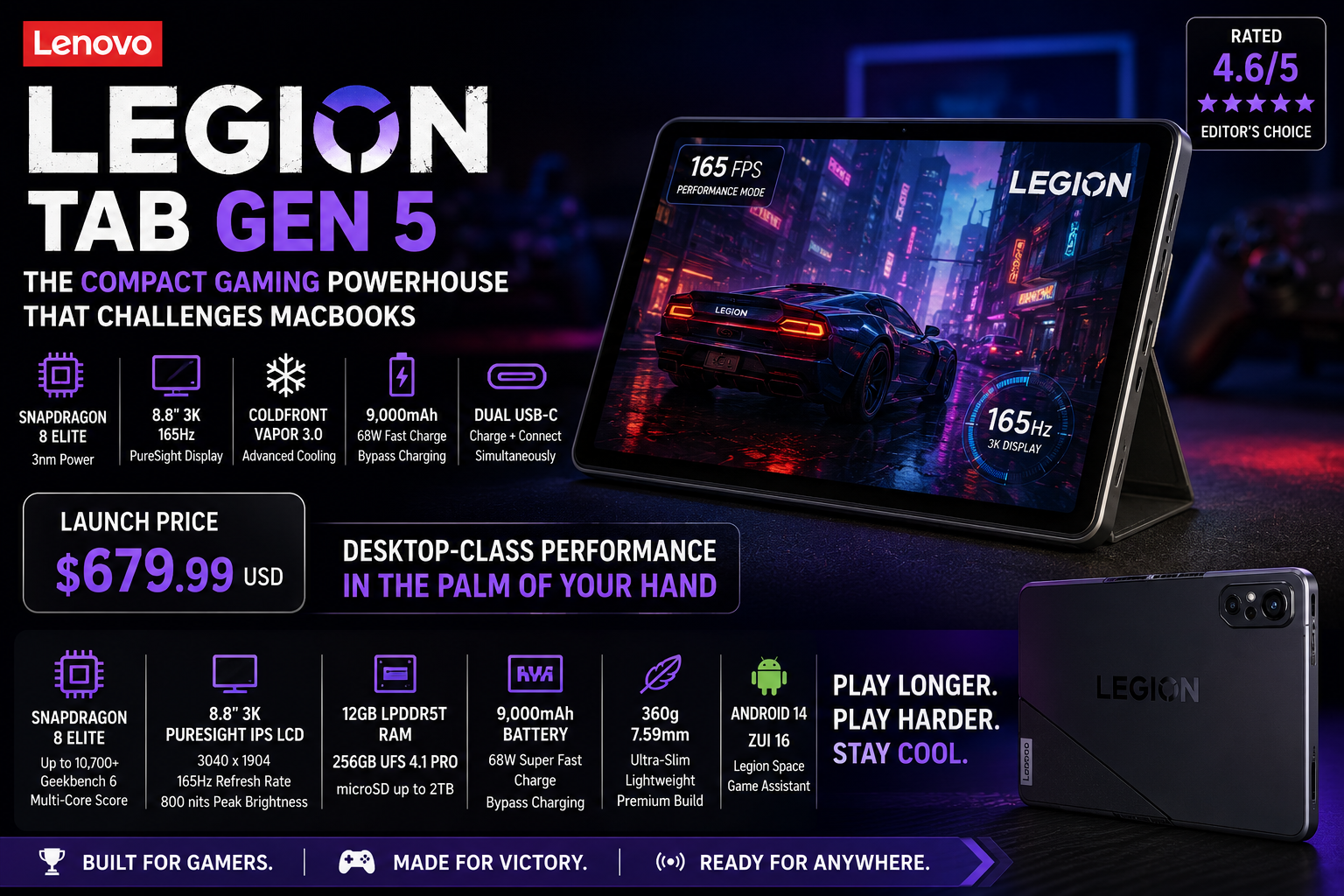
Lenovo Legion Tab Gen 5 Review: The Compact Gaming Powerhouse That Challenges MacBooks
Summary Box
| Product Attribute | Details & Ratings |
| Product Name | Lenovo Legion Tab Gen 5 (8.8″ Snapdragon) |
| Category | Handheld Android Gaming Tablet |
| Launch Price | $679.99 (US Launch MSRP) |
| Processor | Qualcomm Snapdragon 8 Elite Mobile Platform (3nm) |
| Display Panel | 8.8-inch 3K PureSight IPS LCD (3040 x 1904), 165Hz Refresh, 800 nits Peak |
| Memory & Storage | 12GB LPDDR5T RAM | 256GB UFS 4.1 Pro (MicroSD Expansion up to 2TB) |
| Battery & Charging | 9,000 mAh Battery | 68W Quick Charge & Bypass Charging |
| Weight & Thickness | 360 grams | 7.59 mm ultra-slim profile |
| Overall Rating | 4.6 / 5 Stars |
| Editor Verdict | The premier 8.8-inch Android tablet for mobile gamers, emulation enthusiasts, and streamers who demand sustained laptop-class performance in a portable chassis. |
Key Takeaways
- Top-Tier Processing Power: Powered by Qualcomm’s flagship Snapdragon 8 Elite platform, achieving multi-core Geekbench 6 scores exceeding 10,700—putting its raw processing capacity on par with modern thin-and-light laptop chips.
- Gaming-Centric Display: Features an 8.8-inch 3K (3040 x 1904) PureSight LCD panel with a 165Hz variable refresh rate, 480Hz touch sampling rate, and up to 800 nits high brightness.
- Dual USB-C Port Advantage: Maintains two independent USB-C ports (one USB 3.2 Gen 2 with 10Gbps DisplayPort video out and audio, one USB 2.0 for secondary charging), enabling simultaneous charging and peripheral connection.
- Thermal Endurance: Integrates Lenovo’s ColdFront: Vapor 3.0 cooling system alongside battery bypass charging, preventing thermal throttling during extended AAA gaming and emulation sessions.
- Price Adjustment: Retails at $679.99, marking a price increase over the previous Gen 3 model due to broader semiconductor memory market conditions, yet remains competitive against high-end alternatives like the Apple iPad Air.
Table of Contents
- Introduction
- What Happened: Launch & Ecosystem Context
- Why It Matters: The Compact Tablet Revival
- Hardware Specifications Overview
- Key Features Explained
- Performance & Benchmark Analysis
- Camera System
- Battery Life, Charging & Thermals
- Software & Gaming Ecosystem
- Price & Global Availability
- Comparative Analysis: Legion Tab Gen 5 vs Competitors
- Pros & Cons
- Expert Analysis & Practical Buying Advice
- Future Industry Expectations
- Final Verdict
- Frequently Asked Questions (FAQ)
- People Also Ask
- Conclusion
Introduction
Finding a compact tablet optimized for gaming without sacrificing core hardware specifications has historically been a challenge. While mainstream manufacturers have focused heavily on 11-inch and 13-inch media slates, small-form-factor devices often received mid-tier processors or limited thermal management.
Lenovo continues to target this specific niche with the Lenovo Legion Tab Gen 5. Designed specifically for high-frame-rate mobile gaming, emulation, and live streaming, this 8.8-inch Android slate brings desktop-tier architecture down to a device small enough to hold comfortably with two hands.
With Qualcomm’s flagship processor under the hood, an updated vapor chamber cooling design, and a high-resolution 165Hz PureSight panel, the Legion Tab Gen 5 delivers strong performance credentials. In this comprehensive review, we examine whether its hardware enhancements justify the higher price tag and how it holds up for everyday entertainment and gaming workloads.
What Happened: Launch & Ecosystem Context
Lenovo officially introduced the Legion Tab Gen 5 at global industry showcases, updating its 8.8-inch gaming lineup to keep pace with current silicon architectures. Following initial press announcements detailed on the Lenovo Official Newsroom, the tablet entered global markets across North America, Europe, and Asia.
In hands-on testing by outlets including Samantha Mangino’s Tech Review on Mashable and technical teardowns from Notebookcheck’s Hardware Review, the Legion Tab Gen 5 demonstrated substantial generational gains in processing efficiency, sustained frame rates, and battery longevity compared to its predecessors.
Lenovo Legion Tab Generational Roadmap
- Gen 1 (Legion Y700): Qualcomm Snapdragon 870 platform, 120Hz display, 6,550 mAh battery.
- Gen 3 (Legion Tab Gen 3): Qualcomm Snapdragon 8 Gen 3 platform, 144Hz display, 6,550 mAh battery.
- Gen 5 (Legion Tab Gen 5): Qualcomm Snapdragon 8 Elite platform, 165Hz 3K display, 9,000 mAh battery.
By skipping the “Gen 4” moniker in several Western markets to align its naming convention with its flagship laptop series, Lenovo has positioned the Gen 5 slate as a premier handheld companion alongside the Lenovo Legion gaming PC ecosystem.
Why It Matters: The Compact Tablet Revival
For years, the compact tablet sector was dominated almost entirely by standard consumer e-readers and entry-level slates. The demand for 8-inch to 9-inch devices with flagship hardware grew significantly alongside mobile esport titles (such as Call of Duty: Mobile, PUBG Mobile, and Genshin Impact), cloud streaming platforms (Xbox Cloud Gaming, GeForce NOW), and high-demanding Android emulation packages.
The Legion Tab Gen 5 addresses several key pain points for handheld gamers:
- Ergonomics: Standard 11-inch tablets are heavy during prolonged handheld play, while smartphones lack the screen real estate for complex UI overlays. An 8.8-inch display provides a comfortable balance for two-handed control.
- Thermal Management: Compact smartphones often suffer from rapid thermal throttling under sustained loads. Dedicated tablet bodies house larger cooling systems to dissipate heat more effectively.
- Unrestricted Connectivity: Many modern mobile devices feature a single port, restricting simultaneous charging and external display or accessory use. Lenovo’s dual USB-C architecture resolves this hardware limitation.
Hardware Specifications Overview
Below are the detailed specifications for the Lenovo Legion Tab Gen 5, verified against Lenovo’s Official PSREF Specification Sheet and the Lenovo Official Product Page:
| Feature Category | Technical Specification Details |
| Processor (CPU) | Qualcomm Snapdragon 8 Elite Mobile Platform (3nm node) |
| Graphics (GPU) | Integrated Qualcomm Adreno A840 GPU |
| Display Panel | 8.8-inch 3K PureSight IPS LCD (3040 × 1904 resolution, 16:10 aspect ratio) |
| Refresh Rate | 165Hz Variable Refresh Rate |
| Touch Response | 480Hz Touch Sampling Rate (10× Touch Resolution) |
| Screen Brightness | 600 nits typical, 800 nits High Brightness Mode (HBM), Dolby Vision |
| Memory (RAM) | 12GB LPDDR5T (speeds up to 10,667 Mbps) |
| Internal Storage | 256GB UFS 4.1 Pro (MicroSD card slot support up to 2TB) |
| Battery Capacity | 9,000 mAh Li-ion Polymer |
| Charging Power | 68W Quick Charge 4+ / PD 3.0 with Bypass Charging support |
| Primary Camera | 50 MP Auto-Focus Rear Sensor with LED Flash |
| Front Camera | 8 MP / 50 MP Front-Facing Sensor (Regional variants) |
| Audio Hardware | Dual 2712 Superlinear Speakers with Dolby Atmos tuning |
| Connectivity | Wi-Fi 7 (802.11be), Bluetooth 6.0 |
| Physical Ports | 1x USB-C (USB 10Gbps, DP-Out, Audio, Charging) 1x USB-C (USB 480Mbps, OTG, Charging) |
| Weight & Thickness | 360 grams (0.79 lbs) | 7.59 mm profile |
| Colorways | Eclipse Black, Glacier White, Surge |
| Operating System | Android 16 with ZUI / Lenovo AI Engine+ |
Key Features Explained
1. Dual USB-C Architecture with Bypass Charging
One of the most practical hardware choices on the Legion Tab Gen 5 is its dual USB-C port layout. One port is positioned on the short side (portrait orientation) and another on the long side (landscape orientation).
The side-mounted USB 3.2 Gen 2 port supports 10Gbps data transfers, DisplayPort video output for external monitors, and high-speed audio accessories. The bottom USB 2.0 port allows for secondary power input or OTG peripherals.
Crucially, the tablet supports Bypass Charging. When plugged in during gaming sessions, power bypasses the internal battery chemistry and feeds directly to the motherboard. This reduces heat build-up and preserves long-term battery health.
2. PureSight 3K 165Hz Gaming Screen
The 8.8-inch IPS LCD panel features a crisp 3040 × 1904 resolution yielding approximately 408 PPI. The 165Hz refresh rate ensures smooth frame rendering in fast-paced action titles.
With a 480Hz touch sampling rate and TÜV Rheinland certifications for low blue light and flicker-free operation, the screen responds quickly during fast touch inputs while keeping eye strain low during long play sessions.
3. Legion ColdFront: Vapor 3.0 Thermal Cooling
To keep the Snapdragon 8 Elite running smoothly without early thermal throttling, Lenovo implemented a composite vapor chamber cooling system. The enlarged vapor chamber offers an improved surface area for heat dissipation compared to older generations, distributing thermal energy across the aluminum frame.
Performance & Benchmark Analysis
In real-world gaming and synthetic benchmarks, the Qualcomm Snapdragon 8 Elite combined with LPDDR5T RAM delivers strong performance metrics.
Benchmark Highlights (Geekbench 6)
In testing conducted by tech publications including Mashable and synthetic score archives on Geekbench Browser:
- Single-Core Score: ~3,655
- Multi-Core Score: ~10,758
For context, standard mid-range Android tablets average multi-core scores between 3,500 and 5,000, while modern base-model iPads score around 6,200. The multi-core score of 10,758 puts the Legion Tab Gen 5 on par with lightweight laptop processors, giving it plenty of headroom for heavy multitasking, video rendering, and high-level console emulation.
| Tablet Model & Platform | Geekbench 6 Multi-Core Score | Relative Performance Level |
| Lenovo Legion Tab Gen 5 (Snapdragon 8 Elite) | ~10,758 | Laptop-Class Flagship |
| Apple iPad Air M2 (M2 Silicon) | ~9,800 | High-End Premium Slate |
| Apple iPad Base Model (A14/A15) | ~6,233 | Mid-Tier Consumer Standard |
| Standard Mid-Range Android Slates | ~4,200 | Basic Media / Productivity |
Real-World Gaming & Live Streaming
During testing with titles like Genshin Impact and Honkai: Star Rail set to maximum graphic profiles, the tablet maintained steady 60–120 FPS performance with minimal frame drops.
When testing live video streams (such as high-bitrate sports broadcasts or interactive Twitch sessions), video decoding ran smoothly without micro-stutters or system slowdowns.
Camera System
While cameras are rarely the primary focus on a gaming tablet, Lenovo includes functional optics for video conferencing, document scanning, and casual photography.
- Rear Camera: Features a 50MP primary sensor with auto-focus and an LED flash. It handles quick photo captures, QR code scans, and basic 4K video recording reliably in well-lit conditions.
- Front Camera: Equipped with an 8MP (or up to 50MP depending on regional configuration) front-facing camera aligned along the bezel for portrait and landscape video calls, Discord streams, and in-game commentary feeds.
While image processing drops in quality in low-light environments, the cameras perform well for video meetings, online streaming, and daily productivity tasks.
Battery Life, Charging & Thermals
Battery Life Longevity
The Legion Tab Gen 5 upgrades its internal power cell from the 6,550 mAh battery of previous models to a 9,000 mAh battery.
In standardized loop battery tests (mixed web browsing, video streaming, and casual app use at 150 nits brightness), the device lasted 12 hours and 24 minutes. Under continuous heavy 3D gaming, battery life averages around 4.5 to 6 hours depending on screen brightness and screen refresh settings.
- Mixed Everyday Usage: Approximately 12 Hours 24 Minutes
- High-Bitrate Video Streaming: Approximately 10.5 Hours
- Heavy 3D Gaming (165Hz Active): Approximately 5 Hours
Fast Charging Capabilities
The included 68W Quick Charge adapter recharges the 9,000 mAh battery from 0% to 80% in approximately 35–40 minutes, with a full charge completing in under an hour.
Software & Gaming Ecosystem
The tablet ships running Android 16 topped with Lenovo’s ZUI interface, optimized for small-screen touch control and external hardware accessories.
Key Software Optimizations
- Lenovo Game Hub / Legion Space: Acts as a centralized dashboard for installed games, system performance overlays, controller mapping options, and custom fan speed profiles (Performance, Balance, Quiet).
- Lenovo AI Engine+: Dynamically adjusts CPU/GPU frequency allocation, touch sensitivity, and audio equalizer settings based on real-time game telemetry.
- Smart Connect Ecosystem: Allows seamless screen sharing, clipboard sync, and file drag-and-drop integration with compatible Lenovo Windows PCs and Android devices.
Price & Global Availability
The Lenovo Legion Tab Gen 5 launched with a starting retail price of $679.99 USD (MSRP) for the 12GB RAM / 256GB storage base model.
Price Context & Market Dynamics
The price represents a noticeable step up from the Gen 3 model ($549.99 MSRP). According to industry analysis on TechCrunch and semiconductor market updates, global component cost adjustments—particularly regarding high-speed LPDDR5T memory modules and advanced 3nm mobile silicon—contributed to price adjustments across the industry.
However, compared to competing flagship slates like the Apple iPad Air ($749+ base price), the Legion Tab Gen 5 remains competitively positioned for gamers looking for a dedicated compact device.
Comparative Analysis: Legion Tab Gen 5 vs Competitors
| Feature Comparison | Lenovo Legion Tab Gen 5 | Lenovo Legion Tab Gen 3 | Apple iPad Air (11-inch, M2) |
| Screen Size & Res | 8.8″ 3K (3040×1904) IPS | 8.8″ 2.5K (2560×1600) IPS | 11″ Liquid Retina (2360×1640) |
| Refresh Rate | 165Hz | 144Hz | 60Hz |
| Processor | Snapdragon 8 Elite | Snapdragon 8 Gen 3 | Apple M2 Chip |
| Geekbench Multi-Core | ~10,758 | ~7,100 | ~9,800 |
| Battery Size | 9,000 mAh | 6,550 mAh | ~7,600 mAh |
| USB Ports | 2x USB-C (10Gbps + Charge) | 2x USB-C | 1x USB-C (Thunderbolt/USB 4) |
| Weight | 360g | 350g | 462g |
| Starting Price | $679.99 | $549.99 | $599.99 – $749.99 |
Pros & Cons
Pros
- High-Level Performance: Snapdragon 8 Elite platform handles AAA Android titles and complex emulation setups smoothly.
- Compact Ergonomics: 8.8-inch size and 360g weight make it easy to hold during long gaming sessions.
- Smooth Display: 165Hz 3K screen with 480Hz touch sampling provides sharp visuals and responsive inputs.
- Dual USB-C Design: Allows simultaneous high-speed video out/charging and accessory connections without dongles.
- Solid Battery Endurance: 9,000 mAh capacity yields over 12 hours of everyday battery life.
- Effective Thermals: ColdFront: Vapor 3.0 and bypass charging keep operating temperatures under control.
Cons
- Higher Price Point: Launch price of $679.99 is a noticeable jump from earlier generations.
- Average Speaker Quality: Built-in dual speakers sound a bit thin at maximum volume; headphones are recommended.
- Inconsistent Touch Response in Select Titles: Occasional touch unresponsiveness reported near the display center in specific casual apps, usually resolved by restarting the application.
- Basic Included Case: The bundled magnetic stand cover can feel wobbly and offers limited viewing angles.
Expert Analysis & Practical Buying Advice
Who Should Buy It?
- Dedicated Mobile Gamers: Gamers who play competitive titles (Call of Duty, PUBG, Free Fire) benefit directly from the 165Hz refresh rate and 480Hz touch sampling.
- Emulation Enthusiasts: Users who want to run demanding retro console emulators will appreciate the raw CPU/GPU capabilities of the Snapdragon 8 Elite.
- Frequent Travelers & Streamers: Those who want a compact, lightweight screen for watching video streams or playing cloud games on flights will find the 8.8-inch form factor convenient.
Who Should Skip It?
- Casual Media Consumers: If your primary goal is reading eBooks, browsing social feeds, or watching casual videos, more affordable alternatives like the Lenovo Yoga Tab or standard base iPads offer better value for basic tasks.
- Productivity-First Users: Users who require extensive document editing, multi-window desktop workflows, or digital illustration may find an 11-inch or 12.9-inch tablet with a dedicated keyboard cover more practical.
Future Industry Expectations
The release of the Lenovo Legion Tab Gen 5 points to broader trends in compact mobile computing:
- Widespread Adoption of High-Speed Silicon: Mobile processors are narrowing the gap with traditional entry-level laptop chips, enabling more complex software on handheld devices.
- Expansion of Compact Gaming Devices: As cloud gaming services and native Android ports mature, more manufacturers may re-enter the 8-inch flagship tablet segment.
- Advanced Thermal Systems on Compact Devices: Vapor chambers and bypass charging features are likely to become standard additions on performance-focused mobile hardware.
Final Verdict
The Lenovo Legion Tab Gen 5 stands out as one of the most powerful 8.8-inch Android tablets currently available. By combining Qualcomm’s Snapdragon 8 Elite processor with a smooth 165Hz 3K display, effective thermal management, and a generous 9,000 mAh battery, Lenovo has created a capable handheld device for mobile gaming.
While the higher $679.99 price tag and minor audio/accessory limitations are worth noting, its overall performance, ergonomic design, and dual USB-C flexibility make it a compelling choice for gamers and tech enthusiasts looking for top-tier portable hardware.
KunduTech Rating: 4.6 / 5 Stars
Frequently Asked Questions (FAQ)
1. What processor powers the Lenovo Legion Tab Gen 5?
The Lenovo Legion Tab Gen 5 is powered by the Qualcomm Snapdragon 8 Elite Mobile Platform built on an advanced 3nm process node paired with an integrated Adreno A840 GPU.
2. How long does the battery last on the Legion Tab Gen 5?
In standard media playback and browsing tests, the 9,000 mAh battery lasts 12 hours and 24 minutes. Continuous heavy 3D gaming yields approximately 4.5 to 6 hours depending on settings.
3. Does the Lenovo Legion Tab Gen 5 support expandable storage?
Yes. It features a dedicated MicroSD card slot capable of supporting expanded memory cards up to 2TB alongside its internal 256GB UFS 4.1 Pro storage.
4. What are the benefits of having two USB-C ports on a tablet?
The dual USB-C layout allows users to charge the tablet via one port while simultaneously using the second port for wired gaming controllers, USB-C headphones, or connecting to an external display via DisplayPort.
5. What is Bypass Charging on the Lenovo Legion Tab Gen 5?
Bypass Charging supplies power directly to the tablet’s internal circuitry without charging the battery cell, minimizing heat generation during intensive gaming sessions while conserving battery health.
6. What is the screen refresh rate and resolution?
The tablet features an 8.8-inch 3K PureSight IPS display with a resolution of 3040 x 1904 pixels and a variable refresh rate of up to 165Hz.
7. How much does the Lenovo Legion Tab Gen 5 cost?
The launch price for the base configuration (12GB RAM / 256GB Storage) is $679.99 USD.
8. Is the Lenovo Legion Tab Gen 5 good for productivity work?
While its processing power handles productivity tasks easily, its compact 8.8-inch screen size is better suited for mobile gaming and media consumption than heavy multitasking or document editing.
9. Does the tablet come with a protective case included?
Yes, Lenovo includes a lightweight folio case with a removable magnetic screen cover in the box, though it offers limited viewing angles.
10. Does the Lenovo Legion Tab Gen 5 support Wi-Fi 7?
Yes, the Qualcomm Snapdragon 8 Elite platform includes support for Wi-Fi 7 (802.11be) and Bluetooth 6.0 connectivity.
People Also Ask
Is the Lenovo Legion Tab Gen 5 better than an iPad for gaming?
For users who prefer high refresh rate displays (165Hz vs 60Hz on standard iPads), Android emulation, flexible file access, and dual USB ports, the Legion Tab Gen 5 offers clear advantages. However, iPadOS retains an edge in tablet-optimized creative applications.
Can you connect the Legion Tab Gen 5 to a TV or monitor?
Yes. The primary USB-C 3.2 Gen 2 port supports DisplayPort video out, enabling direct plug-and-play connections to external monitors, TVs, or capture cards at up to 4K resolutions.
Why is the Lenovo Legion Tab Gen 5 more expensive than previous models?
The price increase reflects updated hardware components, including Qualcomm’s 3nm Snapdragon 8 Elite processor, LPDDR5T high-speed memory modules, a larger 9,000 mAh battery, and broader component supply chain adjustments.
Conclusion
The Lenovo Legion Tab Gen 5 successfully fills a unique role in the modern tablet landscape. By prioritizing sustained performance, sharp display quality, and practical connectivity in a compact form factor, Lenovo offers a well-rounded device for handheld gaming and portable media use.
External Authoritative Sources
- Lenovo Official Site: Lenovo Legion Tab Gen 5 Product Page
- Lenovo PSREF: Lenovo Product Specifications Reference PDF
- Qualcomm: Qualcomm Snapdragon 8 Elite Official Platform
- Mashable Tech: Samantha Mangino’s Lenovo Legion Tab Gen 5 Review
- Notebookcheck: Lenovo Legion Tab Gen 5 Hardware Review
- Geekbench: Geekbench 6 Processor Benchmark Database