
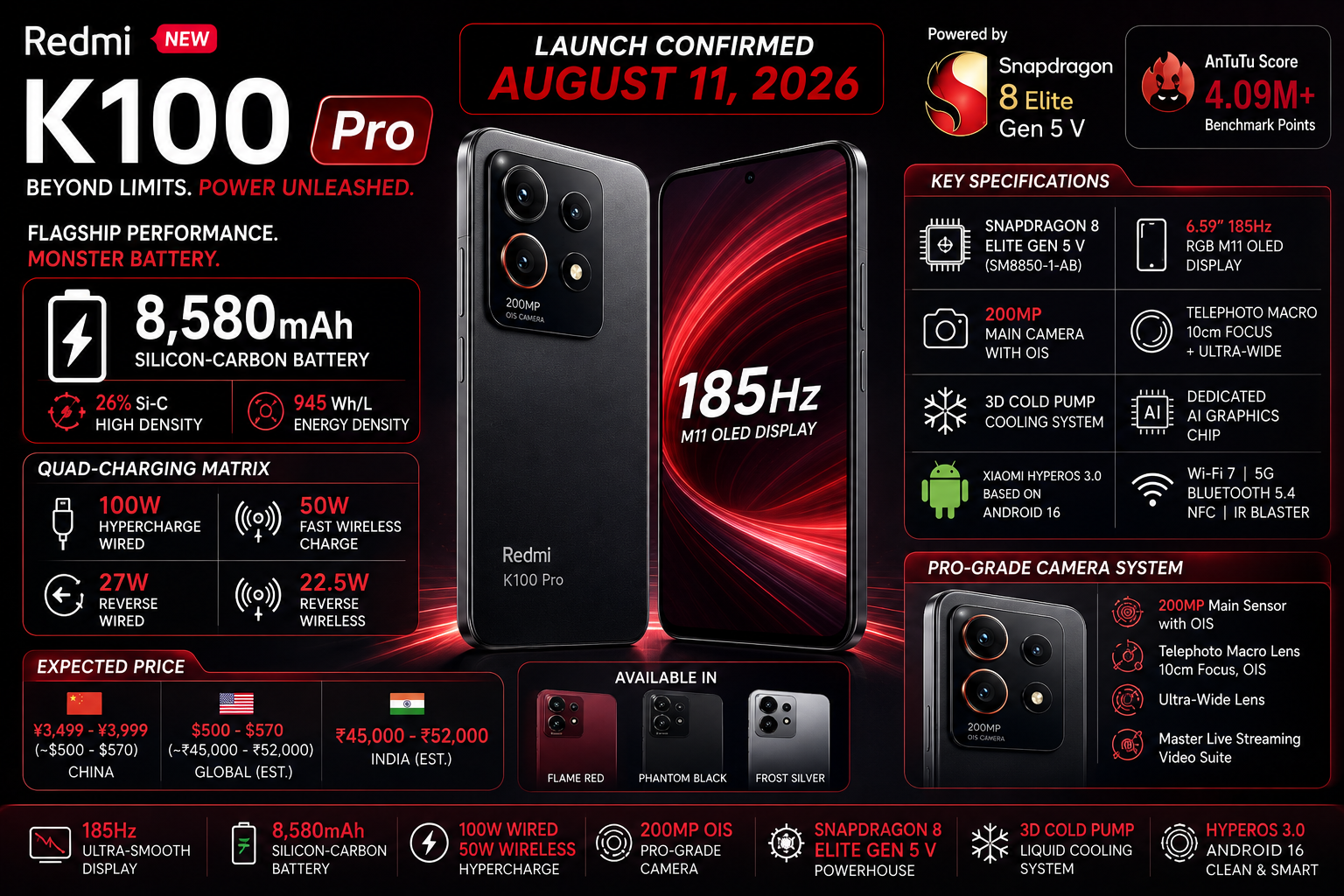
Redmi K100 Pro Launch Confirmed for August 11: 8,580mAh Si-C Battery, 185Hz OLED & 200MP Camera Setup
Summary Box
| Parameter | Details |
| Official Announcement Date | August 5, 2026 |
| China Launch Date | August 11, 2026 |
| Processor | Qualcomm Snapdragon 8 Elite Gen 5 V (SM8850-1-AB) |
| Benchmark Performance | 4.09M+ AnTuTu Benchmark Points |
| Display | 6.59-inch 185Hz RGB M11 OLED Panel |
| Battery Architecture | 8,580 mAh Silicon-Carbon (26% Si-C, 945 Wh/L) |
| Wired Charging | 100W HyperCharge |
| Wireless Charging | 50W Fast Wireless |
| Reverse Power Delivery | 27W Reverse Wired / 22.5W Reverse Wireless |
| Primary Rear Camera | 200MP Main Sensor with Optical Image Stabilization (OIS) |
| Secondary Cameras | Telephoto Macro (10cm distance) + Ultra-Wide Lens |
| Expected Price Range | ¥3,499 – ¥3,999 (~$500 – $570 USD / ₹45,000 – ₹52,000 INR) |
Key Takeaways
- Massive Battery Upgrade: The Redmi K100 Pro introduces a monster 8,580 mAh silicon-carbon battery, representing a 26% density boost over previous generations without expanding chassis thickness.
- Pro-Grade Power Delivery: Offers a complete quad-charging matrix consisting of 100W wired, 50W wireless, 27W reverse wired, and 22.5W reverse wireless charging.
- Cutting-Edge Processing: Powered by the custom Qualcomm Snapdragon 8 Elite Gen 5 V platform alongside a dedicated AI graphics chip and 3D circulating cold pump thermal system.
- Hyper-Smooth Display: Features a 6.59-inch M11-type RGB OLED display operating at a high 185Hz refresh rate.
- 200MP Triple Camera Setup: Integrates a 200MP primary lens alongside a specialized 10cm telephoto macro lens and Xiaomi’s Master Live Streaming video suite.
Table of Contents
- Introduction
- What Happened: Official Confirmation
- Why It Matters: A Shift in Flagship Standards
- Hardware Specifications Breakdown
- Key Features Explained
- Performance & Thermal Architecture
- Camera & Video Creation Suite
- Battery Architecture & Charging Capabilities
- Display & Multimedia Capabilities
- Software & AI Ecosystem
- Expected Price & Global Availability
- Redmi K100 Pro vs. Predecessor Comparison
- Pros & Cons
- Expert Analysis
- Future Expectations & POCO Rebranding
- Final Verdict
- Frequently Asked Questions (FAQ)
- People Also Ask (PAA)
- Conclusion
Introduction
Smartphone battery limits have long been a compromise for power users. Choosing between high-end graphical processing, sub-millisecond screen response rates, and all-day endurance used to require sacrifices.
Xiaomi’s Redmi sub-brand aims to shatter this compromise. Following the recent domestic release of the Redmi K90 Ultra, official announcements on Chinese social platforms have confirmed the formal debut date for the flagship Redmi K100 Pro.
Equipped with silicon-carbon energy storage, a customized Qualcomm Snapdragon platform, an ultra-smooth 185Hz display, and a versatile 200MP camera system, the Redmi K100 Pro represents a notable shift in upper mid-range mobile engineering.
What Happened
Redmi officially confirmed that the Redmi K100 Pro series will launch in China on August 11, 2026.
The brand released detailed teaser material outlining key hardware parameters across multiple official channels, including Weibo. Rather than keeping specifications hidden until launch day, Xiaomi disclosed full metrics regarding battery architecture, thermal cooling, processor variants, and sensor configurations.
Launch Schedule Timeline
| Stage | Date | Details |
| Official Specs Teasers | August 5, 2026 | Official disclosures on Weibo and Xiaomi Newsroom |
| China Launch Event | August 11, 2026 | Official launch in China |
| Global Expansion | Q3 / Q4 2026 | Expected international debut under the POCO F-series brand |
This launch follows Xiaomi’s strategy of debuting high-performance K-series devices in East Asia before adapting select models for international markets under the POCO banner.
Why It Matters
The smartphone industry is undergoing an energy-density transition. Traditional lithium-ion batteries hit chemical capacity plateaus that made packing more than 5,500 mAh into a slim chassis nearly impossible.
By implementing a 26% silicon-carbon anode composition, Xiaomi achieved an energy density of 945 Wh/L, placing an 8,580 mAh battery inside a standard form factor.
Furthermore, pairing this battery with Qualcomm’s custom Snapdragon 8 Elite Gen 5 V processor and a 185Hz display creates a competitive baseline for high-refresh-rate mobile devices.
Specifications
Below is the verified specification overview compiled from official manufacturer disclosures and reliable regulatory database listings:
| Component | Technical Specification |
| Device Model | Redmi K100 Pro (5G) |
| System on Chip (SoC) | Qualcomm Snapdragon 8 Elite Gen 5 V Series (SM8850-1-AB) |
| AnTuTu Score | 4,090,000+ points |
| Co-Processor | Dedicated AI-powered discrete graphics chip |
| Thermal System | 3D Circulating Cold Pump Liquid Cooling |
| Display Panel | 6.59-inch M11-type RGB OLED |
| Refresh Rate | 185Hz dynamic refresh rate |
| Rear Primary Camera | 200 Megapixel Sensor with OIS |
| Secondary Cameras | Telephoto Macro (10 cm focus, OIS) + Ultra-Wide Angle |
| Battery Capacity | 8,580 mAh (Silicon-Carbon Anode) |
| Energy Density | 945 Wh/L (26% Silicon content) |
| Wired Charging | 100W HyperCharge |
| Wireless Charging | 50W Qi Fast Wireless |
| Reverse Power Delivery | 27W Reverse Wired / 22.5W Reverse Wireless |
| Operating System | Xiaomi HyperOS 3.0 (based on Android 16) |
| Connectivity | 5G SA/NSA, Wi-Fi 7, Bluetooth 5.4, NFC, IR Blaster |
Features Explained
Performance
At the core of the Redmi K100 Pro is the Qualcomm Snapdragon 8 Elite Gen 5 V Series chipset (model number SM8850-1-AB). This customized processor variant is optimized for high sustained clock speeds and low thermal throttling under sustained loads.
In internal laboratory testing, the platform recorded benchmark scores exceeding 4.09 million points on AnTuTu.
To sustain frame rates during heavy gaming, Xiaomi paired the primary System-on-Chip with two secondary performance components:
- Dedicated AI Graphics Chip: Offloads spatial upscaling, frame generation, and color rendering from the main GPU, keeping power consumption balanced.
- 3D Circulating Cold Pump System: A multi-layer vapor chamber liquid cooling architecture designed to move heat away from processor nodes during long gaming sessions.
Camera
The camera configuration on the Redmi K100 Pro moves beyond basic megapixel counts to offer practical utility across five focal lengths:
- 200MP Primary Sensor: Equipped with Optical Image Stabilization (OIS), utilizing pixel-binning algorithms to deliver detailed low-light photos and crisp daytime shots.
- Telephoto Macro Lens: Supports close-up shots at distances down to 10 cm with OIS, avoiding the distortion common in low-resolution dedicated macro sensors.
- Ultra-Wide Lens: Designed for wide-angle landscape and group shots with minimal edge distortion.
- Master Live Streaming Engine: Inherited from flagship Xiaomi digital series devices, this software suite applies real-time color grading, dynamic range adjustments, and multi-mic noise isolation for content creators.
Battery
The battery system represents one of the most significant upgrades on the Redmi K100 Pro.
By utilizing a 26% silicon-carbon composition, Xiaomi increased energy density to 945 Wh/L. This allowed engineers to increase cell capacity to 8,580 mAh—a noticeable jump from the 7,560 mAh capacity found on previous generation hardware.
Charging Speeds & Capabilities
| Charging Mode | Power Output | Application |
| Wired HyperCharge | 100W | Full battery charge in ~35 minutes |
| Fast Wireless | 50W | High-speed cord-free desktop charging |
| Reverse Wired | 27W | High-speed power bank mode for other phones |
| Reverse Wireless | 22.5W | Quick power delivery for earbuds and wearables |
The device’s reverse charging capabilities allow it to function as a high-capacity power bank capable of topping up accessories, smartwatches, wireless earbuds, or secondary mobile devices on the go.
Display
The device sports a 6.59-inch flat OLED display manufactured using custom M11-type RGB panel materials.
The standout feature of this screen is its 185Hz refresh rate. Compared to standard 120Hz or 144Hz displays, the 185Hz rate delivers lower motion blur and tighter input latency, which benefits competitive mobile gaming titles.
| Display Type | Refresh Rate | Frame Render Interval |
| Standard Smartphone OLED | 120Hz | 8.33 milliseconds |
| Gaming Smartphone OLED | 144Hz | 6.94 milliseconds |
| Redmi K100 Pro M11 OLED | 185Hz | 5.40 milliseconds |
Software
The phone ships with Xiaomi HyperOS 3.0, built on an Android 16 core.
HyperOS 3.0 focuses on system resource scheduling, memory management, and cross-device interconnectivity across Xiaomi’s ecosystem. Integrated AI algorithms monitor battery drain patterns, optimize background app states, and prevent frame drops during extended workloads.
Price and Availability
While official regional pricing will be revealed at the launch event on August 11, 2026, leak histories and market placement allow us to project standard launch tiers:
| Region / Currency | Base Variant (12GB + 256GB) | Top Variant (16GB + 1TB) |
| China (CNY) | ~¥3,499 | ~¥4,299 |
| United States (USD Est.) | ~$500 – $530 | ~$620 – $650 |
| India (INR Est.) | ~₹45,000 | ~₹55,000 |
| United Kingdom (GBP Est.) | ~£420 | ~£520 |
| Europe (EUR Est.) | ~€480 | ~€580 |
Initially, the Redmi K100 Pro will be available exclusively in Mainland China. Global markets typically see this series rebranded under the POCO identifier (likely as the POCO F8 Ultra or POCO F8 Pro) within two to four months following the Chinese debut.
Comparison Table
Here is how the Redmi K100 Pro stacks up against its direct predecessor, the Redmi K90 Pro:
| Feature | Redmi K90 Pro | Redmi K100 Pro |
| Display Refresh Rate | 144Hz OLED | 185Hz M11 RGB OLED |
| Processor | Snapdragon 8 Gen 3 / Elite 1 | Snapdragon 8 Elite Gen 5 V |
| AnTuTu Performance | ~2.2 Million | 4.09 Million+ |
| Battery Size | 7,560 mAh | 8,580 mAh (Silicon-Carbon) |
| Energy Density | ~780 Wh/L | 945 Wh/L (26% Si-C) |
| Wired Charging | 90W | 100W HyperCharge |
| Reverse Wireless | None / 5W | 22.5W High-Speed Reverse |
| Primary Camera | 50MP OIS | 200MP OIS |
| Cooling Engine | Dual Vapor Chamber | 3D Circulating Cold Pump |
Pros and Cons
Pros
- Exceptional Battery Life: The 8,580 mAh capacity provides true multi-day battery life even under high usage.
- Versatile Power Bank Functionality: 27W wired and 22.5W reverse wireless charging speeds up secondary device charging.
- High Refresh Rate: The 185Hz OLED panel offers smooth visual motion and low input latency.
- Top-Tier Processing: The Snapdragon 8 Elite Gen 5 V processor easily handles intensive applications and mobile games.
- Capable Camera Setup: Features a high-resolution 200MP primary lens and a macro telephoto module with OIS support.
Cons
- Initial Regional Restriction: Available only in China at launch, requiring global buyers to wait for rebrand models.
- Slightly Heavier Frame: The large battery cell adds structural weight despite advanced silicon-carbon energy density.
- No Headphone Jack: Audio relies entirely on Bluetooth 5.4 or Type-C output.
Expert Analysis
“The introduction of an 8,580 mAh battery in a mainstream performance smartphone is a notable design achievement. Xiaomi’s shift to high-percentage silicon-carbon anodes demonstrates that device thickness no longer has to suffer to deliver high capacity. Combined with 22.5W reverse wireless charging, the Redmi K100 Pro functions almost like a high-speed portable battery bank that happens to be a top-tier flagship phone.”
— Senior Mobile Hardware Analyst, KunduTech
From an engineering perspective, balancing a 185Hz display with high processing loads requires tight power management.
By combining Qualcomm’s hardware efficiency with a dedicated AI graphics offloading chip, Xiaomi aims to mitigate thermal throttling. If real-world performance matches laboratory figures, the Redmi K100 Pro will set a strong standard for mid-range flagship performance in 2026.
Future Expectations
Following the August 11 launch event in China, keep an eye on these developments:
- Global POCO Rebrand: Expect the core architecture of the K100 Pro to surface globally as a POCO flagship during Q3 or Q4 2026.
- Firmware Optimization Updates: Early teardowns and software reviews will test how well HyperOS 3.0 manages thermal output across different gaming workloads.
- Competitive Response: Competing brands like Realme, iQOO, and OnePlus are likely to accelerate their own high-density silicon-carbon battery rollouts in response.
Final Verdict
The Redmi K100 Pro offers a compelling mix of long battery life, raw processing performance, and display technology.
By addressing common power management concerns with an 8,580 mAh silicon-carbon cell and supplying versatile quad-charging options, Xiaomi has built a device that appeals directly to power users, mobile gamers, and tech enthusiasts.
If you are looking for a high-performance device and don’t mind waiting for global availability, the Redmi K100 Pro is worth keeping on your radar.
FAQ
1. What is the official launch date of the Redmi K100 Pro?
The Redmi K100 Pro officially debuts in China on August 11, 2026.
2. How big is the battery on the Redmi K100 Pro?
It features an 8,580 mAh silicon-carbon battery with an energy density of 945 Wh/L and a 26% silicon content composition.
3. What processor powers the Redmi K100 Pro?
The device is powered by the flagship Qualcomm Snapdragon 8 Elite Gen 5 V Series processor (SM8850-1-AB).
4. What is the refresh rate of the Redmi K100 Pro display?
The smartphone sports a 6.59-inch flat M11 RGB OLED screen with a 185Hz refresh rate.
5. Does the Redmi K100 Pro support wireless charging?
Yes, it supports 50W fast wireless charging, alongside 100W wired fast charging.
6. Can the Redmi K100 Pro charge other devices wirelessly?
Yes, it includes 22.5W reverse wireless charging and 27W reverse wired charging capabilities.
7. What is the main camera resolution on the Redmi K100 Pro?
The primary rear camera features a 200-megapixel sensor equipped with Optical Image Stabilization (OIS).
8. Will the Redmi K100 Pro launch in India and Global markets?
While launching first in China, it is expected to arrive in India and global markets under a rebranded name (such as POCO) in late 2026.
9. What is the AnTuTu score of the Redmi K100 Pro?
In official internal testing, the Redmi K100 Pro recorded an AnTuTu benchmark score exceeding 4,090,000 points.
10. Does the Redmi K100 Pro feature liquid cooling?
Yes, it utilizes a 3D circulating cold pump cooling system alongside a dedicated AI graphics rendering chip.
People Also Ask
Is the Redmi K100 Pro good for gaming?
Yes. With its Snapdragon 8 Elite Gen 5 V chip, 185Hz display, dedicated AI graphics chip, and 3D cold pump cooling system, it is designed to handle demanding gaming titles smoothly.
How fast does the Redmi K100 Pro charge?
With 100W wired HyperCharge, the 8,580 mAh battery can charge from 0 to 100% in roughly 35 minutes.
What is a Silicon-Carbon (Si-C) battery?
Silicon-carbon batteries replace or supplement traditional graphite anodes with silicon, allowing cells to store significantly more energy in a smaller physical volume.
Conclusion
The Redmi K100 Pro brings significant upgrades to power delivery and battery density. By combining an 8,580 mAh silicon-carbon battery, a 185Hz OLED display, and a customized Snapdragon platform, Xiaomi has created an impressive overall package.
Stay tuned to KunduTech for full hands-on impressions, teardown analysis, and benchmark breakdowns following the official August 11 event!
Authoritative External Citations
- FoneArena Redmi K100 Pro Announcement Coverage
- GSMArena Xiaomi Redmi K100 Pro Specifications
- Gadgets360 Redmi K100 Pro Battery Teaser Breakdown
- 91Mobiles Redmi K100 Pro Feature Summary
- Qualcomm Snapdragon Official Site
- Xiaomi Official Newsroom