
Apple captures 50% of consumer revenue of the top half of the S&P 500. Market offers no other exposure to consumers.
When asked what they do, Apple says they create great products. Products that are designed to be useful and easy to use. “Building incredible products that make their lives better” is how John Ternus, the CEO put it recently. The “user” is usually expected to also be the “buyer”. It is therefore almost tautological to say that Apple is a consumer company.
Yes, there are businesses and other organizations buying Apple products, but they are not the target buyers. There is no “B2B” division. There are no “Enterprise” products. The “Pro” products are useful to professionals as well as consumers and they work for organizations but the Pro products are not designed to satisfy a purchasing manager. They are designed to be requested by if not purchased by the end user.
When looking at other large companies today, I noted that most of them are focused on selling to institutions rather than consumers. I seem to remember that there were more consumer companies among the largest market caps than what I see present today.
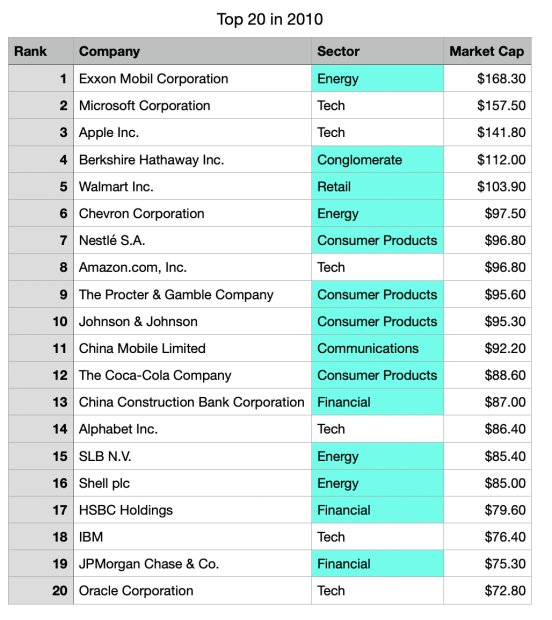
To test my memory, I retrieved a list the top 20 companies by market capitalization in 2010.

I assigned a sector to each and highlighted those which were not Tech companies1. Within the list, beside Apple, there are notable consumer products companies such as Nestlé, P&G, J&J, and Coca-Cola. China Mobile served consumers directly and Walmart and Amazon faced consumers as mass retailers.
Therefore, in 2010, 8 out of 20 of the largest companies were consumer-focused and of the others, there were significant portions of the businesses which were consumer-focused. For instance, Energy and Banking stalwarts such as Exxon and JPMorgan Chase had retail operations. Overall perhaps half the index was involved in some way with consumers. Only IBM, Oracle and SLB (Schlumberger, an oilfield services company) were strictly B2B companies.
Now let’s look at the top 20 of 2026.

I again assigned a sector to each and highlighted those which were not Tech companies2. Within the list, beside Apple, there are no consumer products companies. Walmart and Amazon remain in the index and face consumers as mass retailers, however Amazon, as we shall see, relies mostly on the AWS cloud service business for profitability and growth. The number of tech companies grew from 6 to 14 out of 20 and the combined share of capitalization went from about a third to 83%.
To sharpen the focus, I added a column of trailing revenues for each company and an assessment of the percent of sales that can be attributed to consumer purchasing3. Consumer sales total $850 billion or 15% of total index revenues. We can therefore conclude that of the top 20 largest market caps (which make up 25% of the entire global market capitalization4 ) 85% is derived from sales to businesses or government.
A large number of companies offer 0% consumer exposure: Nvidia, TSMC, Saudi Aramco, Broadcom, Meta (revenues), Eli Lilly, Berkshire Hathaway, Micron, AMD, SK hynix.
For companies which have a mix of business and consumer (B2B and B2C), the percent of business sales has been growing rapidly in the last three years.
The following graph shows Samsung, where the DX division is consumer products.

Samsung’s consumer share of sales has shrunk from 69% to 21%.
Subscribe to Asymco One for full access to our research.
For Amazon, the following is how it reports its sales, with AWS shown as the non-consumer side.

For the third quarter, the share of AWS increased from 16% to 23% over three years. AWS operates at an operating margin of roughly 35% while North America Retail operates at a much lower operating margin of roughly 4.5% to 6.9%. International Retail operates at an operating margin of around 2.9%. Traditional retail and product sales run on thin single-digit operating margins (or near-break-even when separated from higher-margin embedded services like advertising). Therefore AWS or cloud is truly the core of profit and growth at Amazon.
For Microsoft, the picture of B2C vs. B2B is similar:

The B2C oriented “More personal computing” which targets end-users, consumers, and gamers has shrunk to about 15% from 25% in three years.
At Google the picture is similar. Though subscriptions, platforms and devices are down slightly from 13% a year ago to 11% today, Google Cloud has more than doubled as percent of revenues. The real erosion is happening in Search where growth has stalled and anecdotal evidence exists that advertisers are being given worse terms thus decreasing end user search quality.
Clearly, if there is any value in Google’s shares today it’s in whatever Cloud is offering.

To illustrate this even more sharply, at a company-level, the following graph shows the consumer sales vs. market capitalization of the top 20 companies.

Apple is the one outlier.
Apple is over 50% of the total consumer revenue of the top half of the S&P 500.
Put another way, all other S&P 500 consumer sales put together create less value than Apple alone.
This anomaly suggests a curious and possibly unprecedented situation. From an investor’s point of view, Apple is essentially the only consumer investment worth considering.
To wit, if you want to gain exposure to consumers, own Apple. If you don’t believe consumers are a source of value then exclude Apple from your portfolio.
There are some significant implications.
Apple is the last and only consumer play, moreover…
Subscribe to Asymco One to read the rest of this and other in-depth analysis and commentary.