
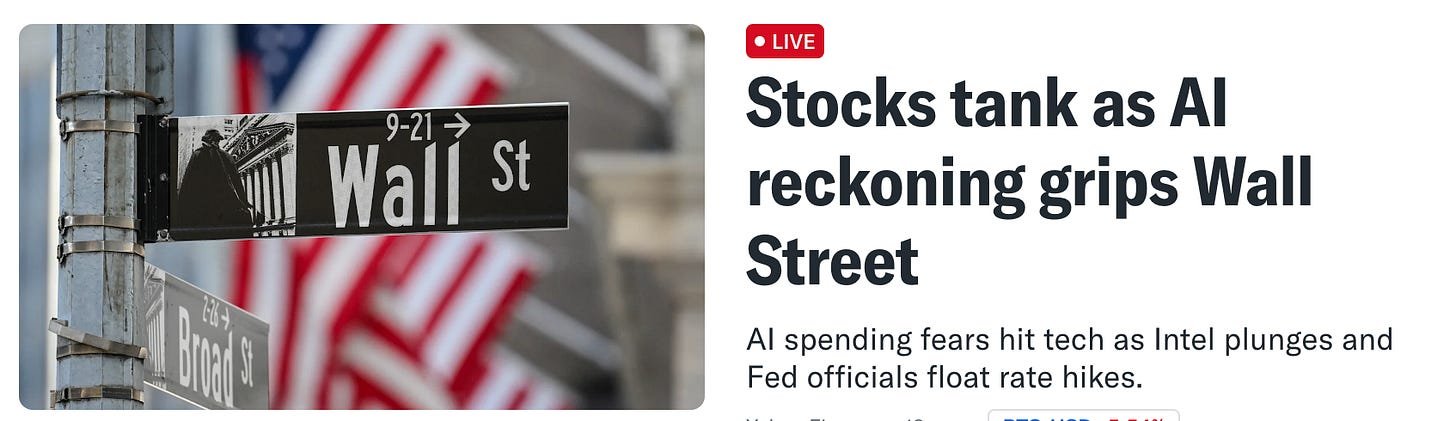
The past month has seen some signs in the financial markets that the AI bubble is beginning to deflate. First it was the neoclouds, which are off-balance sheet entities for large tech and chip companies, getting crushed. Then on Monday, AI giant Anthropic made public its initial draft S-1 filing, the form it has to submit before it sells shares on the stock market. Then, a few days later, Google and Amazon released their earnings, disappointing investors with misses in revenue targets and higher than expected negative free cash flow. Google stock alone fell by 12% on Thursday, a half a trillion dollar collapse. The next day, the whole tech sector got crushed, and it now down 10% from its high.
Wall Street, it seems, is worried.
Whatever one might say about AI, whether it’s a bubble or not, right now, the traditionally profitable big tech firms are consuming large quantities of capital from investors. Last year, for instance, Anthropic lost $80 billion, and Amazon had negative $42 billion free cash flow. The entire big tech complex, it seems, has moved from minting cash to burning it. And investors are, well, not panicking exactly, but wondering if the bubble is ending.
I’ve spent some time going over it, and while the document is suspiciously missing key financial details, there’s enough there to understand a lot about this company and this industry. There’s something unusual about Anthropic’s filing, and big tech earnings in general, that has important policy implications. Unlike nearly any other initial public offering I can think of, large chunks of Anthropic are owned or controlled by its rivals or suppliers: Amazon, Google, Broadcom, and Microsoft. Indeed, I have read a bunch of S-1’s, I have never seen one discuss how dependent the company doing an IPO is on other large firms. These dependencies explain why the entire tech complex is now rising and falling together, as if it’s one interconnected entity. Because in some ways, it now is.
Anthropic itself notes this dynamic under one of the risks listed in the IPO about managing conflicts of interest. Anthropic’s relationships with Amazon, Google, and Microsoft, it says, “create potential conflicts of interest that are difficult to fully anticipate or mitigate.” These “strategic partners,” the company notes, serve as “investors, customers, distribution partners, and competitors,” while chipmaker Broadcom “simultaneously serves as a supplier and lessor.” In essence, Anthropic looks less like a stand-alone business and more like four monopolies in a trench coat.
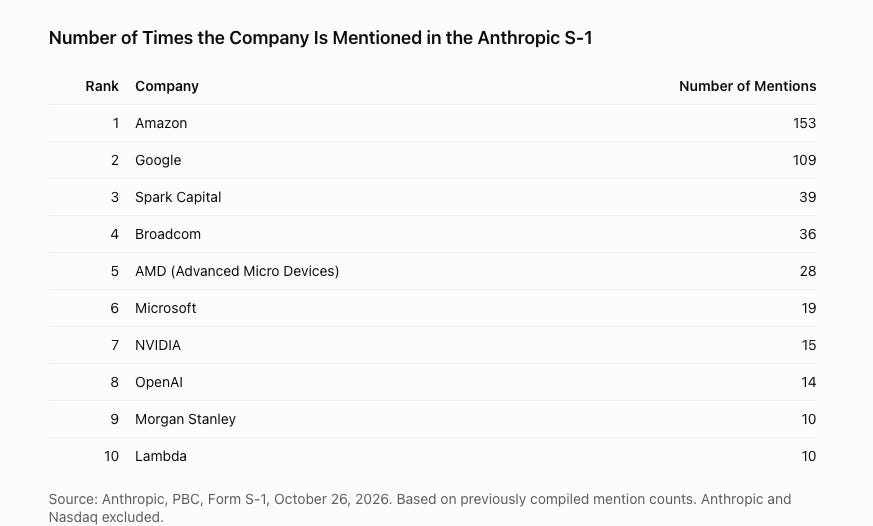
One way to visualize the dynamic is to look at how many third party companies are noted in the S-1. In a normal S-1, no other company would get more than a dozen mentions, if that. An IPO document would discuss the bankers for the deal, competitors, comparable firms, major creditors or partners, and the companies for which the executives used to work. An individual company that isn’t the company going public might be discussed a few times, if it is the main competitor.
But Anthropic’s document is just different. I created a table that lists how many times Anthropic mentions third party firms. Amazon has more than one hundred and fifty citations, and Google has over a hundred. Broadcom and Microsoft also have more than a dozen. All are trillion dollar plus firms, and all have deep relationships with this trillion dollar plus Anthropic IPO.
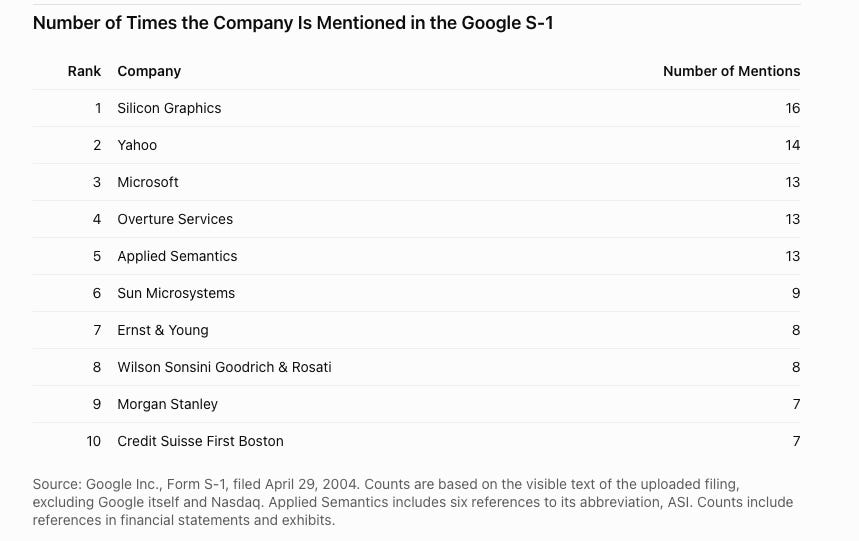
I wanted to see a contrast, so I looked at comparable S-1 documents for Google in 2004 and Amazon in 1995. They are nothing like Anthropic’s, they are much simpler and describe a comprehensible stand-alone business. The top mention for Google for instance, was Silicon Graphics, at just sixteen times. Why? The two had a technology licensing agreement. Yahoo got thirteen mentions, and Microsoft had twelve, all of which were in the context of them having rival search products. Similarly, Amazon in its 1995 S-1 mentioned Coast Wide Supply, a company from whom it leased warehouses, twenty eight times. These are simple relationships.
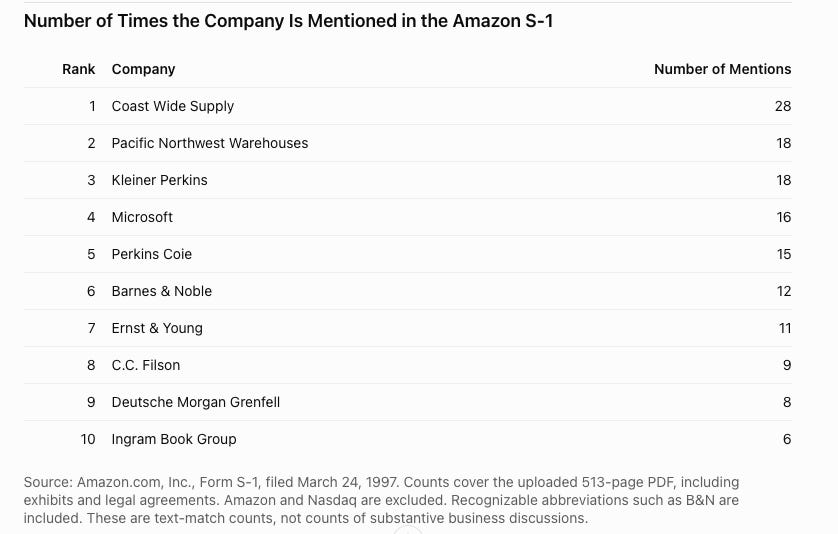
Why does Anthropic discuss other companies so much in its S-1? Maybe it’s nothing. Mentions in the IPO don’t necessarily prove anything. But as I noted, that was just one way to visualize the dynamic. The reason these companies are mentioned many times is because the relationships are complex. Consider:
-
Amazon, Google, and Microsoft are the main distributors for Anthropic, selling roughly 50% of the company’s products, including Claude for Microsoft 365 and Claude in Chrome.
-
Amazon, Google, and Microsoft own large chunks of the company and are significant lenders to it. Google has around 15% of the stock, Amazon has between 10-12%, and Microsoft has an undisclosed if smaller amount.
-
Google and Amazon are also significant lenders, with Amazon offering tens of billions of dollars to the company in a complex convertible debt offering, which is unlocked through purchases of AWS cloud computing services. Broadcom is also a massive lender, guaranteeing $42 billion in borrowing, and a significant supplier of essential computing resources.
-
Anthropic is reliant on Amazon, Google, and Microsoft for “many of the internal tools [Anthropic] uses to operate [its] business.” These three companies also use Claude as customers.
-
Anthropic is buying hundreds of billions of dollars of non-cancellable computing resources from Amazon, Google, and Microsoft.
These relationships have implications for the other companies, too. On Wednesday, Google released its earnings, and so I took a look at its financial documents. Its share of Anthropic is worth a significant amount. Under the baroque heading “gross unrealized gain on non-marketable equity securities,” the number equals $117 billion.
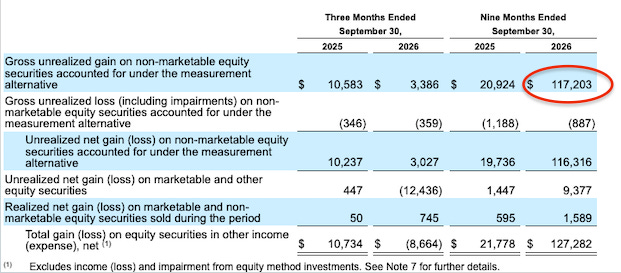
That’s a lot of money, even for Google. How much of that is Anthropic? Well, a few lines up it says “our investments in non-marketable securities accounted for under the measurement alternative primarily consist of our investment in one private company.” (I bolded it for emphasis.)
And that’s before Anthropic goes public, and it’s at a valuation that Google chooses. So there’s another hundred billion of gains to go. That is, as they say, a lot of money in the banana stand. And you can be sure that there’s something similar on Amazon’s balance sheet, and Microsoft’s. There’s also convertible debt, and cash owed back and forth, and promises in compute and non-cancellable data center leasing, and infrastructure tools, these companies using each other products, and so on and so forth.
Since Anthropic will be a multi-trillion dollar initial public offering, this dynamic suggests something systemic about big tech. Google and Amazon both emphasized on their earnings calls the growth in cloud computing, with Google’s revenue jumping 103% to $30 billion a quarter, and Amazon’s up 39% to $46 billion a quarter. Who are they selling to? Well, Anthropic is a major customer. And it turns out the other multi-trillion dollar IPO of the year – SpaceX – has as its largest customer none other than Anthropic. Big tech and AI is now one big complex whose valuation rises or falls together.
That didn’t use to be the case.
When BIG started, in 2019, the five large big tech firms (Microsoft, Apple, Google, Meta, Amazon) dominated individual lines of business. They were distinct, and did not really compete with each other, except in narrow ways. There were alliances, such as Google and Apple in search on the iPhone, but they were stand-alone businesses.
In 2024, however, it became clear something was changing, as these companies each used the margins from their monopolies for capital investment in AI, and cross-investment in third party firms and adjacent off-balance sheet entities like neoclouds. Policymakers saw what was happening, the blurring of these lines, and did start acting. Lina Khan’s FTC opened an investigation into AI investment overlaps. And the Biden Antitrust Division, during the remedy phase of the Google antitrust suit, filed to prevent Google from investing in Anthropic, asking for a divestment of the search giant’s existing stake.
But Trump had a different philosophy of governance, encouraging these cross-ownership investments. He focused his economic policy framework on building more data centers, and encouraging investment and cross-investment from and into ten different firms, as well as their satellites: SpaceX, Oracle, Google, Nvidia, Microsoft, Broadcom, Meta, Amazon, Anthropic, and OpenAI. Khan’s successor didn’t follow up on her investigation into overlaps, and the Trump Antitrust Division quickly rolled back its demand for Google to divest its Anthropic stake.
And these conflicts could explain Google’s lack of positioning at the frontier of AI models, which is otherwise a bit puzzling. It is a key player here, since it has a product, Gemini, as well as the capital and ability to build comparable tools to Claude, as well as chips, data centers, and unique data sets. It also can underprice Anthropic, which it does to rivals when it wants to monopolize. Google scientists even created the fundamental architecture of LLMs!
But the byzantine relationship introduces something odd. If it did compete, vigorously, as it ordinarily might, well that “non-marketable securities” line would drop from $117 billion to $10 billion, instead of increasing to whatever it will after the IPO. That’s not a good incentive. Similarly, its amazing cloud computing growth would slow, upsetting investors. The same is true for Amazon, which just got rid of its division trying to catch up on frontier models. Why compete on price, if these companies already own a large chunk of Anthropic and undermining Anthropic’s enterprise value hurts them? And it’s not as if Anthropic’s rival, OpenAI, isn’t tied into this structure; Microsoft owns a quarter of OpenAI.
There’s also the question of power. Anthropic and OpenAI both rely on the infrastructure of Google, Amazon, and Microsoft, on their financing, their tools, their chips, and data centers. Anthropic and OpenAI may be able to take share from Google, but would they really try to do that? Maybe, but the incentives are certainly not clear. Throw in Broadcom and SpaceX, and you have an extremely opaque system. The motivations here are byzantine, and suggest that what’s really happening is every insider wants to see every company in this world maximize its market value, regardless of underlying intrinsic cash flow or competitive dynamics.
Big tech has become jammed together into one giant quasi-holding company, with interlocking business relationships, cross-shareholdings, and long-term cooperation. As a result, we have a situation where Anthropic is going public, with a massive chunk owned by an ostensible set of rivals. There are a few other important dynamics. Here are the other parts of the patronage network, listed on the S-1.

It’s not just these “rivals” to Anthropic who want to see the IPO succeed. Much of Wall Street, many insiders in Silicon Valley, and a large number of hedge funds, own Anthropic stock or are otherwise tied to the company’s fortune. If Anthropic is able to sell at a high valuation, then everyone in that ecosystem, as well as all of the associated chip, neocloud, and AI firms, will see a boost. If it can’t, look out below. In other words, anyone who might be able to compete with Anthropic still has an incentive to see the company do well.
Now, none of this corporate engineering would matter if big tech were still the capital light money machines of the 2010s or early 2020s. Sure stocks might take a hit, but it doesn’t matter when your free cash flow is in the tens of billions, and you don’t need to invest. Moreover, it wouldn’t really matter that much to anyone but that particular industry if a big tech stock got hit. In 2022, the Nasdaq drew down by a third, it did not matter much on a macro level.
But now, it does. These companies are no longer capital light, they are investing hundreds of billions of dollars into data centers and infrastructure. And it’s not coming out of profits; Google, Meta, and Amazon are all cash flow negative, while even Microsoft is dipping into the debt markets. The chipmakers, like Nvidia and Broadcom, are cash-rich, but that’s because the big tech firms are paying them. Indeed, the AI system is one giant tech stack, chips, data, power, software, et al, costing trillions every year, with every insider hoping that enough money is pouring in from corporate America (and the rest of the world) to make it worth it, or at least to ensure that someone else is holding the bag.
If the AI bubble pops, we’re in recession.

Skanda Amarnath@IrvingSwisher
The spending categories that are most tethered to the AI boom are pushing well over 7.5% of GDP.
Peaked at ~6% in the last tech boom
Housing in the 2000s peaked near 7%.
Not that we didn’t know it already, but it’s a historic capex boom

2:49 PM · Oct 29, 2026 · 426 Views
1 Repost · 4 Likes
The final piece is that the politics and legal problem has changed. It’s clear the monopolization crusade against big tech didn’t break up their concentrated power. Instead, Trump took over, and big tech mutated into something different, something more dangerous and weirder. The legal risk isn’t so much antitrust and privacy, it’s more normal forms of liability, but also, securities law. The analogy here is now much less Standard Oil and much more Enron. It’s not that antitrust has no relevance; Section 8 of the Clayton Act bans interlocking directorates, which is clearly a precedent for what we’re dealing with. It’s just that big tech is no longer micro, it’s a macro-economic phenomenon. The Fed is concerned about AI.
The shift in politics is even starker. In the 2010s and early 2020s, big tech was well-liked by most people. But AI is absolutely loathed by the public. These companies have never faced real public dissatisfaction, they all imagine themselves to be the good guys, with the credibility of having created magical search engines and smartphones. But that era is gone. They are now akin to the bankers on Wall Street in 2008, and politicians are winning elections by saying they hate AI as much as the voters do.
To most economists and Silicon Valley insiders, this Anthropic IPO is good, and represents a healthy tech ecosystem. Selling shares is a standard commercial practice, used to finance economic activity. And AI promises productivity, profits, and industrial transformation, in just a few years. But to many, this IPO, and the SpaceX IPO a few months ago, looks a conspiracy of vastly wealthy men doing whatever they want, in collusion with an unaccountable White House. They are simply minting more billionaires with political power, and this time, there may not even be the cash flow to justify it.
Thanks for reading! My name is Lee Hepner, I’m a guest-writer for BIG while Matt is out on paternity leave. Your tips make this newsletter what it is, so please send tips on weird monopolies, stories I’ve missed, or other thoughts. And if you liked this issue of BIG, you can sign up here for more issues, a newsletter on how to restore fair commerce, innovation, and democracy. Consider becoming a paying subscriber to support this work, or if you are a paying subscriber, giving a gift subscription to a friend, colleague, or family member.
cheers,
Lee Hepner