
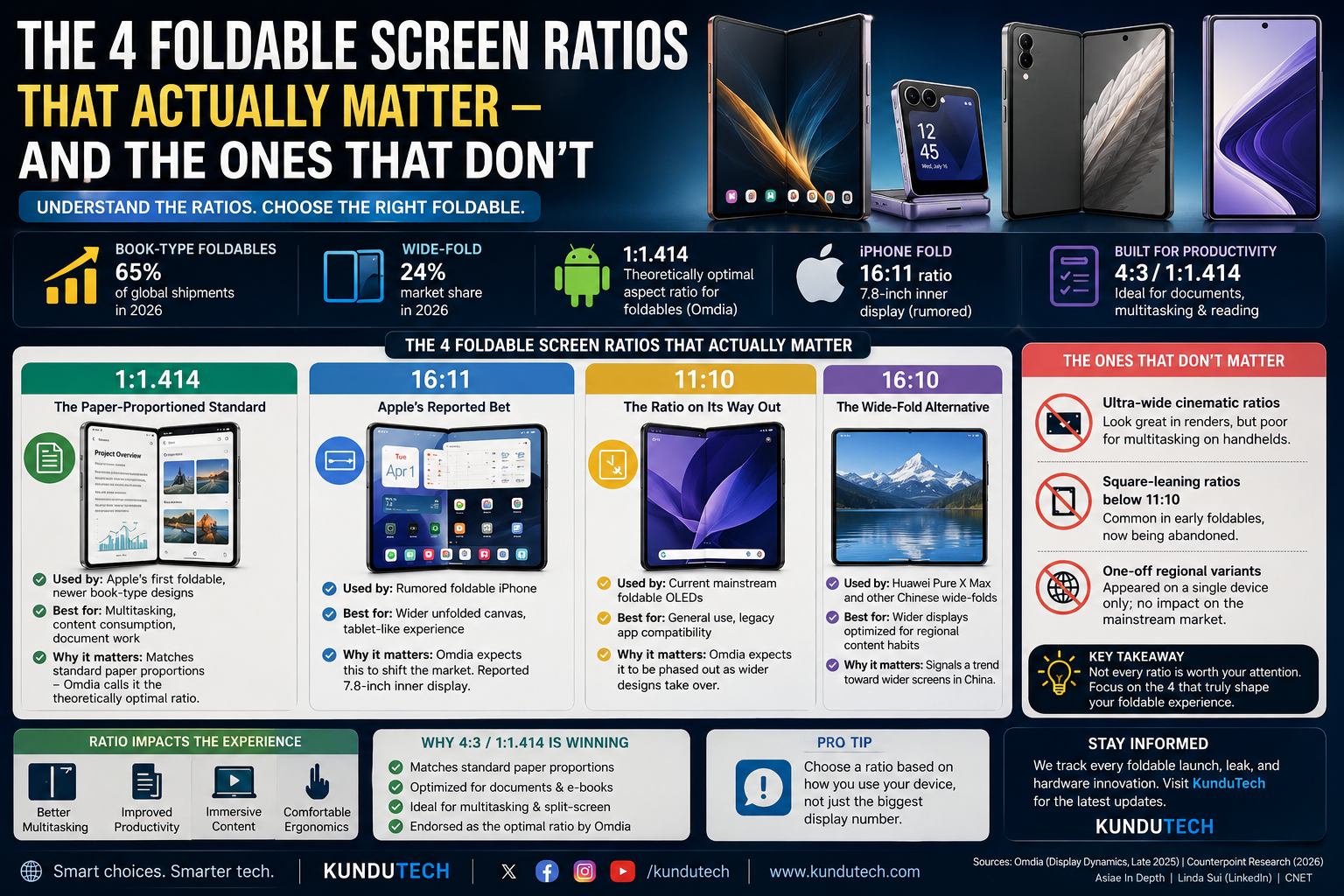
The 4 Foldable Screen Ratios That Actually Matter — And the Ones That Don’t
Did you know that book-type foldables are projected to account for 65% of all global foldable smartphone shipments in 2026, up from just 52% the year before? That single number tells us almost everything about the direction the industry has taken, and it’s exactly why understanding the 4 foldable screen ratios that actually matter matters so much right now, whether you’re eyeing a Samsung Galaxy Z Fold 7, waiting on the rumored iPhone Fold, or just trying to make sense of the marketing noise.
Key Takeaways
- Four ratios dominate the current foldable landscape: 1:1.414, 16:11, 11:10, and 16:10, each tied to a different design philosophy.
- 1:1.414 is emerging as the gold standard because it mirrors standard paper proportions, which is why Omdia calls it the theoretically optimal aspect ratio for a foldable device.
- Book-type foldables are winning the ecosystem, with Counterpoint Research projecting 65% of global foldable shipments will use this format in 2026.
- Wide-fold designs are pulling ahead of wide-flip designs, expected to capture 24% of the market compared to just 9% for wide-flip in 2026.
- The rumored foldable iPhone is expected to use a 16:11 ratio, a meaningful departure from the 11:10 ratio that has been mainstream in current-generation OLED foldables.
- Not every ratio you’ll see quoted online is worth your attention; some are legacy holdovers with shrinking relevance.
- For a wider look at the current smartphone landscape shaping these decisions, our smartphones coverage tracks every major hardware innovation as it lands.
What “Screen Ratio” Actually Means on a Foldable Phone
Screen ratio, or aspect ratio, describes the relationship between a display’s width and height when it’s fully unfolded.
On a traditional phone, this number is fairly boring. On a foldable, it’s the single spec that determines whether the device feels like a mini tablet, a stretched-out notepad, or an awkward slab that’s hard to hold with one hand.
That’s why, when we talk about the 4 foldable screen ratios that actually matter, we’re really talking about the difference between a phone that fits naturally into your daily shopping and digital life, and one that fights you every time you try to use it.
The 4 Foldable Screen Ratios That Actually Matter
After tracking hardware innovations across Samsung, Apple, Huawei, and the broader Android ecosystem, we’ve narrowed the field down to four ratios that genuinely shape the foldable experience in 2026. Everything else is noise dressed up as a spec sheet.
| Ratio | Used By | Best For |
|---|---|---|
| 1:1.414 | Apple’s first foldable device, newer book-type designs | Multitasking, content consumption, document work |
| 16:11 | Rumored foldable iPhone | Wider unfolded canvas, closer to a small tablet feel |
| 11:10 | Current mainstream foldable OLEDs | Legacy compatibility, being phased out |
| 16:10 | Huawei Pure X Max and other Chinese wide-fold devices | Wider displays optimized for regional content habits |
1:1.414 — The Paper-Proportioned Standard
This ratio is quickly becoming the reference point for the entire foldable category.
It’s not an accident that it lines up almost exactly with a standard sheet of paper. According to Omdia’s Display Dynamics research from late 2025, 1.414 is considered the theoretically optimal aspect ratio for a foldable device, and Counterpoint Research confirms it’s the wide-fold display ratio expected for Apple’s first foldable device, optimized specifically for multitasking and content consumption.
16:11 — Apple’s Reported Bet
The 16:11 ratio is the one to watch if you’re specifically tracking the iPhone fold rumor mill.
Omdia’s research suggests this is the anticipated aspect ratio for the foldable iPhone, and it’s expected to shift the market away from the ratios that currently dominate. CNET’s reporting adds another data point here too, predicting a 7.8-inch inner display for Apple’s upcoming book-style foldable, which would put it comfortably in small-tablet territory once unfolded.
11:10 — The Ratio on Its Way Out
If your current foldable feels a little squarer than you’d like when open, there’s a good reason. 11:10 has been the mainstream aspect ratio for foldable OLEDs up to this point, but Omdia expects it to be phased out as newer, wider designs take over the ecosystem.
16:10 — The Wide-Fold Alternative
This is the ratio Huawei adopted for the Pure X Max, and it represents a broader trend toward wider displays taking hold in the Chinese foldable market. It’s worth watching because it signals that manufacturers outside of Samsung and Apple are experimenting independently rather than simply following the American and Korean playbook.
4:3 Is Taking Center Stage — Here’s Why That Matters
One ratio deserves its own spotlight: 4:3. According to reporting from Asiae’s In Depth coverage, this aspect ratio is taking center stage as the new standard for foldable phones from Samsung, Apple, and Huawei, specifically because it’s optimized for document editing and e-book reading.
That’s a meaningful shift in priorities. Earlier foldables leaned toward entertainment-first proportions; the current wave is being engineered around productivity, which explains why so much of this hardware innovation is converging on paper-like proportions rather than cinema-style widescreen shapes.
Did You Know?
1.414 has been identified as the theoretically optimal aspect ratio for a foldable device, aligning with standard paper proportions.
Source: Omdia
The 1:1.414 standard crushes rival foldable screen ratios.
The Foldable Screen Ratios That Don’t Matter
Not every ratio floating around comparison charts deserves your attention. Some are simply legacy specs that manufacturers haven’t fully retired yet, and others are niche formats that never scaled beyond a single device.
- Ultra-wide cinematic ratios adapted from TV panels: these look impressive in marketing renders but rarely translate into usable multitasking on a handheld screen.
- Square-leaning ratios below 11:10: these were common in earlier generations of folding smartphones but are being abandoned as manufacturers chase the paper-proportioned 1:1.414 standard.
- One-off regional variants: a handful of ratios only ever appeared on a single regional release and never influenced the broader foldable smartphone category.
When you’re comparing a foldable galaxy device against, say, a Motorola razr fold, the ratio noise can get overwhelming fast. Focusing on the 4 foldable screen ratios that actually matter, rather than every number a spec sheet throws at you, keeps the decision manageable.
Samsung Galaxy Z Fold and the Book-Type Standard
Samsung remains the reference point for the entire book-type category. The Samsung Galaxy Z Fold 7, and the widely rumored Samsung Galaxy Z Fold 8 following behind it, are the devices most consumers picture when they hear “samsung foldable” or “galaxy z fold.”
Samsung’s design language has consistently pushed toward the wider, more paper-like proportions that Counterpoint Research flags as the winning formula. As the samsung triple fold rumors continue to circulate, the ratio conversation only gets more interesting, since a three-panel device introduces an entirely new set of proportional challenges once fully unfolded.
The iPhone Fold: Apple’s Ratio Strategy
Every rumor about the apple iphone fold eventually circles back to one question: what will the unfolded screen actually feel like in your hands? Based on current reporting, the answer points to a 16:11 canvas with a roughly 7.8-inch inner display, a shape distinctly wider and more tablet-like than Samsung’s current book-type devices.
This matters because Apple rarely enters a hardware category without a defined point of view. If the foldable iphone does land with 16:11 proportions, it signals Apple is betting on productivity and content consumption over the more compact, phone-first feel that has defined earlier folding smartphone generations.
Motorola Razr Fold, Google Pixel Fold, and the Flip-Style Question
Not every foldable is chasing the book-type format. The motorola razr fold line, along with the now-discontinued google pixel fold, represent a different branch of the ecosystem entirely, one built around flip-style and compact folding designs rather than tablet-style unfolding.
LinkedIn analysis from display researcher Linda Sui highlights an important distinction here: “wide flip” devices like the Huawei Pura X use a 1:1.4 ratio designed to match the proportions of an A4 page, while standard flip phones stick to much narrower, taller proportions. This is a meaningfully different design goal than the book-type foldables chasing 1:1.414 when fully open.
Did You Know?
Wide-fold designs are expected to capture 24% of the foldable market mix in 2026, nearly double the 9% projected for wide-flip devices.
Source: Linda Sui, LinkedIn
How Screen Ratio Affects the Software You Actually Use
A ratio isn’t just a number on a spec sheet. It determines how apps split-screen, how multitasking panes are arranged, and whether a document actually looks like a document once you unfold the device.
This is where the Android ecosystem plays a bigger role than people expect. Multi-window support has been refined specifically around these wider, paper-proportioned canvases, and our Android coverage tracks exactly how these software-level adjustments keep pace with the hardware.
App developers are adapting too. If you rely on productivity apps for work, it’s worth checking our apps section before buying, since not every app is optimized for every one of the 4 foldable screen ratios that actually matter yet.
Protecting a Foldable Display: Why Ratio Also Affects Durability
A wider, more paper-proportioned display generally means more exposed hinge area and a larger fold line, which changes what kind of protection actually works. Cases and screen protectors designed for the older 11:10 mainstream ratio don’t always fit correctly on the newer 1:1.414 or 16:11 designs.
Before you buy accessories for any folding smartphone, it’s worth checking our accessories reviews to confirm compatibility with your specific ratio and fold direction.
How to Choose the Right Foldable Screen Ratio for You
Not every reader needs the same shape of screen. Your ideal ratio depends heavily on how you actually plan to use the device.
- Document editing and e-book reading: look for 1:1.414 or 4:3 devices, since these are explicitly optimized for that use case.
- Wide multitasking and content consumption: the 16:11 ratio, expected on the foldable iPhone, is built for exactly this.
- Compact, one-handed flip usability: standard flip ratios still outperform wide-flip designs for pure pocketability.
- Regional content habits (streaming-heavy use): 16:10 devices like the Huawei Pure X Max lean wider for exactly this reason.
Understanding these use cases, rather than chasing whichever ratio a manufacturer markets loudest, is how you make an informed decision on what is genuinely a significant purchase.
Conclusion
The foldable phone category has matured past its awkward, experimental years, and screen ratio is now the clearest signal of where a device is actually headed. Once you understand the 4 foldable screen ratios that actually matter, the rest of the spec sheet starts to make a lot more sense.
Whether you’re comparing a samsung galaxy z fold 7 against a rumored samsung galaxy z fold 8, weighing an apple iphone fold against a motorola razr fold, or simply trying to figure out if a foldable smartphone fits your daily shopping and digital life, the ratio is the detail worth checking first. We’ll keep monitoring these hardware innovations as they land throughout 2026, and we’ll keep this guide updated as new devices reach the market.
Frequently Asked Questions
What is the best screen ratio for a foldable phone in 2026?
Most industry research points to 1:1.414 as the best all-around ratio, since it mirrors standard paper proportions and is optimized for multitasking and content consumption. It’s also the ratio Counterpoint Research expects Apple’s first foldable device to adopt.
What screen ratio will the iPhone Fold use?
Reporting from Omdia and CNET points to a 16:11 ratio with a roughly 7.8-inch inner display for the rumored foldable iPhone. This would be noticeably wider than the 11:10 ratio used in most current mainstream foldable OLEDs.
Is the Samsung Galaxy Z Fold 7 the best foldable available right now?
The Samsung Galaxy Z Fold 7 remains one of the strongest book-type foldables on the market, and it reflects the industry’s broader shift toward wider, paper-proportioned displays. Whether it’s “the best” depends on whether your priority is document work, multitasking, or general daily use.
Why are foldable phones moving toward a 4:3 or 1:1.414 ratio instead of widescreen shapes?
Manufacturers including Samsung, Apple, and Huawei are optimizing for document editing and e-book reading rather than video-first use cases. That’s a direct shift in priorities compared to earlier generations of folding smartphones, which leaned more toward entertainment-friendly proportions.
What’s the difference between wide-fold and wide-flip foldable designs?
Wide-fold devices use book-type ratios like 1:1.414 and are projected to reach 24% market share in 2026, while wide-flip devices use a 1:1.4 ratio matching A4 proportions and are expected to reach only 9%. Wide-fold is clearly the dominant format among the 4 foldable screen ratios that actually matter right now.
Is buying a foldable smartphone worth it in 2026?
For anyone who values multitasking, document editing, or a larger content canvas, a foldable smartphone with a modern 1:1.414 or 16:11 ratio is a genuinely useful upgrade over a standard slab phone. It’s worth being informed about which ratio best matches your habits before committing to a purchase, since the wrong shape can make the device feel awkward day to day.
Do older foldable phones with an 11:10 ratio still make sense to buy?
Devices using the legacy 11:10 ratio are still functional and often cheaper, but Omdia expects this format to be phased out as newer, wider designs take over the ecosystem. If long-term software support and resale value matter to you, a newer ratio is generally the safer bet.