
The Future of Foldables: What Samsung, Google, and Android 17 Reveal About 2026 and Beyond
Did you know that foldable devices lose an average of 62.3% of their resale value within just six months of release, compared to 49.8% for traditional flagship phones? That single number tells you a lot about where the future of foldables currently stands: exciting, fast-moving, and still finding its financial footing. At KunduTech, we constantly monitor how technological shifts affect your daily shopping and digital life, and few categories are shifting faster right now than foldable smartphones.
Key Takeaways
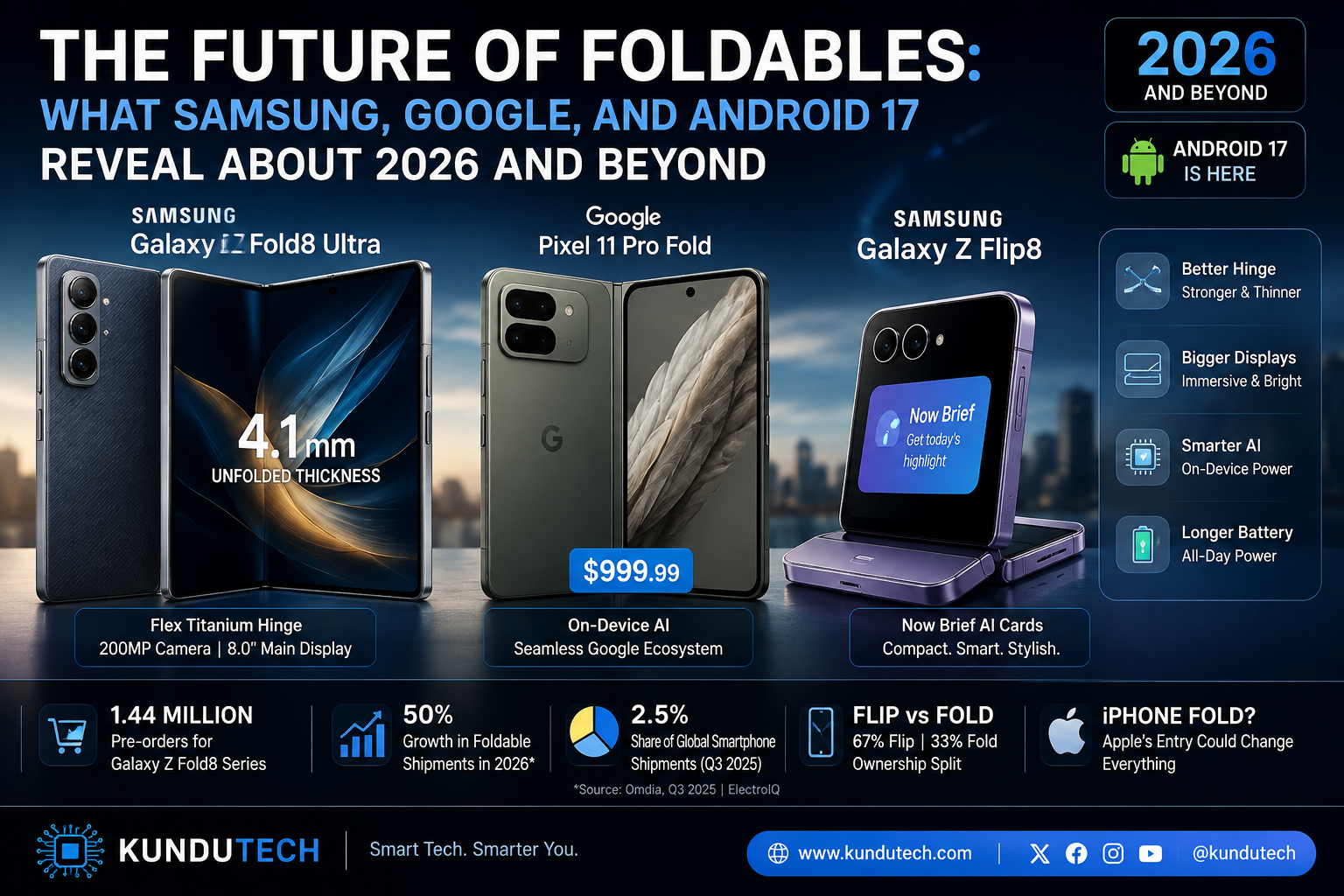
- Samsung is leading the charge. The Galaxy Z Fold8 Ultra introduces Flex Titanium hinge architecture and a 4.1 mm unfolded thickness.
- Pre-order demand is real. The Galaxy Z Fold8 series broke records with 1.44 million pre-orders ahead of global launch.
- Google is joining the fold race. The Pixel 11 Pro Fold is priced at $999.99 and pushes on-device AI into a foldable body.
- Software is catching up to hardware. Android 17 ships with a dedicated foldable gaming mode and multitasking upgrades.
- Samsung’s own skin matters too. One UI 9 deepens foldable optimization with context-aware AI across apps.
- Is a foldable iPhone coming? While Apple has not confirmed a foldable iPhone, industry chatter around an “iPhone Fold” continues to intensify as rivals gain ground.
- Adoption is still niche. Foldables represented just 2.5% of global smartphone shipments as recently as Q3 2025.
Why the Future of Foldables Matters Right Now
For years, foldable smartphones fought two primary battles: overcoming mechanical durability concerns and justifying their premium price tags through software utility.
In 2026, that battle is shifting in favor of foldables. Manufacturing yields for ultra-thin glass crossed the 90% threshold in late 2024, a jump expected to cut panel costs by roughly a third within a year. That single supply-chain improvement is doing more to shape the future of foldables than almost any single feature announcement.
Cheaper panels mean cheaper devices, wider adoption, and less financial risk for anyone considering a first foldable purchase. It also explains why Omdia forecasts global foldable shipments to grow by a staggering 50% year-over-year in 2026 as competition increases and flip-shaped devices become more affordable.
Samsung Galaxy Z Fold8 Ultra: Setting the Bar for 2026 Foldables
Samsung remains the brand to beat, and its 2026 Unpacked event in London made that clear. The Galaxy Z8 series introduced what Samsung calls Agentic AI, a system that operates with autonomous agency across apps and tasks rather than simply answering questions.
On the hardware side, Samsung introduced Flex Titanium hinge architecture, significantly reducing screen crease visibility while shaving the Galaxy Z Fold8 Ultra down to a slim 4.1 mm unfolded thickness. That is a meaningful engineering leap for a device category once defined by bulk.
Here is a quick breakdown of the eighth-generation lineup:
| Model | Key Feature | Notable Spec |
|---|---|---|
| Galaxy Z Fold8 Ultra | Flex Titanium hinge | 4.1 mm unfolded, 200 MP primary camera, 8.0-inch main display |
| Galaxy Z Fold8 | Improved screen-to-body ratio | Wide aspect foldable with integrated AI features |
| Galaxy Z Flip8 | Now Brief contextual AI cards | Clamshell design with dynamic AI features |
Whether Samsung’s eighth generation is worth the upgrade depends heavily on how much value you place on that Flex Titanium build and the desktop-grade camera hardware packed into the Ultra model.
Samsung Z Fold 7 and the Triple Fold Rumors Shaping What Comes Next
Before the Z8 series arrived, the Samsung Z Fold 7 quietly proved just how lucrative this category has become. According to Omdia, one Samsung Galaxy Z Fold7 sold at list price generates the equivalent revenue of approximately 15 entry-level Galaxy A06 4G units.
That single data point explains why manufacturers keep pushing further into folding form factors, even while adoption remains modest. It also fuels persistent talk of a Samsung triple fold, a device that unfolds twice into a tablet-sized display rather than once.
While Samsung has not formally confirmed a commercial triple-fold launch date, the record-breaking demand behind the Galaxy Z Fold 8 series and its 1.44 million pre-orders gives the company every incentive to keep experimenting. The foldable segment continues to mature, with consumer demand expanding beyond early adopters and into mainstream buyers.
Did You Know?
One Galaxy Z Fold7 sold at list price generates the equivalent revenue of approximately 15 entry-level Galaxy A06 4G units.
Source: Omdia
Google Pixel 11 Pro Fold: The Android Ecosystem’s Answer
Samsung is not the only company betting big on this form factor. Google Pixel 11 pre-orders have opened, with on-device AI features and new imaging capabilities highlighted across the lineup, including the Pixel 11 Pro Fold priced at $999.99.
Android-based integration promises faster rollouts for foldables and multi-app workflows, which matters because software lag has historically been the biggest complaint about folding devices. Pixel-exclusive extras include enhanced camera pipelines and Wear OS updates that tie the phone more tightly into Google’s broader ecosystem.
For readers comparing the two major camps, we’d point you toward our full breakdown of what Google’s latest updates mean for your daily digital life, since Pixel and Samsung are increasingly competing on software depth rather than hardware alone.
iPhone Fold Speculation: Is Apple Finally Entering the Foldable Race?
No conversation about the future of foldables is complete without addressing the elephant in the room: the rumored iPhone Fold. Searches for “foldable iPhone” and “i phone fold” have climbed steadily as Apple’s competitors rack up record pre-orders.
Apple has stayed characteristically quiet, but the pressure is mounting. With Samsung’s Z Fold8 series pulling in 1.44 million pre-orders and Google fielding a $999.99 Pixel 11 Pro Fold, Apple risks ceding an entire premium category if it waits much longer.
We do not yet have confirmed specs, pricing, or a release date for a foldable iPhone. What we can say is that Apple’s typical playbook is to enter a category late, once display technology, hinge durability, and battery efficiency have matured enough to meet its own quality bar. Given how far Samsung’s Flex Titanium hinge and Google’s foldable software integration have come in 2026, that bar may finally be within reach.
Android 17 and One UI 9: The Software Layer Behind Every Foldable
Hardware innovations only matter if the software keeps up, and 2026 has been a strong year on that front. Android 17 brings App Bubbles, Screen Reactions, a dedicated foldable gaming mode, and memory management improvements, with rollout beginning mid-2026 and Pixel devices leading the update.
The update emphasizes multitasking on large foldable displays and stronger privacy controls, both of which are essential for anyone using a foldable as a genuine laptop replacement rather than a novelty. If you want the full rundown, we cover it in depth in our Android 17 features guide.
On the Samsung side, One UI 9 brings deeper foldable optimizations and context-aware AI features that improve multitasking and cross-app workflows on large inner displays. Security and privacy controls have also been enhanced with refined biometric workflows, a detail we always flag because smartphones store nearly every detail of our daily lives: financial records, personal messages, and location history. Read our complete One UI 9 features guide for a closer look at Samsung’s software layer.
Flip vs. Fold: Which Foldable Format Actually Wins in 2026?
Not all foldables are created equal, and the market has clearly picked a favorite so far. Flip-style models currently dominate, accounting for 67% of total foldable ownership compared to 33% for larger book-type devices like the Z Fold8 Ultra.
That preference makes sense once you factor in price and pocketability. Flip phones tend to be cheaper, more compact, and less intimidating for first-time foldable buyers, while book-style devices like the Galaxy Z Fold8 series target power users who want tablet-sized screens on demand.
- Flip-style foldables: More affordable, pocket-friendly, ideal for everyday users.
- Book-style foldables: Larger inner displays, better for productivity, multitasking, and content creation.
- Emerging triple-fold designs: Aimed at users who want a tablet and phone in one device, though pricing remains unconfirmed.
Whichever format you lean toward, both categories are pulling the future of foldables in the same direction: thinner, lighter, and more software-capable with every generation.
The Adoption Gap: Why Most People Still Aren’t Buying Foldables
Here is where we have to be honest with you, because we always favor solution-oriented reporting over hype. Despite all the innovation, a large majority of consumers remain unconvinced.
Surveys show that 64% of respondents say they are not willing or interested in buying a foldable smartphone in the coming year. Foldable smartphone share in the overall global smartphone market’s shipments reached just 2.5% as of Q3 2025, meaning this remains very much a premium, enthusiast-driven category.
Despite massive industry hype, foldable phones still make up a tiny fraction of global sales.
Price sensitivity is the biggest culprit. Foldables also depreciate faster than standard flagships, which discourages buyers who plan to trade in their phone within a year or two.
Durability concerns linger too, even though high-end devices like the Samsung Galaxy Z Fold 5 use hinges certified for 200,000 folds during stress tests. That is roughly a decade of daily use assuming you fold the device around 55 times a day, which should reassure most buyers, but perception often lags behind engineering.
iOS vs. Android in the Foldable Ecosystem
One statistic worth watching closely as the future of foldables unfolds (pun intended) involves operating system share. Android’s operating system share in the foldable segment is projected to drop to 52% by 2029, down from 89% in 2025, as iOS enters the market.
That is a dramatic shift, and it hinges entirely on Apple actually shipping a foldable iPhone within that window. If Apple enters with even a modest launch, it could reshape competitive dynamics across the entire ecosystem, much like it did with wearables and earbuds.
Did You Know?
Android’s operating system share in the foldable segment is projected to drop to 52% by 2029, down from 89% in 2025, as iOS enters the market.
Source: ElectroIQ
What to Watch For Next in the Foldable Ecosystem
Navigating this vast marketplace requires understanding how hardware, software, and pricing interact to deliver maximum value for foldable buyers. A few developments we are watching closely heading into late 2026:
- Cheaper panel manufacturing should push flip-style foldable prices down further, expanding the addressable market.
- Samsung’s triple-fold ambitions may finally move from rumor to reality given the runaway success of the Z Fold8 series.
- A foldable iPhone remains unconfirmed, but competitive pressure is building fast.
- Software maturity through Android 17 and One UI 9 continues closing the gap between foldables and traditional laptops for productivity tasks.
For ongoing coverage of new launches in this space, our smartphones section and Android archives track every relevant announcement as it happens.
Conclusion: The Future of Foldables Is Closer Than It Looks
The future of foldables is not a distant, theoretical trend anymore. It is playing out right now through record Samsung pre-orders, a $999.99 Google Pixel 11 Pro Fold, mounting iPhone Fold speculation, and software updates purpose-built for these unusual screens.
Yes, adoption remains niche, and depreciation rates give plenty of buyers pause. But between falling panel costs, hardware breakthroughs like Flex Titanium hinges, and Android 17’s foldable gaming mode, the trajectory points firmly upward.
Our mission is to help readers make informed decisions in an increasingly complex digital landscape, and foldables are quickly becoming a category you cannot ignore. Leave a comment below, and our tech team at KunduTech will help you decide whether a foldable phone fits your daily shopping and digital life.
Frequently Asked Questions
Is a foldable iPhone actually coming?
Apple has not officially confirmed a foldable iPhone, but rising competitive pressure from Samsung’s record-breaking Z Fold8 pre-orders and Google’s Pixel 11 Pro Fold makes an eventual “iPhone Fold” increasingly likely. Industry watchers expect Apple to enter only once hinge durability and display technology fully match its quality standards.
What is the Samsung Galaxy Z Fold 7 known for?
The Samsung Z Fold 7 is notable for its outsized revenue impact, with one unit sold at list price generating the equivalent revenue of roughly 15 entry-level Galaxy A06 4G phones. It also set the stage for the record-breaking demand behind the newer Galaxy Z Fold8 series.
Is Samsung really building a triple-fold phone?
Samsung has not confirmed a commercial launch date for a triple-fold device, but persistent rumors and the company’s clear appetite for foldable innovation suggest a Samsung triple fold is a realistic next step. The runaway success of the Galaxy Z Fold8 series only strengthens that case.
Are foldable phones worth buying in 2026?
Foldables in 2026 offer genuinely improved hardware, including thinner builds and sturdier hinges, plus software like Android 17 and One UI 9 that finally takes advantage of the larger screens. That said, foldables still depreciate faster than standard flagships, so they make the most sense for buyers who value the format itself rather than resale value.
Why do so many people still avoid foldable phones?
Roughly 64% of surveyed consumers say they have no interest in buying a foldable phone in the near future, largely due to price and durability concerns. Foldables also depreciate faster than traditional flagships, which discourages buyers who trade in devices frequently.
Which foldable format is more popular, flip or fold?
Flip-style foldables currently dominate the market, accounting for 67% of foldable ownership compared to 33% for larger book-style devices. Their lower price and pocket-friendly size make them the more accessible entry point into the foldable category.
Will Android or iOS dominate the foldable market long-term?
Android currently controls the vast majority of the foldable segment, holding around 89% share as of 2025. That share is projected to fall to 52% by 2029 if Apple enters with its own foldable iPhone, which would meaningfully reshape the future of foldables.