
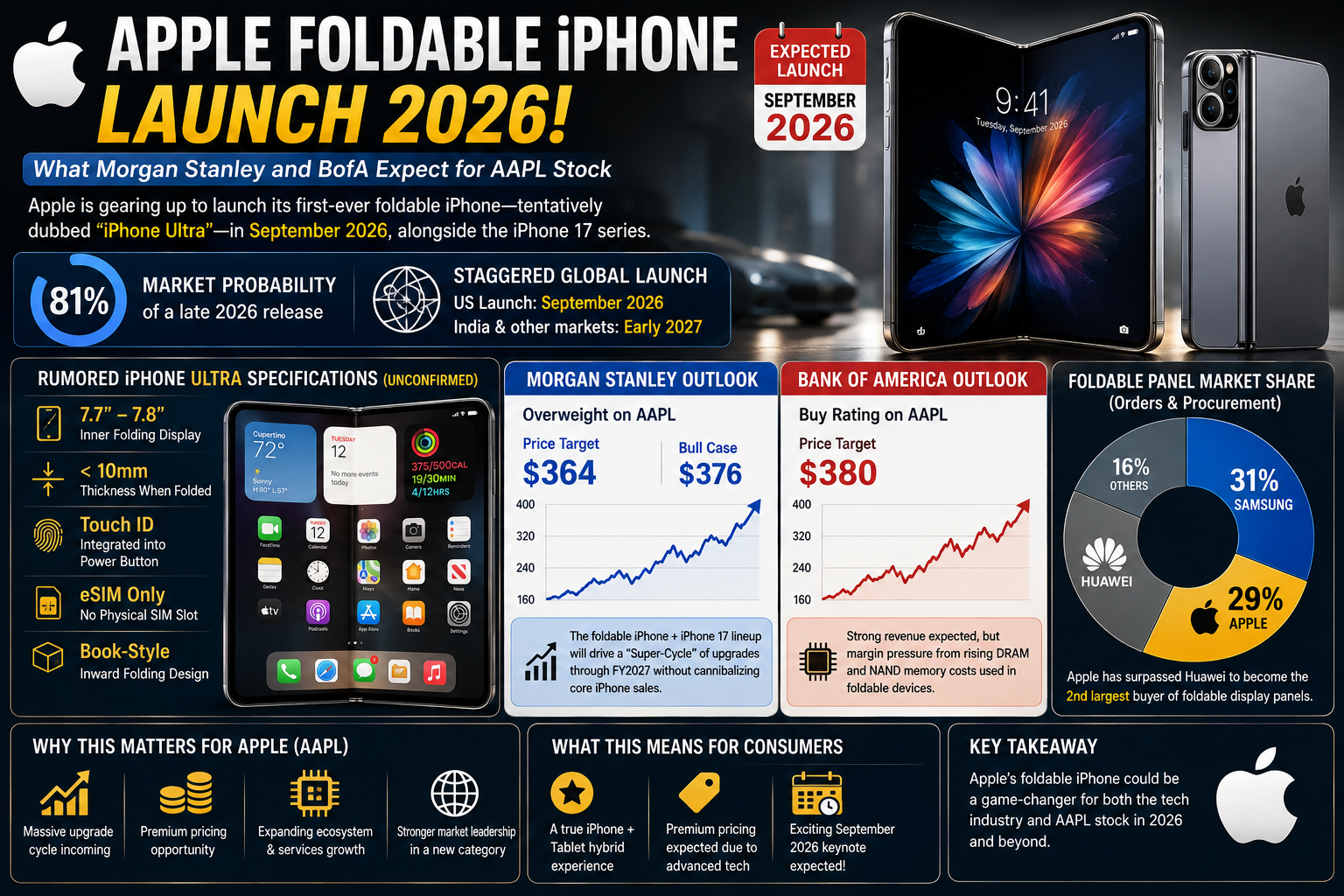
Apple Foldable iPhone Launch 2026: What Morgan Stanley and BofA Expect for AAPL Stock
Apple is reportedly preparing to execute its most significant hardware shift in over a decade. According to recent supply chain reports and Wall Street analyst notes, the Cupertino giant is gearing up to launch its first-ever foldable smartphone—tentatively dubbed the “iPhone Ultra”—in September 2026, alongside the iPhone 17 series.
This highly anticipated device has triggered intense speculation in both the technology and financial sectors. With an estimated 81% market probability of a late 2026 release, major institutional analysts are closely evaluating how this premium device will impact Apple Inc. (AAPL) in the upcoming fiscal year.
Leading financial institutions, including Bank of America (BofA) and Morgan Stanley, have released detailed outlooks for Apple stock this August. While both firms remain overwhelmingly bullish on Apple’s trajectory, they highlight different risk factors and catalysts surrounding the foldable iPhone launch.
Here is a comprehensive breakdown of the rumored foldable iPhone specifications and what top analysts predict for Apple’s financial future.
Apple’s First Foldable iPhone: Rumored Specs and Release Strategy
Apple has historically avoided rushing into unproven product categories, choosing instead to let competitors test the waters before entering with a highly refined product. As the foldable market matures, Apple appears ready to make its move.
Based on supply chain checks conducted by Bank of America earlier this year, the first foldable iPhone will likely adopt a “book-style” inward-folding design, similar to the Samsung Galaxy Z Fold series.
Expected iPhone Ultra Specifications (Unconfirmed):
- Display Size: A massive 7.7 to 7.8-inch inner folding display.
- Thickness: Extremely thin profile, measuring under 10mm when fully folded.
- Biometrics: A surprising shift to Touch ID integrated into the power button, rather than Face ID.
- Connectivity: A completely eSIM-only design with no physical SIM slot.
According to industry trackers, Apple has aggressively increased its initial supply chain orders, preparing for a production volume of 10 million to 20 million units.
Staggered Launch: When Will It Come to India?
Reports suggest Apple will employ a staggered release strategy for the foldable iPhone. While the United States will likely see a September 2026 launch, other global markets—potentially including India—may not receive the device until early 2027. This strategy helps Apple manage initial supply chain constraints while testing the device’s reception in its primary market.
Morgan Stanley’s Bullish Outlook: The iPhone 17 Super-Cycle
Morgan Stanley is highly optimistic about Apple’s upcoming hardware cycle. The firm has recently maintained an “Overweight” rating on AAPL stock, raising its price target to $364 (with a bull-case target reaching as high as $376).
The bank’s analysts believe the late 2026 foldable iPhone will act as a massive catalyst for premium upgrades. They argue that Apple has a massive installed base of older iPhone users who are waiting for a genuinely revolutionary hardware change to justify upgrading.
Morgan Stanley highlights that the introduction of a foldable device, combined with the standard iPhone 17 lineup and expanding Apple Intelligence features, will create a “super-cycle” of device sales extending deep into fiscal year 2027 without cannibalizing Apple’s core smartphone sales.
Bank of America (BofA) Weighs In: Strong Revenue vs. Margin Pressures
Bank of America shares Morgan Stanley’s optimism regarding consumer demand but introduces a note of caution regarding manufacturing costs. BofA maintains a “Buy” rating on Apple with an aggressive price target of $380, citing expected record-breaking revenue.
However, BofA warns of impending margin pressure. The global tech industry is currently experiencing a massive surge in memory component costs—specifically DRAM and NAND storage. As AI server infrastructure consumes global memory supplies, smartphone manufacturers are paying a premium for RAM.
Because the foldable iPhone will require advanced memory configurations to handle on-device AI processing and complex multitasking across a 7.8-inch display, component costs will be exceptionally high. While Apple is expected to pass some of these costs to the consumer by pricing the iPhone Ultra at a premium, BofA cautions that gross margins may temporarily shrink.
Apple Disrupts the Foldable Display Market
Even before the device hits store shelves, Apple is already reshaping the global foldable component industry.
According to Counterpoint Research, Apple has now captured a massive 29% share of global foldable panel procurement. By simply placing supply chain orders, Apple has surpassed Huawei (24%) to become the world’s second-largest buyer of foldable screens, sitting just behind Samsung (31%).
This massive procurement volume suggests that Apple expects the “iPhone Ultra” to be a mainstream success rather than a niche luxury product, fundamentally altering the Samsung-Huawei duopoly that has dominated the foldable space for the last five years.
What This Means for Consumers
For technology enthusiasts, September 2026 is shaping up to be one of the most exciting Apple events in recent memory. If the rumors hold true, the foldable iPhone will finally provide Apple users with a tablet-hybrid experience, offering intense competition to the Samsung Galaxy Z Fold series.
However, consumers should be prepared for premium pricing. Given the advanced hinge technology, massive display, and the aforementioned increase in global memory costs, the starting price for the foldable iPhone is expected to be significantly higher than the current iPhone Pro Max models.
FAQ
When is Apple releasing its first foldable iPhone?
Supply chain reports and financial analysts expect Apple to announce its first foldable iPhone in September 2026. However, it will likely see a staggered global rollout, meaning some regions may not receive the device until early 2027.
What is the rumored price of the foldable iPhone?
While official pricing has not been announced, analysts warn that high component costs—specifically for memory and the foldable display panel—will likely result in a premium price tag, expected to be noticeably higher than the current iPhone Pro Max series.
What does Morgan Stanley predict for Apple stock?
Morgan Stanley maintains an “Overweight” rating on Apple (AAPL) stock with a price target of $364. They believe the introduction of the foldable iPhone, alongside the iPhone 17, will trigger a massive upgrade cycle driven by strong consumer demand.
Why is Bank of America worried about Apple’s profit margins?
Bank of America maintains a “Buy” rating and a $380 price target for Apple but warns of margin pressure. This is due to rising global costs for DRAM and NAND memory components, which are essential for manufacturing the new foldable devices.
What will the Apple foldable iPhone look like?
Current leaks suggest a “book-style” inward-folding design similar to the Galaxy Z Fold. It is expected to feature a 7.7 to 7.8-inch inner display, measure less than 10mm thick when closed, and may utilize Touch ID instead of Face ID.