
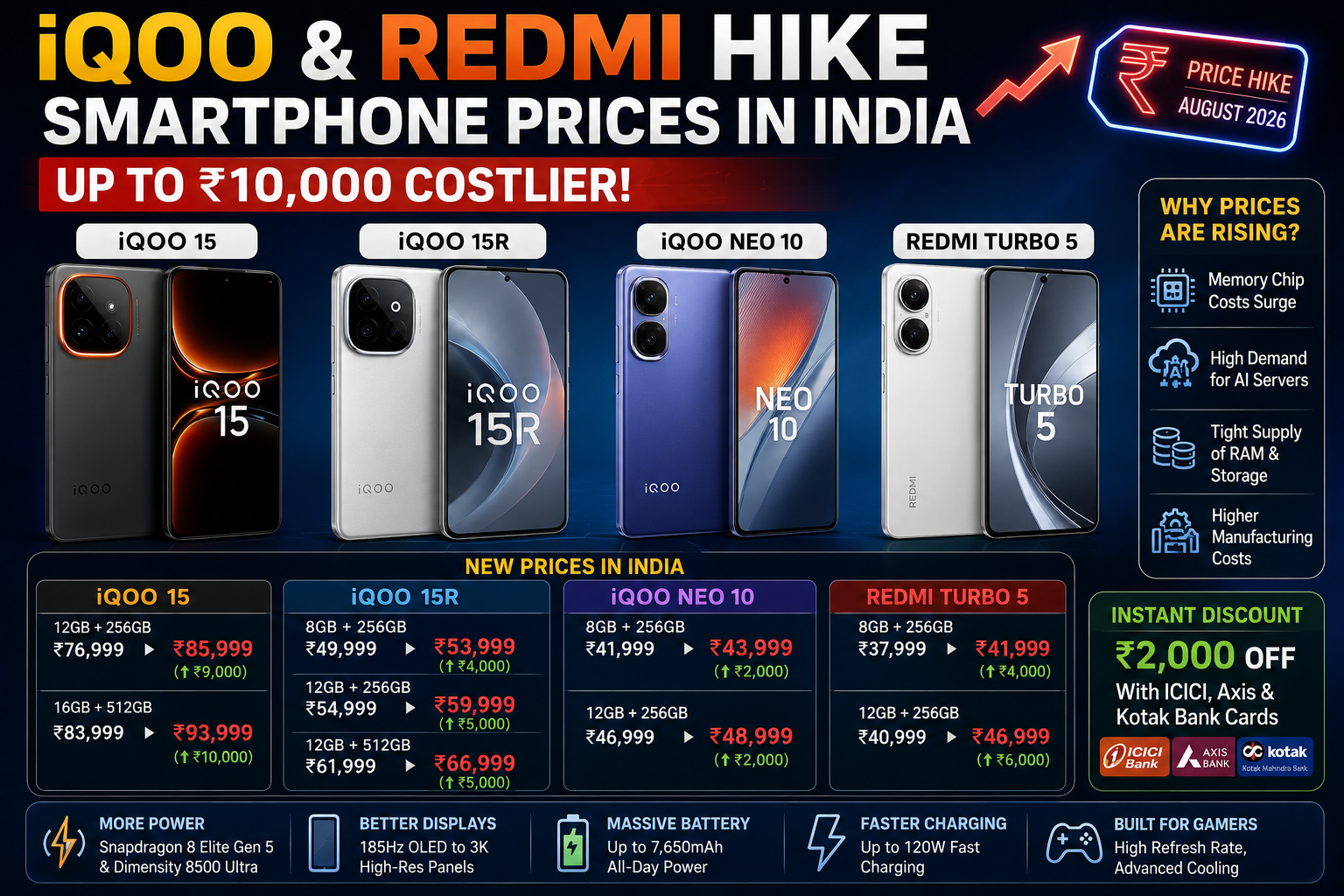
iQOO and Redmi Hike Smartphone Prices in India: iQOO 15, Neo 10, and Turbo 5 Now Up to ₹10,000 Costlier
Smartphone buyers in India are facing a sudden financial pinch this month. In a significant market shift, leading smartphone manufacturers iQOO and Xiaomi (Redmi) have officially increased the retail prices of their most popular performance-focused devices. The latest price revisions affect the flagship iQOO 15, the performance-oriented iQOO 15R, the mid-range iQOO Neo 10, and Xiaomi’s highly anticipated Redmi Turbo 5.
The price hikes range from a modest ₹2,000 to a staggering ₹10,000, depending on the specific model and storage configuration. These changes push several devices into entirely different budget categories, altering the competitive landscape of the Indian smartphone market.
For consumers planning to upgrade their devices, these revisions represent a substantial shift in value for money. Below is a detailed breakdown of the new prices, the economic reasons driving this sudden surge, and an analysis of whether these smartphones remain a good investment at their revised price points.
Why Are Smartphone Prices Increasing in 2026?
The sudden increase in retail prices across multiple brands is not an isolated event but rather a symptom of global supply chain economics. According to industry reports, the primary driver behind the August 2026 smartphone price hike is a severe surge in memory manufacturing costs.
The AI Boom and Memory Shortages
Memory manufacturers are currently redirecting their fabrication resources toward producing high-margin AI server chips. The global explosion of artificial intelligence infrastructure requires massive amounts of advanced memory components. As foundries prioritize enterprise AI hardware over consumer electronics, the supply of standard DRAM (RAM) and NAND (storage) memory used in smartphones has tightened significantly.
With supply constrained and demand remaining steady, the cost of acquiring LPDDR5X RAM and UFS 4.1 storage modules has skyrocketed. Rather than absorbing these component costs and sacrificing profit margins, smartphone brands like iQOO and Xiaomi are passing the financial burden onto the consumer. Industry analysts expect this trend to continue, meaning other brands could announce similar price revisions in the coming months.
iQOO 15, 15R, and Neo 10: New Revised Prices in India
iQOO has implemented price increases across three of its most prominent lineups. The flagship iQOO 15 has received the steepest hike, while the iQOO Neo 10 sees a more manageable adjustment.
iQOO 15 Price Hike
The iQOO 15 represents the pinnacle of the brand’s 2026 lineup. With top-tier specifications, the device targets mobile gamers and power users. However, it also bears the brunt of the component cost surge.
| Model Configuration | Old Price | New Price | Total Price Hike |
| iQOO 15 (12GB + 256GB) | ₹76,999 | ₹85,999 | ₹9,000 |
| iQOO 15 (16GB + 512GB) | ₹83,999 | ₹93,999 | ₹10,000 |
A ₹10,000 jump on the top-end variant pushes the iQOO 15 dangerously close to the ₹1 Lakh mark. Buyers seeking absolute peak performance will now have to re-evaluate their budgets.
iQOO 15R Price Hike
The iQOO 15R, heavily marketed as a premium mid-flagship running on the Snapdragon 8 Gen 5 processor, has also witnessed a noticeable jump across all three of its storage variants.
| Model Configuration | Old Price | New Price | Total Price Hike |
| iQOO 15R (8GB + 256GB) | ₹49,999 | ₹53,999 | ₹4,000 |
| iQOO 15R (12GB + 256GB) | ₹54,999 | ₹59,999 | ₹5,000 |
| iQOO 15R (12GB + 512GB) | ₹61,999 | ₹66,999 | ₹5,000 |
Despite the ₹4,000 to ₹5,000 increase, the iQOO 15R still offers a massive 7,600mAh battery, a 6.59-inch 144Hz AMOLED display, and a 50MP Sony LYT-700V camera. However, crossing the ₹50,000 threshold for the base variant removes its psychological advantage as a “sub-50K” performance killer.
iQOO Neo 10 Price Hike
The iQOO Neo 10 remains one of the most popular gaming phones in the mid-range segment. Fortunately for buyers, it has received the smallest price increase among the iQOO lineup.
| Model Configuration | Old Price | New Price | Total Price Hike |
| iQOO Neo 10 (8GB + 256GB) | ₹41,999 | ₹43,999 | ₹2,000 |
| iQOO Neo 10 (12GB + 256GB) | ₹46,999 | ₹48,999 | ₹2,000 |
Powered by the highly capable Snapdragon 8s Gen 4 chipset and featuring a 7,000mAh battery with 120W fast charging, the iQOO Neo 10 absorbs the ₹2,000 hike reasonably well without entirely losing its competitive edge.
Redmi Turbo 5: Price Increase and Bank Discount Offers
Xiaomi has not been immune to the rising memory costs. The highly rated Redmi Turbo 5, which boasts a durable IP69-rated build and a MediaTek Dimensity 8500 Ultra processor, has also seen its retail pricing recalibrated.
| Model Configuration | Old Price | New Price | Total Price Hike |
| Redmi Turbo 5 (8GB + 256GB) | ₹37,999 | ₹41,999 | ₹4,000 |
| Redmi Turbo 5 (12GB + 256GB) | ₹40,999 | ₹46,999 | ₹6,000 |
The base model jumps out of the sub-₹40,000 category entirely, now retailing at ₹41,999. The premium 12GB variant has suffered a steeper ₹6,000 hike.
How to Soften the Blow
To prevent an immediate drop in sales volume, Xiaomi has introduced strategic bank partner promotions. Buyers utilizing credit cards or EMI options from ICICI, Axis, and Kotak Mahindra Bank can claim an instant flat discount of ₹2,000.
While this does not completely negate the price increase, it brings the effective price of the base Redmi Turbo 5 down to ₹39,999, keeping it nominally within the ₹40K segment for eligible cardholders.
Device Value Analysis: Are They Still Worth Buying?
Whenever a smartphone receives a mid-cycle price hike, its value proposition must be re-evaluated against the competition.
The Case for the Redmi Turbo 5
Even at ₹41,999, the Redmi Turbo 5 remains a unique proposition. It features a gigantic 7,650mAh battery, 100W charging, a 6.59-inch 1.5K OLED display peaking at 3,500 nits, and unprecedented quadruple ingress protection (IP66, IP68, IP69, and IP69K). Very few phones in the ₹40,000 to ₹45,000 bracket offer this level of battery endurance combined with rugged durability. If you can leverage the ₹2,000 bank discount, it remains a highly viable purchase.
The Case for the iQOO 15R and Neo 10
The iQOO Neo 10, now starting at ₹43,999, remains a superb gaming device. The Snapdragon 8s Gen 4 provides excellent thermal stability, and the ₹2,000 hike does not destroy its market positioning.
The iQOO 15R, however, sits in a tougher spot. Starting at ₹53,999, it now faces aggressive competition from entry-level flagship devices from Samsung and OnePlus. Buyers who demand the specific combination of the Snapdragon 8 Gen 5 and a 7,600mAh battery will still find it appealing, but budget-conscious gamers might now pivot toward the Neo 10 to save ₹10,000.
The Case for the iQOO 15
The iQOO 15 is the hardest sell post-hike. A ₹10,000 increase is monumental. At ₹93,999 for the top variant, buyers are firmly in the ultra-premium territory dominated by the Apple iPhone Pro series and Samsung Galaxy S-Ultra models. While the iQOO 15’s hardware is undeniable, the brand prestige at the ₹90,000+ price point becomes a major deciding factor for Indian consumers.
What Should Buyers Do Now?
If you are in immediate need of a smartphone and have your eyes set on the iQOO Neo 10 or the Redmi Turbo 5, utilizing bank discounts is currently the most practical approach. However, if your purchase is not urgent, waiting might be the wisest financial decision.
With the Indian festive season approaching in the coming months, major e-commerce platforms like Amazon and Flipkart will host their annual flagship sales (such as the Great Indian Festival and Big Billion Days). Historically, these sales feature heavy manufacturer discounts, aggressive bank cashbacks, and exchange bonuses that could temporarily offset these recent price hikes.
Furthermore, as memory foundries eventually stabilize their production lines to accommodate both AI and consumer electronics demands, component costs may level out as we move toward 2027. Until then, the era of aggressively underpriced flagship killers appears to be on pause.
FAQ
Are the price hikes for iQOO and Redmi permanent?
Yes, the current revised retail prices are officially listed and active. While brands may offer temporary discounts during major festive sales, the base retail prices have been permanently adjusted due to the increased cost of manufacturing memory components.
Why did the Redmi Turbo 5 get a price increase?
Xiaomi increased the price of the Redmi Turbo 5 by up to ₹6,000 due to escalating global memory fabrication expenses. Manufacturers are prioritizing AI server chips, which has created a tightened supply and higher costs for the LPDDR5X RAM and UFS 4.1 storage used in the device.
Can I get a discount on the new Redmi Turbo 5 price?
Yes. Xiaomi is offering an instant flat discount of ₹2,000 on the Redmi Turbo 5 for buyers using credit cards and EMI options from ICICI, Axis, and Kotak Mahindra Bank, bringing the base price effectively down to ₹39,999.
Which iQOO phone received the highest price hike?
The flagship iQOO 15 received the highest price increase. Its 12GB+256GB variant increased by ₹9,000, while the top-end 16GB+512GB model saw a massive ₹10,000 price hike, bringing its new price to ₹93,999.
Is the iQOO Neo 10 still a good phone for gaming at ₹43,999?
Absolutely. Despite the ₹2,000 price hike, the iQOO Neo 10 remains an excellent gaming smartphone. It is powered by the Snapdragon 8s Gen 4 chipset, features a 144Hz AMOLED display, and houses a massive 7,000mAh battery with 120W fast charging.
Will other smartphone brands increase their prices in 2026?
It is highly likely. The supply chain constraints affecting DRAM and NAND memory are impacting the entire tech industry. Market analysts anticipate that other major smartphone manufacturers will likely announce similar price corrections in the near future.